
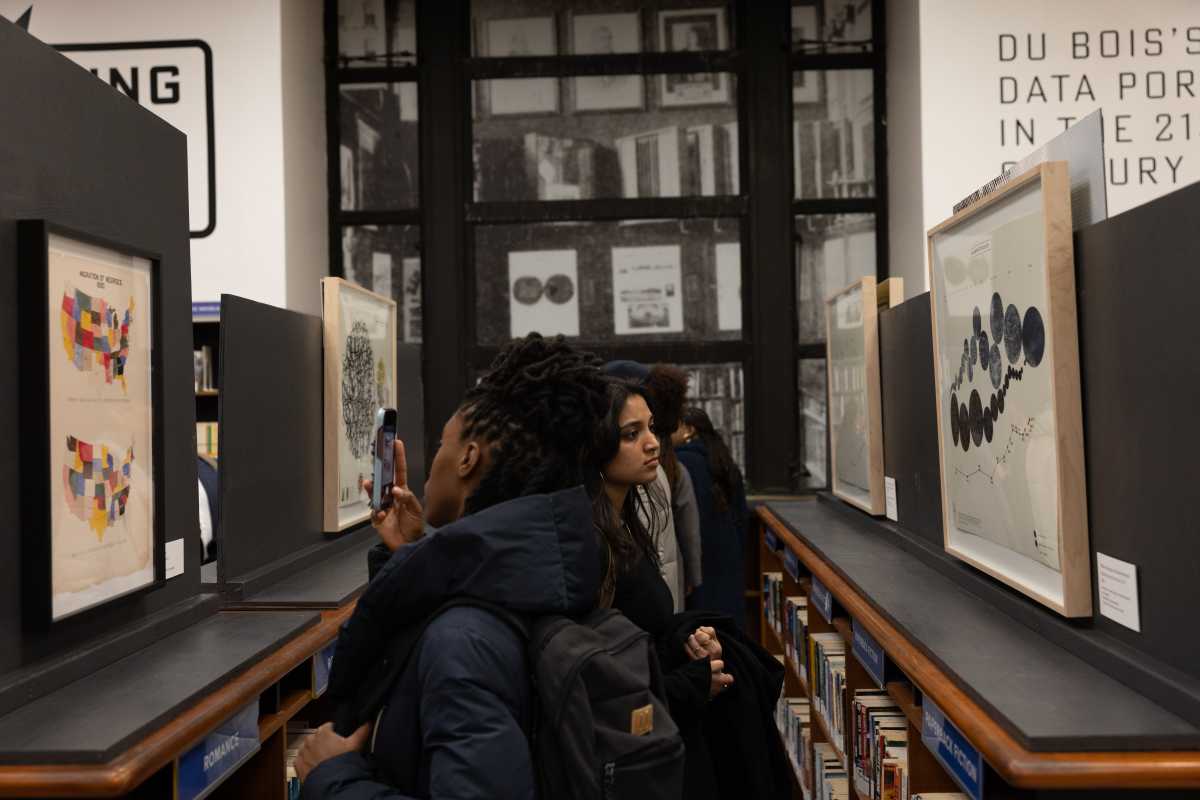
The new exhibit “Printing Black America: Du Bois’s Data Portraits in the 21st Century” at the Brooklyn Public Library re-imagines an old project with modern information.
Photo courtesy of Gregg Richards/Brooklyn Public Library
Beautiful by design and powerful in content, W.E.B Du Bois’s “Data Portraits” offer a representation of Black America existing in the context of a United States that codified “separate but equal” in Plessy v. Ferguson not long before the work was shown at the 1900 World Fair.
Building on Du Bois’s legacy, over 125 years later, urbanist Shraddha Ramani and Brooklyn-based visual artist William Villalongo recontextualize and reimagine Du Bois’s work in the Brooklyn Public Library’s new exhibition, “Printing Black America: Du Bois’s Data Portraits in the 21st Century.“
“We’re trying to both highlight Du Bois’s work but talk about it in the context of a living archive,” Villalongo said. “The questions and inquiries that Du Bois brought up about Black life in America are still very much relevant and evolving.”
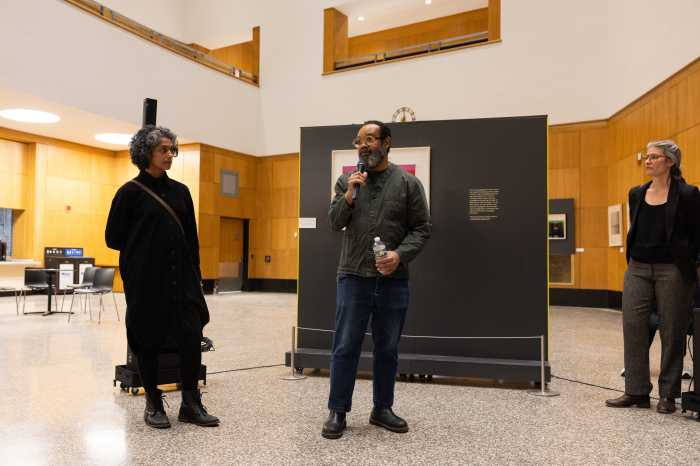 Artist William Villalongo (center) and urbanist Shraddha Ramani (left) created “Printing Black America,” with help from scholars in the field. Photo courtesy of Gregg Richards/Brooklyn Public Library
Their work — a series of print portfolios inspired by Du Bois’ original project — will be exhibited at the main branch of the Brooklyn Public Library until May 31. Continuing Du Bois’ collaborative approach, the prints were created in partnership with scholars, sociologists and innovative Black thinkers.
For the original “Exhibit of American Negroes,” Du Bois, who lived in Brooklyn from 1951 to 1961, hand-drew infographics based on data collected in handwritten surveys and limited national data on Black lives in the U.S. census.
Relying on Du Bois’s trenchant data analysis, the original work visualized the “color line,” delineating where rapid post-slavery advancements in the socio-economic realities of Black Americans took the form of progress concerning literacy rates, occupational shifts and property ownership.
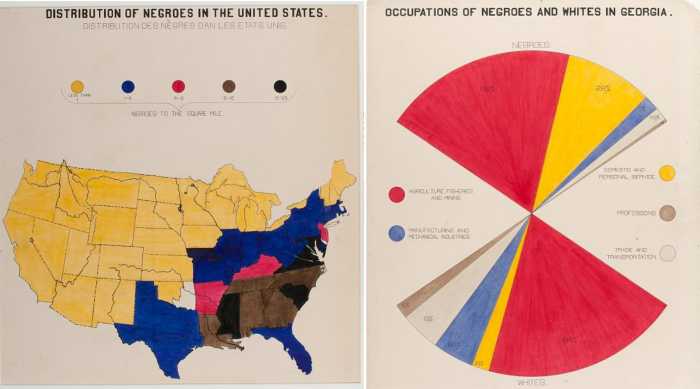 Two of DuBois’ original “Data Portraits” from the 1900 World’s Fair. Images via U.S. Library of Congress
“Printing Black America” presents that historical source material alongside contemporary works, using the same means of mechanical reproduction in image and print used in Du Bois’s era, parsing the information into themes of First Impressions, Populations, Employment, Ownership, Education and Communities.
The intangibility of sinister post-Reconstruction doctrines begs the question: how does one make sense of institutional racism? For Shraddha and Villalongo, the answer emerges from the complexities of Du Bois’s data, which forms the basis of this art.
“We try to bring into the visuals a critique of how data is collected and shown,” Ramani said. “The ambiguity is contained there, how it divides people into classes in questionable ways that not everyone can recognize and see themselves in the data.”
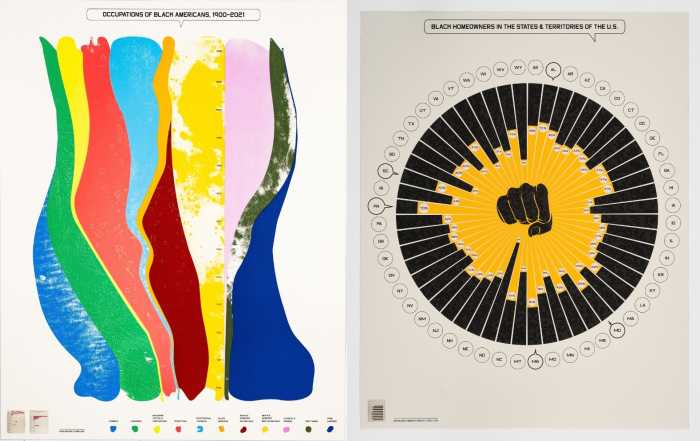 Two pieces from “Printing Black America” use DuBois’ approach to explore modern data. Images courtesy of Brooklyn Public Library
While Du Bois, as the leading academic, was most closely associated with the Paris World’s Fair in 1900, other sociologists also showed work at the tiny booth.
“The data visualizations were only one part of it, and that’s the piece that we see the most today,” Ramani said. “But, it was shown in the context of books and patents and other work that was produced by Black people at the time.”
Cora Fisher, the curator of visual art at the Brooklyn Public Library, said that to make the material more digestible for viewers, Ramani and Villalongo wanted to spread the exhibition across the library. As a result, the library commissioned essays by professors, historians, researchers and other artists, and the reframed work was integrated across several intersecting reference sections.
“One of the things that we’ve done in this exhibition is invite a panoply of other voices to pose questions in short interpretive essays,” Fisher said.
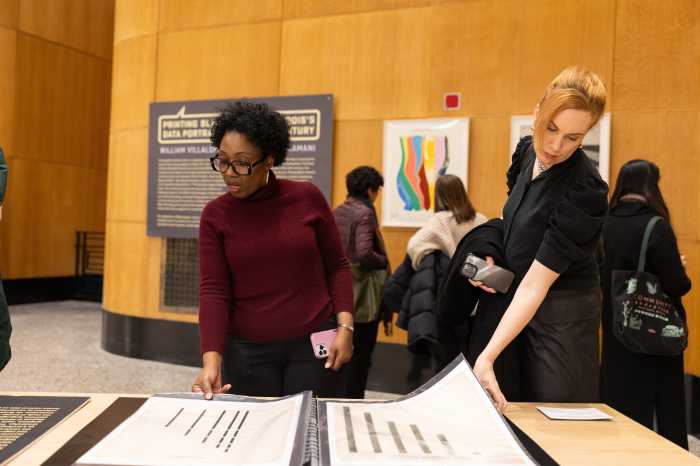 The exhibit includes both prints and short interpretive essays. Photo courtesy of Gregg Richards/Brooklyn Public Library
“Having the work be curated into the subjects or the research and study areas at the library, really makes the thematics that we came up with more complex,” Villalongo said. “It has also given us an opportunity to curate book selections that are paired with the larger context of the Negro exhibition.”
Like its source, “Printing Black America” gives visibility to the shapes of collective, creative resistance, and to Black joy, dignity and continued self-determination.
“I hope viewers will be introduced to the figure of Du Bois and to the notion of data visualization as a tool for communities to define themselves on their own terms,” Fisher said. “And, for folks to learn about that and think about how technology and art relate to their own lives.”