
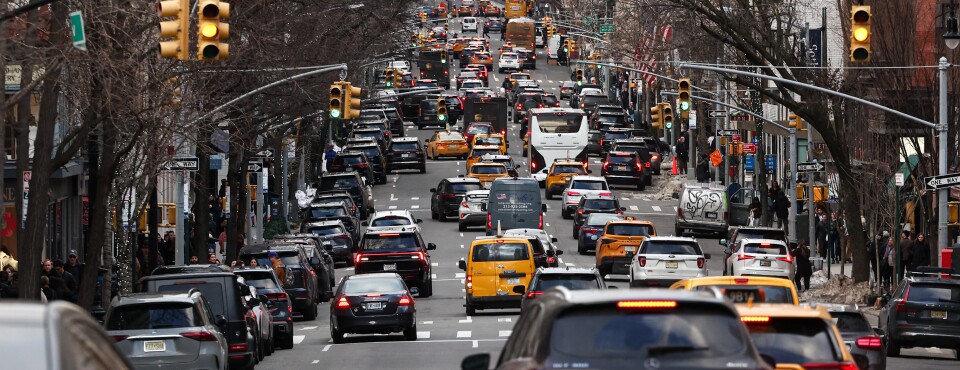
The Second Circuit on Thursday was not convinced that New York’s congestion pricing program violates drivers’ right to travel into downtown Manhattan.
The judges floated the possibility they may not have jurisdiction to weigh in on the case, in which suburban Rockland and Orange counties claim the $9 toll for entering into the business district violates the US Constitution.
“Can you point me to a case where have we ever suggested the right to travel has been violated when you charge tolls to people even though they don’t have an alternative way of traveling? We charge tolls all the time and there are people who don’t have other ways. One would think there would be hundreds of cases saying this violates the right to travel, but I haven’t found a single one,” US Court of Appeals for the Second Circuit Senior Judge Guido Calabresi asked the counties during oral arguments.
The counties want the court to revive their case at the US District Court for the Southern District of New York and allow it to proceed to discovery to see how the revenue from the program is used and whether it’s achieving the goal of reducing traffic congestion.
Southern District Judge Lewis Liman last week upheld the congestion pricing program, saying the US Transportation Department’s attempt to end it was unlawful.
Tax or Fee?
Toll revenue goes toward improving the buses and subways of the Metropolitan Transportation Authority. The counties argue the toll is actually a tax imposed generally on drivers who ultimately don’t benefit from use of the transit system.
The benefit is the use of Manhattan roads, “which is a scarce resource,” said Judge Michael H. Park.
“To charge one person for something—not for their use of the facility, but for a general purpose—we submit is too attenuated a relationship,” Matthew Parisi of McGowan Harrington Parisi PLLC argued on behalf of Rockland County.
But the difference between a tax and a fee is generality, Park said, and since the tolling program has a specific purpose it seems “not like a general tax.”
“Why would we call that a tax as opposed to a fee?” Park asked.
Calabresi leaned in favor of the toll being classified as a tax because it raised “a considerable amount of revenue.” If that’s the case, though, the court doesn’t have jurisdiction since it’s an issue of state law suited for state court.
Calabresi proposed the court could, hypothetically, weigh in on the merits of the federal claims while leaving the question of whether the toll is a tax up to the state court.
Parisi said the court should decide whether the toll is a state tax. But the court doesn’t have authority to direct state courts as to whether something is a tax or not, and “it shouldn’t be able to do that through a declaratory judgment action either,” said D. Brandon Trice of Kaplan Martin, arguing on behalf of the MTA and Triborough Bridge and Tunnel Authority.
Judge Sarah A. L. Merriam also sat on the panel.
Sive, Paget & Riesel PC also represents the city agencies.
The cases are Cnty. of Rockland v. Triborough Bridge and Tunnel Auth., 2d Cir., No. 25-1963, oral argument 3/12/26 and Neuhaus v. Triborough Bridge and Tunnel Auth., 2d Cir., No. 25-1964, oral argument 3/12/26.