
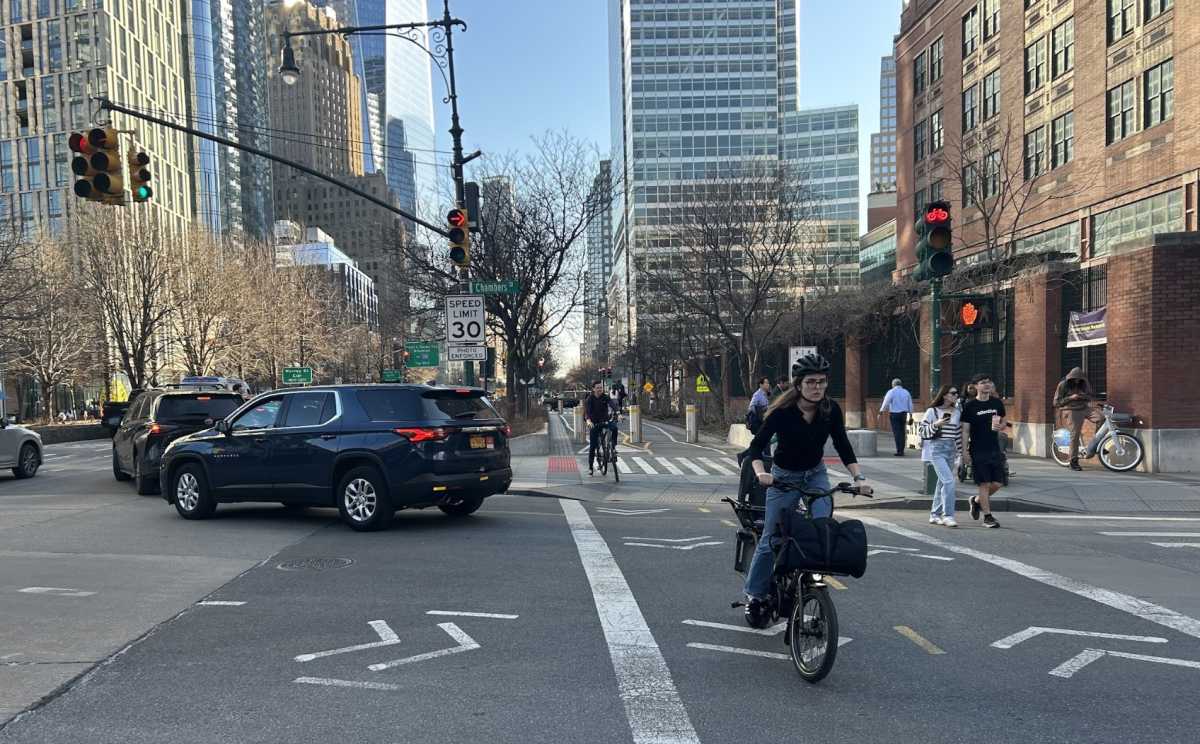
The West Street and Chambers Street intersection on the West Side Highway bike path, where a biker was hit and killed in 2016 by a car driver. A suit, filed by that biker’s husband, has been greenlit for trial after 10 years.
Andrew Denney
Olga Cook was hit and killed by a car while biking on the West Side Highway bike path in 2016. An appeals court Tuesday greenlit her husband’s 10-year fight for a chance to get her justice at trial.
It’s the city’s fault Olga Cook died, alleges her husband, Travis Cook, because officials failed to properly time the traffic lights at the West Street and Chambers Street intersection on the West Side Highway path. Both Olga Cook, who was biking northbound, and the car, driving southbound and turning right across the bike path, had simultaneous green lights, thanks to an outdated system that doesn’t meet national street standards known as single phasing.
Because of that, the car turned right into Olga Cook, 30, who was biking straight through a green light, believing she had the exclusive right of way. She was obeying all laws and wearing a helmet, her husband’s suit says.
Had there been a red right-turn light for cars, per nationwide traffic standards, he says his wife would still be alive.
The city’s Law Department declined a request for comment, as the suit is still pending. In legal filings, the city argues it’s not responsible for Olga Cook’s death because the state designed the intersection. However, the court sided with Travis Cook’s argument that the city can be held liable because it was exclusively in charge of the traffic light’s timing at that intersection for at least a year prior to the crash.
“The city needs to recognize that timing and phasing of traffic lights is their responsibility, and when they do it, they have to do it in accordance with the proper standards, whether or not it’s Chambers Street or any other location throughout New York City,” Daniel Flanzig, Travis Cook’s attorney, told amNewYork Law. “When you time a light, you have to do it so that you eliminate conflicts to the best of your ability and meet the national standards that are required.”
Moreover, Flanzig argues, the city was aware the intersection was a dangerous one: Between 2010 and 2014, there were 56 crashes at the intersection, injuring 16 cyclists.
Now, the intersection Olga Cook was killed at and all others along the West Side Highway have been equipped with proper signals, Flanzig said. He believes that’s in large part because of her husband’s suit.
“Unfortunately, it cost Olga her life to make a dramatic change on that corridor,” Flanzig said. “There are certain cases out there that help bring change, and I believe this is really one of them. It’s made New York City a safer place to bike.”
Trial over Olga Cook’s death could start in New York Supreme Court within a year. Flanzig said he’s confident in his client’s case and his ability to win significant monetary damages from the city.
“I think the evidence is pretty clear … that this was the city’s responsibility and that Travis suffered as a result of losing his wife at 30 years old,” Flanzig said.
Alexa Sledge, a spokesperson for pedestrian and cyclist advocacy group Transportation Alternatives, said it was great that traffic lighting along the West Side Highway had been improved for cyclists, but there are still many other places throughout the city where cars turn across bike lanes when bikers have the right of way, creating dangerous conditions that continue to injure and kill cyclists.
Sledge said the city needs improved signals and protected intersections on bike lanes, and to be proactive.
“The city is aware of the danger,” Sledge said. “It shouldn’t take a suit for the city to make these changes.”