
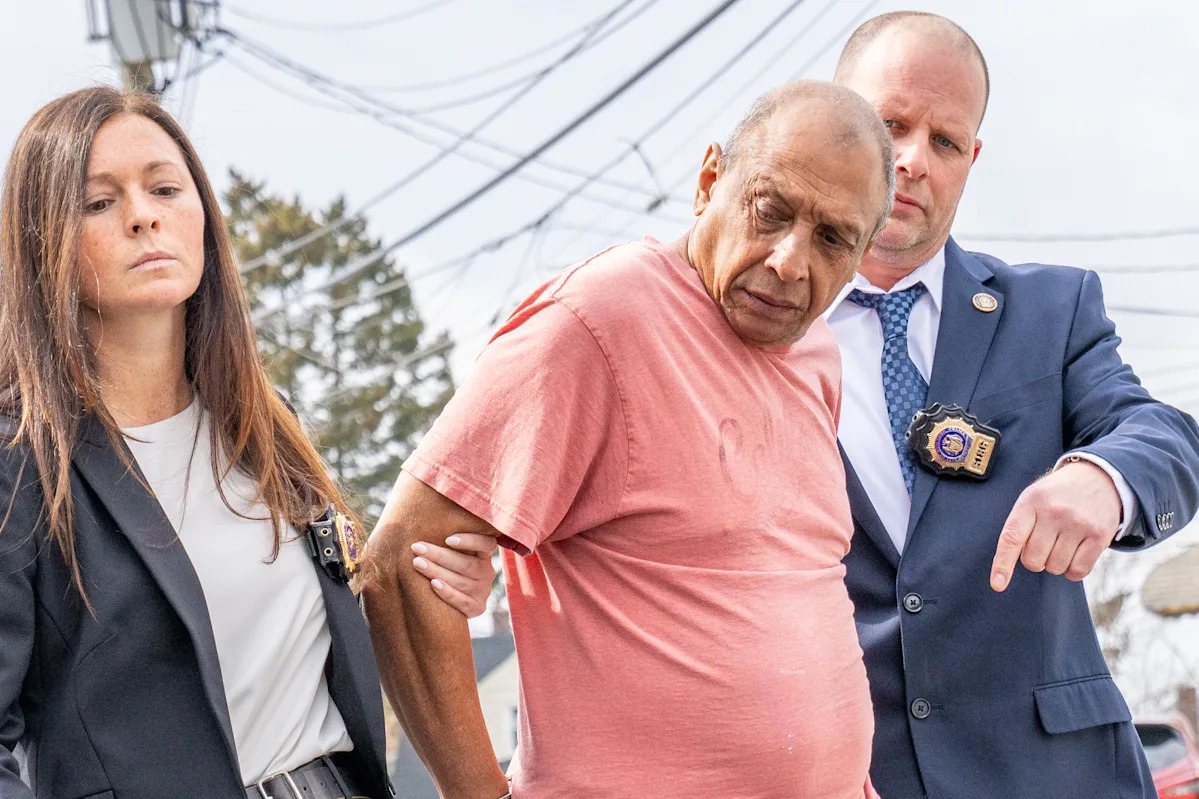
A 74-year-old murder suspect’s use of a popular app meant to help track friends, loved ones, and even pets gave NYPD cops crucial evidence in building the case he murdered and dismembered his much younger wife and dumped her remains in two Queens parks, prosecutors say.
Accessing the Life360 app on his cell phone, cops learned Rupchand Simboo had visited the Jamaica Bay Wildlife Refuge in Broad Channel and the outskirts of Idlewild Park in Rosedale — the two locations where his wife’s remains were ultimately discovered in pieces.
The app put him at those remote two locations less than 48 hours after his wife, Salicia Ali, disappeared on July 13, prosecutors said as they charged Simboo with murder, concealment of a human corpse, and tampering with physical evidence Wednesday.
A woman’s headless limbless torso, later identified as Ali, was found wrapped in a blue moving blanket and yellow rope by city sanitation workers just outside of Idlewild Park near JFK Airport off of Brookville Blvd. and 149th St. on Sept. 22.
The body was found in some brush “about 100 feet south of the street,” NYPD Chief of Detectives Joseph Kenny told reporters following the discovery. Sanitation workers had just thrown it into the truck’s hopper when they smelled a foul odor and alerted the police, he said.
Ali’s head and limbs were recovered at the Jamaica Wildlife Refuge last Thursday and Friday. Cops were there looking for evidence based on the Life360 tracking data, prosecutors revealed.
A blue moving blanket and yellow rope matching the ones found wrapped around the torso were located inside Simboo’s apartment and garage by detectives executing a search warrant, prosecutors said late Wednesday as Queens Criminal Court Judge Sharifa Nasser-Cuellar ordered the septuagenarian held without bail.
If convicted, Simboo faces 25 years to life in prison, Queens District Attorney Melinda Katz said.
“As alleged, (Simboo) went to extraordinary lengths to evade responsibility for the brutal killing of his wife, discarding her remains in remote locations and concealing critical evidence,” Katz said Thursday. “Were it not for the diligence of New York City Sanitation workers, who discovered the remains and promptly notified authorities, the victim’s loved ones might still be searching for answers.”
By linking to cellphones and locater tags that can be given to a child and put on a pet’s collar, Life360 offers “peace of mind” by “keeping tabs on all your family members all through the day—whether they’re off to school or on the way home from practice,” the app’s website boasts.
The app can provide the user with up to 30 days of location history and unlimited “place alerts” depending on the plan, which ranges from $7.99 to $24.99 a month.
Police believe Simboo killed Ali, back on July 13 — the day she was last seen alive. It is not clear exactly how he killed her, with prosecutors saying she died of “homicidal violence.”
After she died, Simboo went about “methodically” dismembering the body, slicing off her head and limbs, Kenny said in September.
“A knife was used to cut through the soft tissue, and a saw was used to cut through the bone,” Kenny told reporters.
Tattoos found on the victim’s torso helped police link the remains to Ali, who had moved to the U.S. from Trinidad in 2024.
Simboo and Ali met in 2023. The two got married when she moved to the U.S. and lived together in a modest two-family house in South Ozone Park.
Ali, who made daily calls to her mother and three daughters back in Trinidad, was last seen alive on a FaceTime call with relatives on July 13. At the behest of her family Simboo reported Ali missing six days later, telling police she had left their home at 11 p.m. on July 13 and never returned.
Cops investigating her disappearance learned that she never returned to job as a home health aide after July 13.
But Ali’s two cellphones were pinged at their home through that night until 9 a.m. on July 14. The phones then traveled 11 miles to a construction site where Simboo worked before they were shut off. Simboo told police Ali didn’t know where he worked, according to court papers.
Once Ali’s torso was discovered and the victim was identified through her tattoos — three names and a flower — detectives executed search warrants for Simboo’s cellphone, where they found the crucial Life360 tracking data. They also executed search warrants on his home, where they found the blanket and rope.
Cops gave Ali’s family the heartbreaking news in October, relatives said.
“We were shocked when we got the news. It is very horrific. This is something you would hear about in movies,” Ali’s relative told the Trinidad Express. “You never thought it would happen to our family.”
When Ali stopped making her daily calls, the family didn’t think much of it, since “people who knew her in the US” said “they were seeing her about,” the relative told the Trinidad Express. “We didn’t think anything had happened to her, but just said she wanted a break from the family,” the relative said.