


Henry Darger spent his life creating a 15,000-page novel, a 5,000-page autobiography, and more than 350 large watercolor paintings, none of which he ever attempted to publish or exhibit. His landlord and a neighbor discovered this body of work in the cluttered apartment they were clearing out when Darger moved to a nursing home shortly before his death in 1973 at the age of 81. “Henry Darger is viewed today as probably the greatest Outsider artist in the art brut canon,” says art historian Michael Bonesteel.
Theatergoers learn the basics of this fascinating story from the wall labels that accompany posters of Darger’s artwork along the walls of the Vineyard Theater, but not in “Bughouse” itself, a largely listless and unilluminating solo play about Darger that is running at the Vineyard through April 3.
Conceived and directed by MacArthur “genius” Martha Clarke, who is herself 81, and is best known for her having created a vivid work of dance theater from Hieronymus Bosch’s painting “The Garden of Earthly Delights,” the play has a script by Beth Henley, Pulitzer-winning playwright of “Crimes of the Heart,” based on Darger’s own writing. It stars John Kelly, an Obie-winning actor and himself a visual artist. Yet despite its near-legendary creative team, its short running time and some moments of visual invention, “Bughouse” failed to keep my interest, much less convince me of Darger’s greatness in “the art brut canon” or anywhere else.
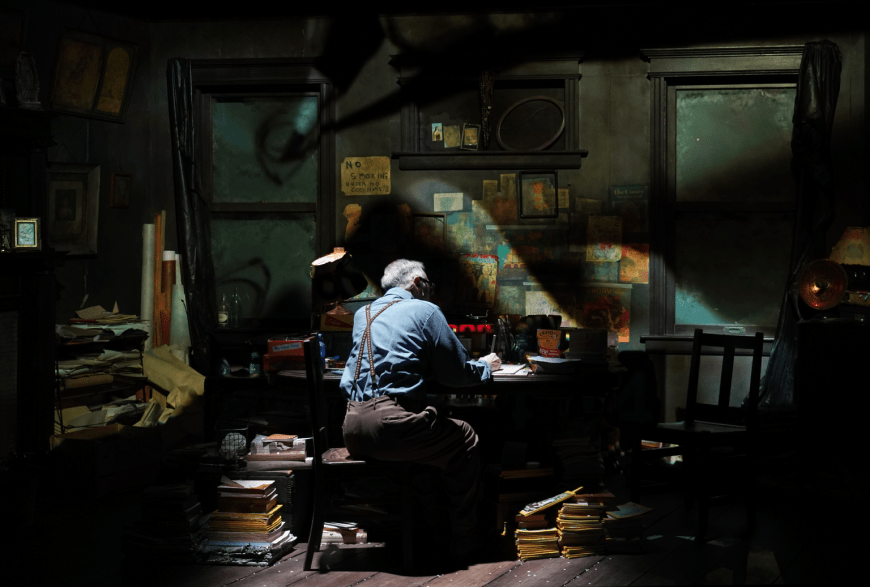
Sitting at a typewriter in a dark, elaborately messy set under a harsh spotlight, Kelly as Darger mixes excerpts from his fictional stories with reminiscences of his sad upbringing: His mother having died when he was a toddler, and his injured father sent to a poor house, he grew up in institutions, treated by staff and fellow inmates alike as if he were feeble-minded, until he escaped successfully (after two failed attempts.) He found a job in Chicago as a hospital janitor, which is what he did for a living from then on. Through the mixing of fact and fantasy, we are led to understand that his childhood trauma guided the obsessions in the fantasy world he created. (The show is recommended for ages 16+ and includes a content advisory that says in part “The writings and paintings of Henry Darger often feature child protagonists, and in the context of imaginary battles and other scenes, some depict harm against children. There are also paintings in which children are depicted without clothes. Some of these images are included in brief moments in Bughouse.”) There is a meandering quality to much of what he says, punctuated with occasional free association, that may remind you of impromptu speakers on the A train. Kelly portrays some other characters – or rather, he portrays Darger voicing other characters, and sometimes lip-synching recorded voiceovers. The overall effect, perhaps less interested in storytelling than in peeking inside Darger’s psyche, is not a model of coherence.
The most engaging aspect of “Bughouse” is what’s projected onto the two windows of Darger’s apartment, and, later, in a mirror. These are turned into screens for Fred Murphy’s stock footage of street scenes from the era of Darger’s childhood, and, best of all, Ruth Lingford’s animation of the characters from Darger’s major opus. His fantasy epic is entitled “The Story of the Vivian Girls, in What is Known as the Realms of the Unreal, of the Glandeco-Angelinian War Storm, Caused by the Child Slave Rebellion” — which, yes, I learned from the wall labels.
Bughouse
Vinyard Theater through April 3
Running time: 60 minutes with no intermission
Tickets: $38 – $119
Conceived and directed by Martha Clarke
Script by Beth Henley, adapted from the writings of Henry Darger
Starring John KellyProduction design by Neil Patel, costume design by Donna Zakowska, lighting
design by Christopher Akerlind, sound design by Arthur Solari, projection design John Narun, set decorator and prop manager Faye Armon-Troncoso, cinematography by Fred Murphy, animation by Ruth Lingford,
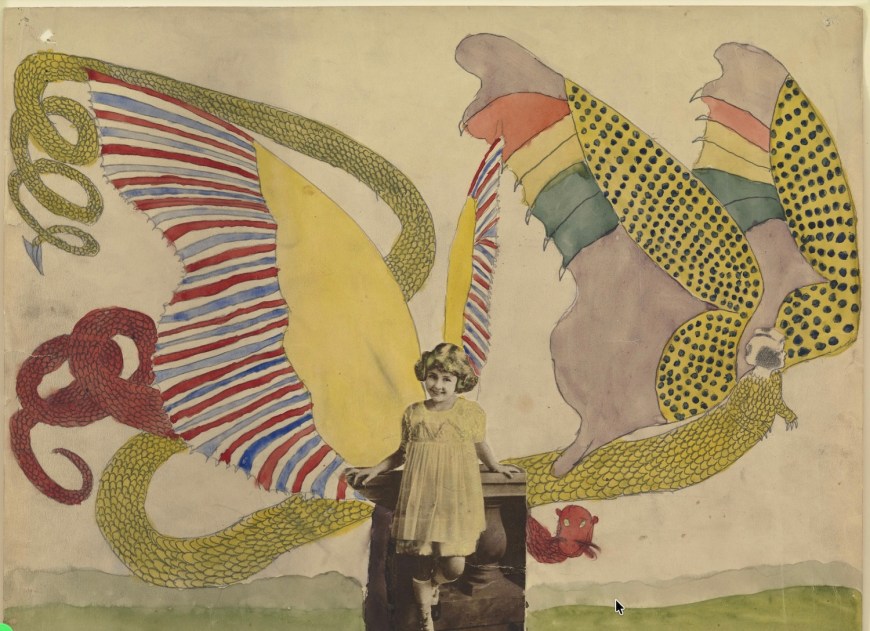
Below is a reproduction of one of the works by Henry Darger at the Museum of Modern Art
The caption reads: “Spangled Blengins. Boy King Islands. One is a young Tuskerhorian the other a human headed Dortherean.n.d.”
Like this:
Like Loading…
Related