
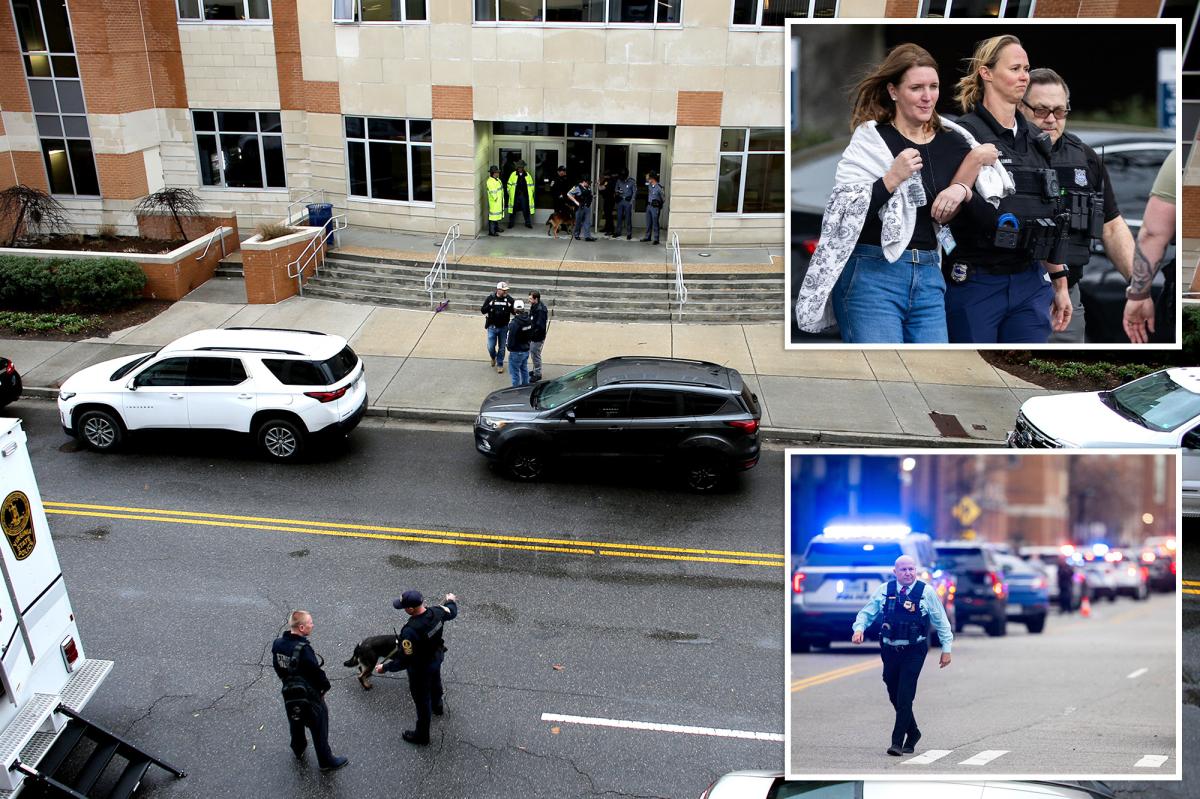
The madman who opened fire at Old Dominion University on Thursday, killing a retired military officer instructing an ROTC class, has been identified as an ex-National Guard soldier convicted of trying to support ISIS, The Post has learned.
Mohamed Bailor Jalloh, 36, stormed into a classroom inside ODU’s Constant Hall and asked if it was an ROTC class. When someone confirmed that it was, he launched the suspected terror attack, shooting the professor several times, law enforcement sources said.
A heroic ROTC cadet at the Virginia school jumped into action to prevent more carnage, stabbing Jalloh to death after the crazed suspect gunned down the class instructor, the sources said.
Police at the scene of the shooting on Old Dominion University’s campus on March 12, 2026. AP
An ex-National guardsman fatally shot a retired military officer during a ROTC class at Old Dominion University on Thursday afternoon. AP
FBI Director Kash Patel said that the shooting is being investigated “as an act of terrorism.”
The slain instructor was a retired military officer who was declared dead at a local hospital, sources said.
ODU Police Chief Garrett Shelton confirmed at a press conference that one victim was dead and two injured ROTC members were in stable condition.
“Old Dominion University faced a tragedy on our main campus,” Old Dominion University president Brian Hemphill said in a statement.
“I am grateful for the swift response of our police officers, emergency management personnel, and our partners at the City of Norfolk who promptly assisted the injured.”
The assailant — 36-year-old Mohamed Bailor Jalloh — was killed by a knife-wielding ROTC student after he gunned down their instructor. AP
In 2017, Jalloh, a former member of the Virginia National Guard, was sentenced to 11 years in prison for attempting to provide material support to ISIS and the ISIL, according to the Department of Justice.
A naturalized US citizen from Sierra Leone, Jalloh left the National Guard and became a devoted follower of Anwar al-Awlaki, the slain leader of Al-Qaeda’s branch in the Arabian Peninsula, the DOJ said.
He connected with members of the ISIL during a six-month stay in Africa. During one meeting on the trip, unknowingly observed by an FBI informant, Jalloh mentioned a desire to launch his own terror attack, the DOJ said.
The shooting is being investigated as an act of terrorism, according to FBI Director Kash Patel. AP
Jalloh told the FBI source that he believed it was better to plan an attack during the month of Ramadan – which spans from mid-February to mid-March–because that was “100 percent the right thing,” according to the DOJ.
When he returned to the US, Jalloh tried and failed to obtain firearms in North Carolina.
He then went to a gun dealership in his native northern Virginia, which sold him an assault rifle but rendered it inoperable before he left with it.
Start your day with all you need to know
Morning Report delivers the latest news, videos, photos and more.
Thanks for signing up!
Jalloh was arrested the day after he bought the assault rifle, according to the DOJ.
Days after his arrest, his brother Cherner Jalloh told The Intercept that the entire ordeal was another instance of a “Mohamed that got set up.”
“The FBI used his love for those being oppressed against him by inciting him in all manners that they deemed fit,” Cherner claimed.
He added that Jalloh looked up to the unidentified FBI informant like “an older brother” and relied on him for “knowledge about what is going on in the Middle East.”
The instructor was a retired military officer who was declared dead at a hospital, according to sources. AP
Jalloh’s sister, Mariatu Jalloh, also believed he was “manipulated” by the informant.
“The government is taking statements and actions that had nothing to do with one another and putting them together to paint a certain picture.…They’re connecting dots,” she said.
At his sentencing, Jalloh renounced ISIS, citing his links to the terrorist organization as “the most devastating [mistake] I have ever decided to make in my life.”
“I’m very, very sorry for what I have done. I did not intend to cause any harm to anyone. And I want to say — I want to say, every time I see any atrocities that ISIS commits, I am disgusted by it because I know this is not what I want to be a part of,” he said, according to a transcript obtained by CBS News.
Jalloh was released from prison in December 2024.
The Post reached out to the DOJ for information about why Jalloh was released early from prison.
Jalloh’s affiliation with ODU, if any, is unclear.