
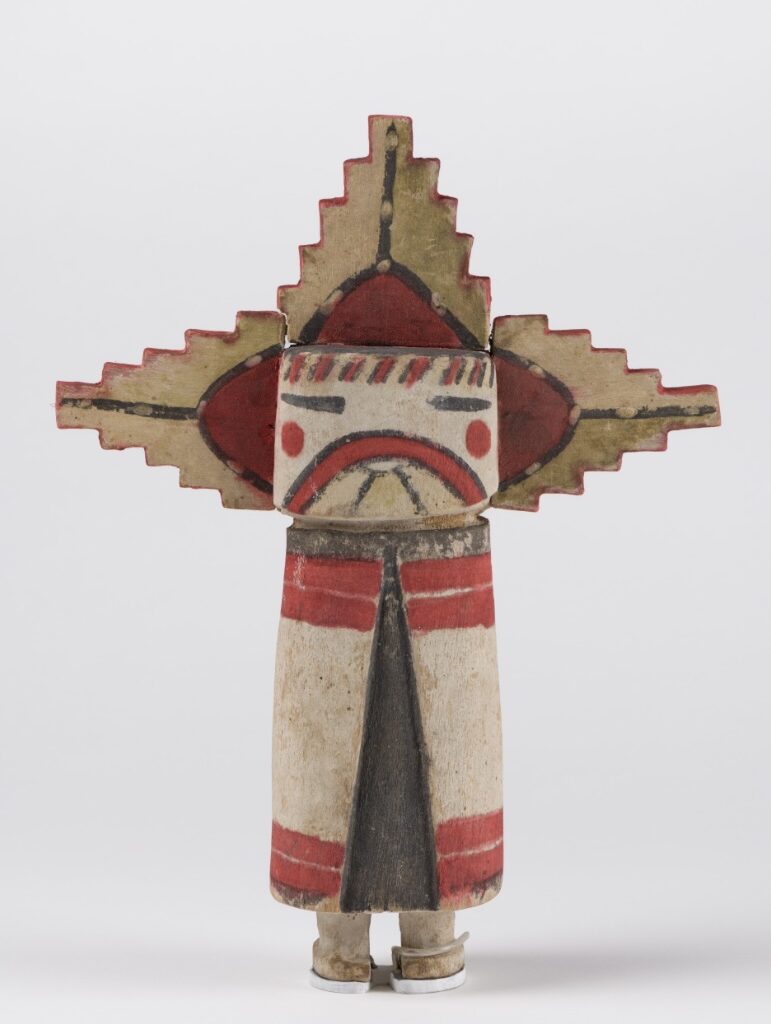
Palhikwmana Tihu (Water Maiden Kachina Doll), late 19th century. Cottonwood and pigment. Brooklyn Museum, Museum Expedition 1904, Museum Collection Fund, 04.297.5531. (Photo: Brooklyn Museum)
Featuring more than 120 artworks, the first-of-its-kind exhibition presents historical objects from the Museum’s expansive Indigenous art collection as well as contemporary works by Hopi women artists to examine the kachina doll tradition from the perspective of Hopi girls and women.
On October 2, 2026, the Brooklyn Museum will open Hopi Kachina Dolls: Blessings for a Balanced World in the Elizabeth A. Sackler Center for Feminist Art. It marks the first exhibition to examine the kachina doll tradition from the perspective of girls and women in the Hopi community, an Indigenous tribe located in northeastern Arizona. Carved of cottonwood and painted with distinctive designs, kachina dolls (tithu)1 represent Katsinam, spirits who bring moisture and keep the Hopi world in balance. This groundbreaking exhibition demonstrates the enduring significance of the kachina doll tradition and the vitality of Hopi visual culture. Hopi Kachina Dolls: Blessings for a Balanced World is organized by guest curator Colleen Lucero, Managing Director of the Hopivewat Learning Center; Nancy Rosoff, Andrew W. Mellon Senior Curator of Arts of the Americas; and Dare Turner, Curator of Indigenous Art; with Grace Billingslea, Curatorial Assistant, Arts of the Americas, of the Brooklyn Museum.
Though infants, girls, and women are the sole recipients of kachina dolls in the Hopi community, their viewpoints have been historically overlooked in previous publications and exhibitions. Featuring more than 120 works dating from the nineteenth century to the present, Blessings for a Balanced Worldpresents historical belongings in conversation with exquisitely crafted artworks that include Katsina imagery, underscoring the continued importance of the tradition.
“Katsina spirits play a vital role in my life by guiding me with pure dedicated faith, humility, and kindness. They teach us to have faith in ourselves and our prayers for rain; they bless us with gifts to enrich our lives; and their kindness teaches us to treat each other with respect,” says Colleen Lucero. “I am excited to share this tradition with the broader public.”
“For nearly 20 years, the Center for Feminist Art has been home to groundbreaking exhibitions uplifting women’s art across time and geographies. We are proud to present this iconic Native American art form in a new way that honors its cultural significance for Hopi girls and women,” says Nancy Rosoff. “By challenging dominant art-historical narratives, we aim to uplift the lived experiences, intergenerational knowledge, and creative expression of Hopi women.”
From the Museum’s wide-ranging collection of Indigenous art, the exhibition will feature fifty-three kachina dolls, as well as key loans including vibrant contemporary ceramics, baskets, jewelry, and textiles crafted by Hopi women artists. The presentation also highlights contemporary photography and newly commissioned video interviews with artists and community members offering personal reflections on the experience of growing up Hopi.
Organized in thematic sections, Blessings for a Balanced World introduces the enduring significance of tithu in Hopi traditions. It begins by tracing the key phases of a Hopi woman’s life, from infancy through adolescence to womanhood and marriage. Visitors will learn about Hopi infant cultural traditions, such as a newborn’s baby-naming ceremony, in which the baby receives a name and a quilt from female relatives as well as a flat kachina doll and a small wicker plaque from the Katsina spirits. Gifts traditionally presented to Hopi girls in their childhood and teenage years, including more elaborate kachina dolls, pottery, and coiled baskets, will also be on view. As adolescents, Hopi girls learn about women’s roles and responsibilities and how one becomes a young woman through the corn-grinding ceremony. Upon marriage, Hopi women are gifted more complex tithu, baskets, and pottery elaborately decorated with imagery of Katsinam. Also on view will be a hahawpi (wedding plaque) given to the groom and photographs of a Hopi woman’s wedding attire.
The exhibition will also examine how the Katsinam and Hopi Social Dances reinforce women’s roles within their community and their important relationships through prayer to the Katsina spirits who guide them. During the Katsina Season from February to July, when Katsinam come down from the San Francisco Peaks to bring rain to Hopi villages, women are responsible for preparing food and welcoming their extended families and clans. Social Dances in August and January give thanks to the Creator for the Hopi way of life and sustain family relationships. For example, participants in the Butterfly Dance, held during the summer, pray for rain, a good harvest, and a full life. As they dance, the young maidens mimic butterflies with their elaborately decorated kopatsoki (tablita headdresses) and flowing garments swaying back and forth to the songs. To illuminate these practices, the section features a Butterfly Maiden kachina doll and two Butterfly Dance ensembles, which draw upon loans from Hopi community members and the Museum’s collection. The boy’s ensemble includes a historical kilt whitened with Hopi clay and a modern ribbon shirt, while the girl’s ensemble includes the kopatsoki, a handmade dress and cape, and traditional accessories.
The final section, “Sharing Katsinam with the World,” focuses on the resiliency and creativity of Hopi women who have produced innovative art forms for centuries, spanning the nineteenth-century tourist trade to today’s art market. Thirty ceramic vessels, baskets, and jewelry with Katsina-inspired images underscore the importance of the kachina doll tradition in women’s lives and illustrate how Hopi women artists serve as carriers of culture. A newly commissioned video presents interviews with six of the exhibition’s artists, highlighting the myriad ways Hopi women ensure the continued vitality of their community.
The Brooklyn Museum holds a rich collection of Indigenous arts of the Americas that spans the Western Hemisphere, stretching from 4000 B.C.E. to the present. For over a century, the Museum has collected, presented, and interpreted these works in ways that challenge traditional narratives. Hopi Kachina Dolls: Blessings for a Balanced World exemplifies the Museum’s long-standing commitment to celebrating diverse experiences, educating and inspiring audiences, and reimagining historical collections to highlight voices and stories that have often been underrepresented.
A fully illustrated catalogue will accompany the exhibition, featuring essays by curators Colleen Lucero, Nancy Rosoff, and Dare Turner; contributions by scholars Diane Dittemore and Kelley Hays-Gilpin; and interviews with accomplished basket weavers Jessica Lomatewama and Kathryn Kooyahoema, potters Darlene James and Gwen Setalla, and jewelry designers Verma Nequatewa and Cheryl Wadsworth Soohafyah, and three generations of women from the Shupla family.
1Katsinam is the plural form of Katsina, the Hopi name for the Ancestral Spirits. Kachina, the Anglicized term for Katsina, is used in reference to kachina dolls, which the Hopi call tihu (singular) and tithu (plural).
Credits
Hopi Kachina Dolls: Blessings for a Balanced World is organized by guest curator Colleen Lucero, Managing Director of the Hopivewat Learning Center; Nancy Rosoff, Andrew W. Mellon Senior Curator of Arts of the Americas; and Dare Turner, Curator of Indigenous Art; with Grace Billingslea, Curatorial Assistant, Arts of the Americas, of the Brooklyn Museum.
Major support is provided by the Henry Luce Foundation.
Significant support is provided by Constance Christensen, the National Endowment for the Humanities, and the Helene Zucker Seeman Memorial Exhibition Fund.
The Brooklyn Museum Exhibition Fund supports the research, development, and presentation of all the Museum’s exhibitions, from major international shows to innovative curatorial projects, ensuring the Museum can present ambitious, world-class exhibitions that engage diverse audiences. We gratefully acknowledge the donors whose support of the Brooklyn Museum Exhibition Fund makes this work possible: Nancy P. Magoon, John H. and Regina K. Scully, and Deedee and Barrie Wigmore.
About the Brooklyn Museum
For 200 years, the Brooklyn Museum has been recognized as a trailblazer. Through a vast array of exhibitions, public programs, and community-centered initiatives, it continues to broaden the narratives of art, uplift a multitude of voices, and center creative expression within important dialogues of the day. Housed in a landmark building in the heart of Brooklyn, the Museum is home to an astounding encyclopedic collection of more than 140,000 objects representing cultures worldwide and over 6,000 years of history—from ancient Egyptian masterpieces to significant American works, to groundbreaking installations presented in the only feminist art center of its kind. As one of the oldest and largest art museums in the country, the Brooklyn Museum remains committed to innovation, creating compelling experiences for its communities and celebrating the power of art to inspire awe, conversation, and joy.
Like this:
Like Loading…
Related
Discover more from City Life Org
Subscribe to get the latest posts sent to your email.