

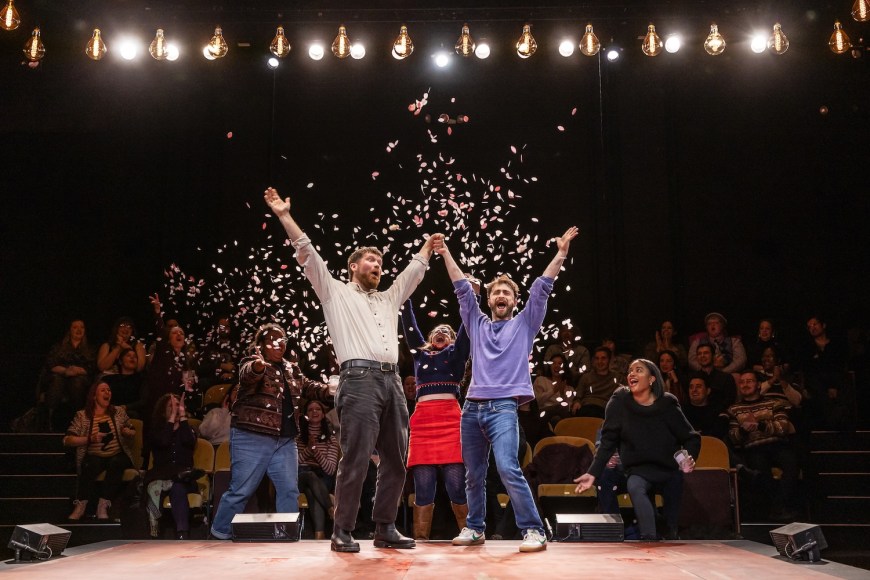
Before Daniel Radcliffe gets on stage to start this funny and moving play that’s built around his character compiling a list of “everything worth living for,” he rushes around the Hudson Theater, greeting and chatting up individual members of the audience. He’s recruiting volunteers for the show, but in a way so up-close and sociable that the thought occurred to me: Had he been the star of “Every Brilliant Thing” when I first saw a production of it Off-Broadway in 2014, several theatergoers each night might have fainted. Sure, the Harry Potter star had already been on Broadway three times by then, but it was just three years after the film franchise had finished, and he was still the swoon-worthy object of teenage fan affection; the unusual intimacy and informality of the show might have overwhelmed some of them.
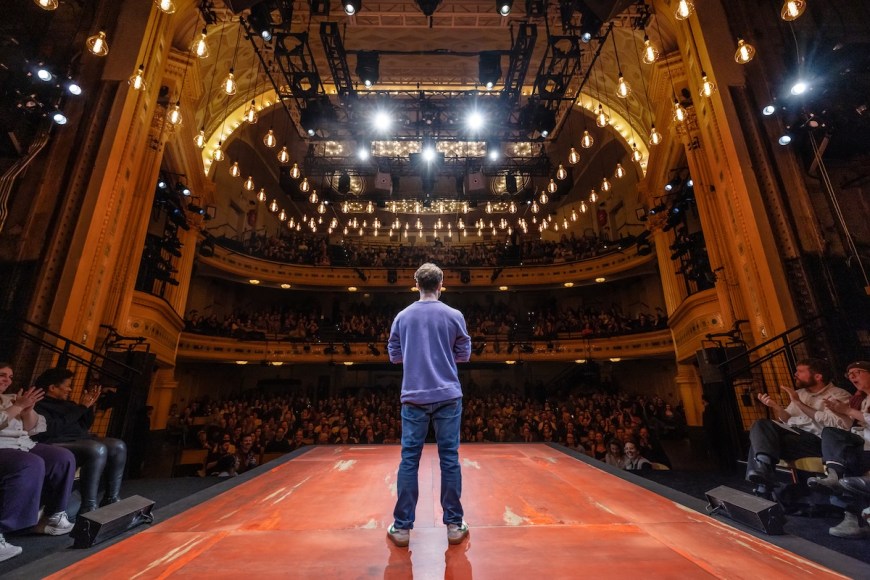
There is some unfortunate irony in this observation, because once “Every Brilliant Thing” gets underway now, the size of the Broadway theater challenges the very intimacy and informality on which this highly interactive show depends. The Hudson seats five times the number of theatergoers as what’s now called the Greenwich House Theater, which is where I first saw “Every Brilliant Thing” a dozen years ago, with the original performer Jonny Donahoe. The experience on Broadway can’t help but be different. Will theatergoers who have never seen the show in a smaller venue nevertheless consider the vastness of the Hudson to be a disadvantage? I feel they might. Will they think it still worth it for the chance to see Daniel Radcliffe in this role? I feel they might.

The unnamed character whom Radcliffe portrays tells us he was seven years old when he started his list, with seven items: He calls out numbers one to seven, and one by one the audience members who had received those numbered cards respond:
1. Ice cream.
2. Water fights.
3. Staying up past your bedtime and being allowed to watch TV.
4. Things with stripes.
5. Rollercoasters.
6. Super Mario.
7. People falling over.
He started the list to cheer up his mother, who had just attempted suicide. It grew to eight pages, which he left on her pillow when she returned from the hospital. “She never mentioned it to me, but I knew she’d read it because she’d corrected my spelling.”
He put the list aside for a decade, until her second attempt. The list then grew as he grew, through his own struggles. The “brilliant” things sometimes turn sophisticated:
“The feeling of calm which follows the realization that, although you may be in a regrettable situation, there’s nothing you can do about it.”
“Every Brilliant Thing,” in other words, tells a concrete story about suicide and depression.
There is always a risk that the core story can seem secondary amid the hubbub engendered by the audience interaction, all the more so when the audience is so large. But at its best, the show’s playfulness works in concert with its underlying serious subject. During his mother’s initial hospitalization, Radcliffe is sent to the school librarian Mrs. Patterson for counseling. Radcliffe the narrator asks an audience member to be Mrs. Patterson, but Radcliffe the child turns her back on her; so Radcliffe the narrator says “And then she did a truly remarkable thing” – and then tells us she took her shoes and socks off her feet, put a sock on her hand, and performed with a sock puppet so that the child would feel comfortable talking with her. What choice did the audience member have but to obey directions – a humorous moment (for the other theatergoers anyway), but also an instructive one. (He similarly cast other theatergoers for roles as his father, the veterinarian who put his dog to sleep, and his first love.)
The creative team led by directors Jeremy Herrin and Duncan Macmillan (who is also the chief playwright) does what they can to compensate for the large house, putting audience seats on either side of the stage, and placing the main theatergoer-participants in them. At the same time, Radcliffe makes sure to go up beyond the orchestra seats to recruit volunteers who will read out loud. But this very effort at inclusion means a reliance on regular theatergoers sitting in all three tiers to deliver their lines audibly; even people sitting close to the stage told me they couldn’t decipher much that was shouted out.
What’s not lost is Radcliffe’s performance. Jonny Donahoe, the co-creator of the show and originator of the role, had experience as a stand-up comedian; he was also a big guy who looks as if he’s about to give you a bear hug. These would not likely be among the top attributes of his Broadway successor in the role. But Daniel Radcliffe is also a witty, energetic and generous host, a cool hand at comedy (as we saw in “Franklin Shepard INC”) and something more. When his character says things like: “If you got all the way through life without ever being heart crushingly depressed, you probably haven’t been paying attention,” the pain he communicates makes it clear that he’s been paying attention.

Every Brilliant Thing
Hudson Theater through May 24
Running time: 70 minutes, no intermission
Tickets: $100 – $369. Rush and Lottery: $45 (Check out Broadway Rush and Lottery Policies)
Written by Duncan Macmillan with Jonny Donahoe
Directed by Jeremy Herrin and Duncan Macmillan
Set and costume design by Vicki Mortimer, lighting design by Jack Knowles and sound design by Tom Gibbons
Cast: Daniel Radcliffe
Like this:
Like Loading…
Related