
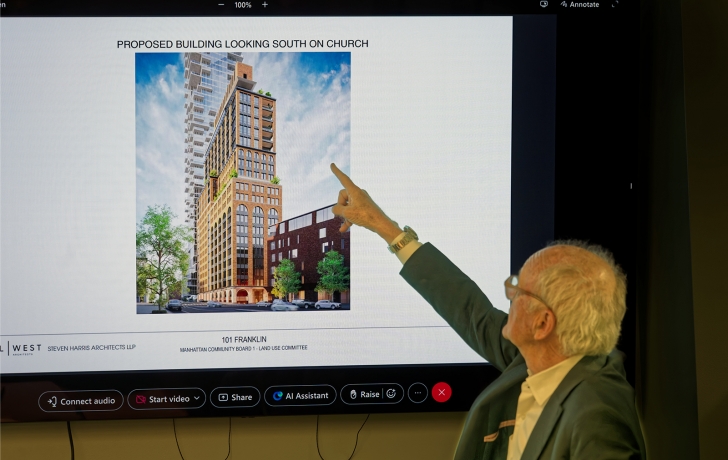
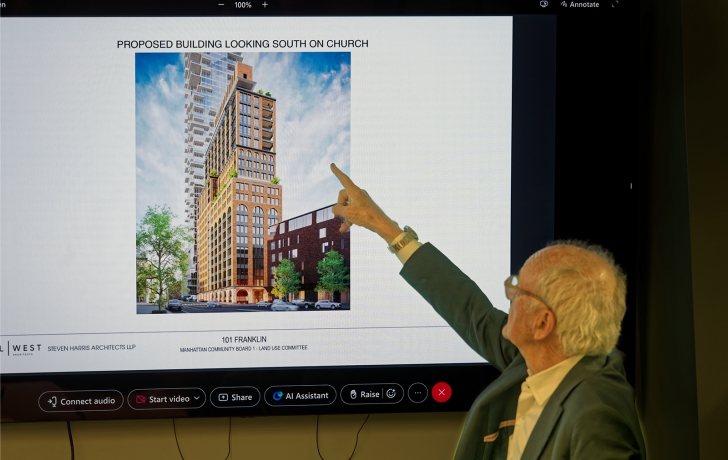
At a Community Board 1 committee meeting on March 9, architect Steven Harris presents his proposed design for the conversion of the former office building at 250 Church Street, to be called 101 Franklin. The plan calls for adding four stories to what was a 17-story building. Photo: Carl Glassman/Tribeca Trib
A Tribeca office building, vacant for eight years, will become Lower Manhattan’s (and possibly the city’s) first residential conversion made possible by the recent zoning changes known as City of Yes.
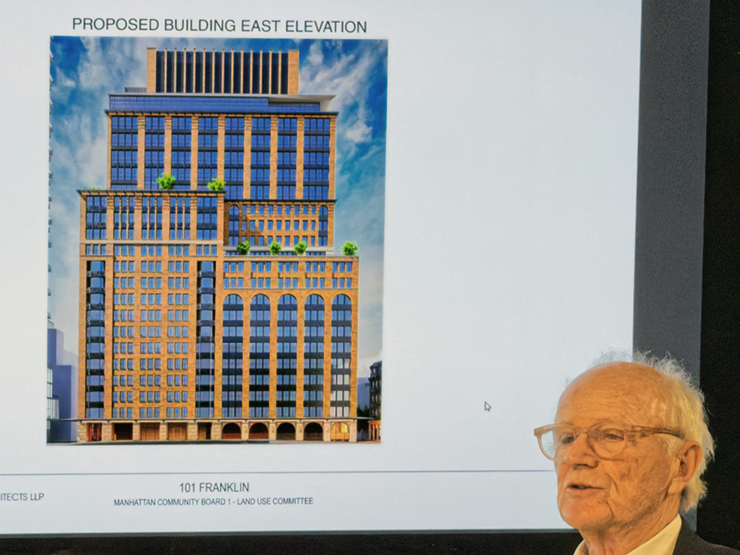
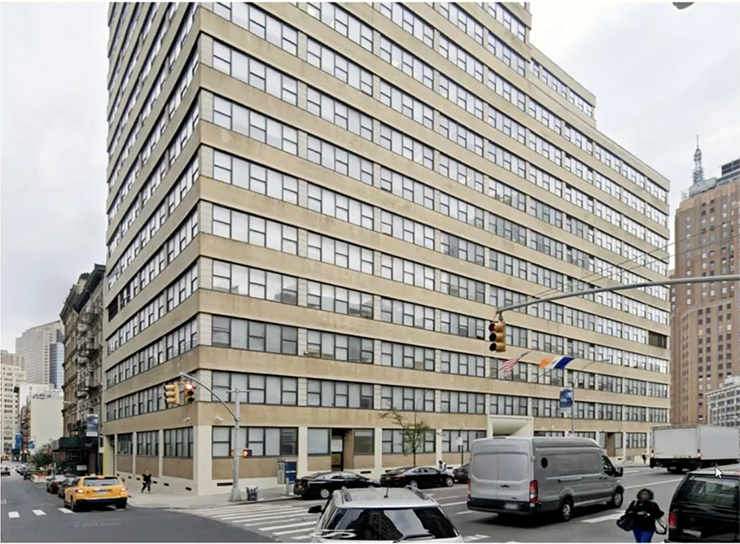
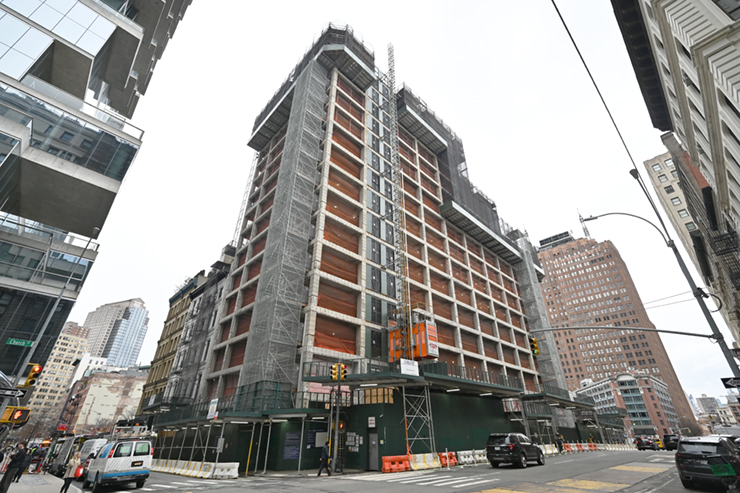
What had been a utilitarian structure at 250 Church Street, the block-long, 17-story former home of two city agencies, is slated to become a 21-story, 251,000-square-foot luxury condominium called 101 Franklin. Its all-new look is meant to recall the character of classic Tribeca buildings, with the use of arches, brick, and a wraparound metal awning.
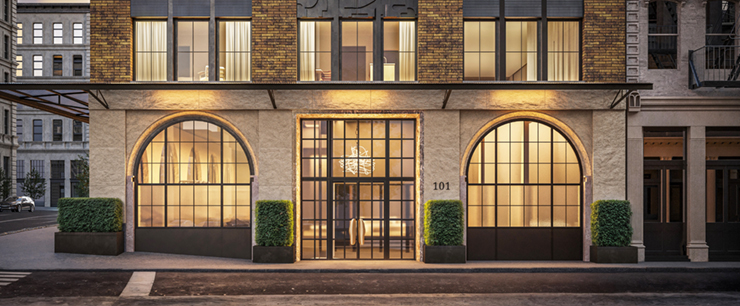 The architects and developers behind the project appeared before Community Board 1’s Land Use, Zoning and Economic Development Committee on Monday to seek advisory approval to the City Planning Commission for aspects of their proposal. The new City of Yes zoning amendments make possible the conversion of the commercial building. But the developers still need city approval for the four stories they want to add (as well as a proposed 15-space enclosed garage). They seek to hollow out an interior court for required light and air and transfer the “lost” floor area to the top of the building.
While the building’s design by Tribeca-based architect Steven Harris won praise from the committee, several in the group along with Councilman Christopher Marte heavily criticized the absence of affordable apartments.
“Not only does this application not include a single affordable housing unit, it yields just 73 condos averaging over 2,500 square feet each,” said Marte, who had been the sole vote in the Council to oppose City of Yes last year because it did not mandate affordable housing. “This proposal does nothing to address our housing crisis. Conversion at this location and even without a height increase could yield over 250 rental units and many of those units could be affordable.”
 “We argued very strongly that any commercial to residential conversion should include a requirement for affordable housing,” noted committee member Richard Corman. “Unfortunately, that was not accepted by City Planning and we would have a very different building today if Community Board 1’s resolution had been accepted.”
The developers, Cannon Hill Capital Partners, Skylight Real Estate Partners and TPG, claimed that a rental building with below-market units is not financially possible. “Given the unique neighborhood and the challenges in converting this type of building to residential, it’s just not feasible to include affordable housing here,” said Aaron Kahen, the lawyer representing the project.
The committee, recognizing that the planned building is a fait accompli, called on the developers to compensate the community by financially backing improvements to the neighborhood. “If you are not willing to give us some affordable units, then it would be very desired and appreciated if you gave us some subsidies, a give back to the community, a park, something that we can all enjoy,” said committee member Vicky Cameron.
 While declining to say what or how much they are willing to contribute, the developers said they are scheduled to talk to Marte about funding one or more volunteer groups that oversee a local public space. Chief among the organizations mentioned is Friends of Barnett Newman Triangle, who have ambitious plans to enlarge and beautify the traffic triangle on Church Street, between Franklin and White Streets and a stone’s throw from 101 Franklin.
“We are going to be your neighbor, right?” said Jesse Lasserson of Cannon Hill Capital Partners. “So we want to contribute to the neighborhood, too. It only benefits us if the neighborhood is more attractive and has more green space and more open space as well.”
Besides its complaints about the lack of affordable apartments, the committee took issue with the less-than-half (about 48%) of ground-floor space given over to retail use. The north half of the Church Street side is proposed to be the residents’ gym, visible from the street, and the new garage would occupy part of the Leonard Street side.
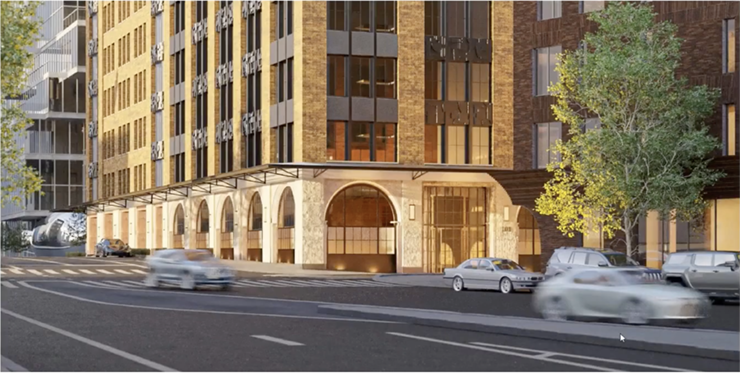 “There should be retail there to create a continuous, vibrant, pedestrian experience,” said committee member Laura Starr.
“Retail is what provides quality of life and vibrancy to any neighborhood,” added CB1 Chair Tammy Meltzer, noting that it is only on Church Street where the public can “engage” with the building.
David West, the architect of record on the project, argued otherwise. “We are transforming the streetscape from a nondescript, inactive office use with virtually no eye-level transparency to a lively, active, transparent area serving both residents and members of the community with 24-7 activation,” he said.
In addition, said architect Steven Harris, the developers “have very generously bought an extraordinarily expensive painting that will be the thing you will see from the street as you look all the way into the building.” He did not provide details about the art or the artist.
The committee’s resolution called for additional retail space on the building’s Church Street side, a lower structure that it said would be more harmonious with surrounding buildings, and elimination of the garage. The full board will vote on the resolution on March 24.