
NEW YORK — Kacie Niimoto sat in a glass-walled room on the site of a decommissioned Navy yard, giving up her Saturday to run tests on specialized equipment.
She and her colleague, Jason Kwon, who was working beside her, are employees of the 4-year-old, Brooklyn, New York-based climate technology company Arbon, which is developing a new way to remove carbon dioxide from the air in industrial applications.
It’s a startup that needs more than servers, software engineers and a clever app design. It needs access to machines and workspaces where it can test new materials and designs. That’s one reason why Arbon is one of the roughly 200 member companies at Newlab, a co-working space in the Brooklyn Navy Yard across the East River from Manhattan that specializes in providing the tools and workspaces for hardware-focused technology startups.
And the prospect of growing companies like Arbon is why Louisiana economic development officials are excited that Newlab is coming to New Orleans.

Newlab has locations in Brooklyn, Detroit and Uruguay. In January, it broke ground at the long-shuttered Bywater Naval Station in New Orleans. Its Brooklyn flagship facility has become home to a lively innovation community, bringing jobs to the once-forlorn area that’s now full of other restored industrial spaces. Across all locations, Newlab said its members have generated $5.8 billion in venture funding and more than $2.3 billion in “exits,” the tech term for an acquisition or other transaction that creates returns for investors.
Jason Kwon and Kacie Niimoto visit in the cafe of the Newlab coworking space in the Brooklyn Navy Yard on Saturday, March 7, 2026. The pair work for a startup hoping to create innovative ways to remove carbon dioxide from the air.
BY RICH COLLINS | Staff writer
In New Orleans, public and private partners are aiming for a comparable result at the former Naval Station site, which is about to undergo a $300 million redevelopment that includes the $50 million co-working space along with apartments and retail.
“Newlab Brooklyn was physically, culturally and economically transformative for New York City,” said Michael Hecht, CEO of Greater New Orleans Inc., the region’s development nonprofit. “I expect an even greater relative impact from Newlab New Orleans on our city and region.”
A sign points the way to the front entrance of the Newlab coworking space in the Brooklyn Navy Yard.
BY RICH COLLINS | Staff writer
Newlab strategic growth specialist Sahil Jain said the company is working toward a 2027 opening in Bywater. The facility there could serve up to 30 companies, Jain said.
“We are supporting their mandates to attract businesses to Louisiana,” Jain said during a phone interview. “LED is focused on bringing the next big manufacturing plant or data center — really big whales. We’ll focus on the small fish that eventually are going to be big whales.”
From battleships to big ideas
Co-founders David Belt and Scott Cohen opened Newlab in 2016 in the Navy yard, a site that served as a center of American shipbuilding for more than a century and half until it was decommissioned in 1966.
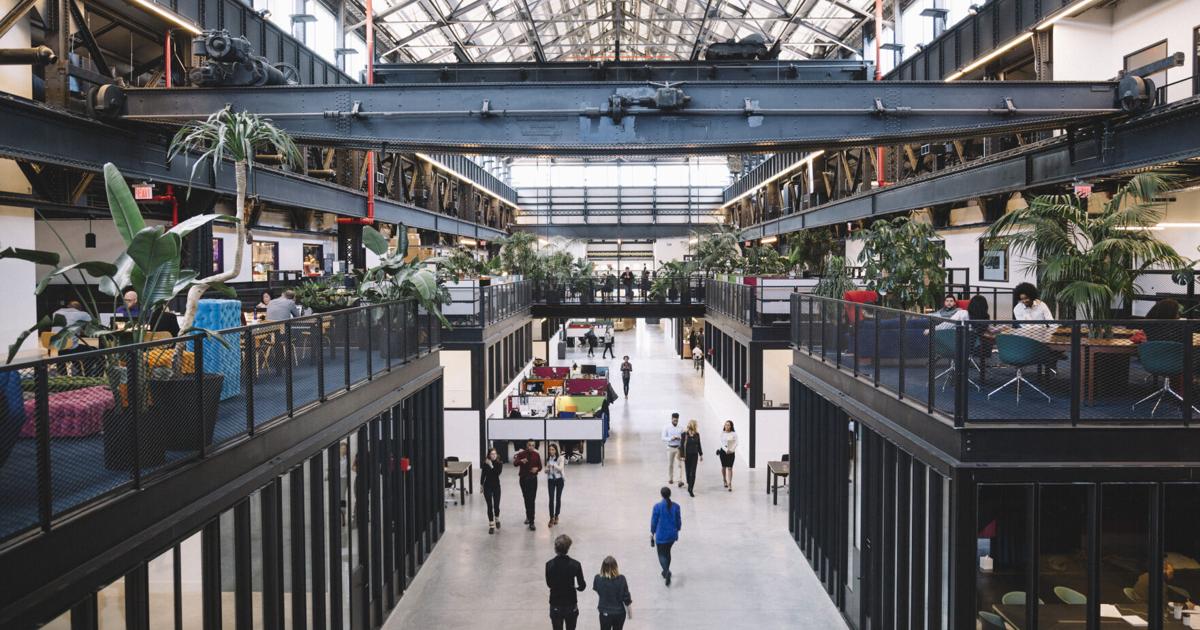
The co-working space fills the bottom section of U-shaped Building 128, where the USS Arizona, a Navy battleship later destroyed in the Pearl Harbor attacks, was constructed. Original gantry cranes are still in place, looming over desks decorated with potted plants and action figures.
Newlab’s neighbors at the Navy yard include a soundstage where “Spider-Man 3,” “Enchanted” and other feature films were made, along with a two-story grocery store, a food hall and offices. A former paymaster’s building, where shipyard workers would collect their checks, is now home to a whiskey bar.
Rosa Barney, part of Newlab’s brand and marketing team, demonstrates a prototype of a vehicle charging device designed to connect to an existing streetlight pole on Saturday, March 7, 2026. Newlab’s Brooklyn coworking space features displays of many of the innovations coming from member companies.
BY RICH COLLINS | Staff writer
Newlab’s 84,000-square-foot building has four floors of workspace and a cafe. On busy weekdays, dozens of people and a good number of dogs are milling about the common areas. Scattered across two floors are a woodshop, a metalworking space and a 3D printing room. There are also electronic, textile and biological labs.
Three dozen on-site Newlab staffers keep everything running and manage global operations. A “product realization team,” trained to use all the equipment, helps members create prototypes and leads safety training.
“Every day, people are in here using these machines and building amazing stuff,” Newlab marketing executive Rosa Barney said as she led a tour of the facility.
A Newlab member operates a saw in this undated photo.
Provided photo
Throughout the building, museum-style displays celebrate members’ products and projects, including life-like robotic hands, new-and-improved “benchtop bioreactors” and EV chargers that attach to existing light poles.
Kwon, the Arbon employee who is based in Arizona, said efforts to build community, including tax prep help and cookie-baking events, are a nice perk.
“If we were anywhere else, we’d be stuck to our own work and not really see anyone,” he said. “It’s good to look around once in a while and say, ‘Hey, there are other human beings here.'”
Evolving business model
Over the last decade, Newlab has evolved to become a tech consultant, real estate developer, co-working space operator, economic developer and investor.
One key part of the company’s business model: It doesn’t own its namesake labs. Instead, it looks for underused industrial space in strategic areas and partners with public and private entities to put them back into commerce.
A rendering of Newlab New Orleans, a $50 million “innovation hub” that’s slated for the former Navy base in New Orleans’ Bywater neighborhood.
Provided photo
The New Orleans Newlab is being built with about $30 million from Louisiana’s economic development agency, GNO Inc., the LSU-led FUEL initiative and the city , among others. Additional support comes Shell and other corporations. When the space is complete, Newlab has a five-year agreement to operate it.
Companies will pay membership fees to access the workspaces. Newlab also charges consulting fees to companies, municipalities and others looking to solve problems with new technology.
Michael Hecht, President & CEO of Greater New Orleans, Inc.
FILE PHOTO BY HILARY SCHEINUK
Last year, the New York City Department of Transportation partnered with Newlab to coordinate the use of artificial intelligence and computer vision to detect potholes and other road hazards. That same year, Shell participated in a Newlab-led carbon capture innovation program. The oil giant ultimately invested in Mantel, a startup from several MIT grads that develops molten salt-based carbon capture tech.
The consulting gigs all fall under the company’s “commercialization” umbrella, intended to take ideas out of the lab and into the marketplace.
“Our consulting practice started because city leaders would come in, see entrepreneurs building cool things, and they would see ways to use it,” Jain said.
Newlab also invests in about 10% of its member companies, according to Garrett Winther, the company’s chief product officer. And those bets sometimes pay off big.
Seeqc, a 6-year-old startup that makes digital chips to power quantum computing systems, is one of Newlab’s success stories. In January, the company, now valued at approximately $1 billion, announced a merger agreement to go public.
Aerospace startup Launcher, maker of 3D-printed rockets, was acquired in 2023. In 2018, Uber bought JUMP, an e-bike company launched from Newlab’s Brooklyn site.
David Belt speaks during a press conference at the Louisiana State Capitol, Monday, May 12, 2025, to announce a $50 million investment in in the Newlab New Orleans “innovation hub” at the former Navy base in New Orleans.
STAFF PHOTO BY HILARY SCHEINUK
Winther said the investments, and all of Newlab’s work, are driven by the desire to “unlock critical technology stuck in the hands of entrepreneurs” struggling to build companies.
“I wake up every day thinking about how to help technologies that need to exist,” said Winther, who lives in Colorado but oversees operations at Newlab’s Detroit facility. “Reindustrialization, climate change, AI and automation are upending how we think about our industry and economy, and these founders need a place to go.”