
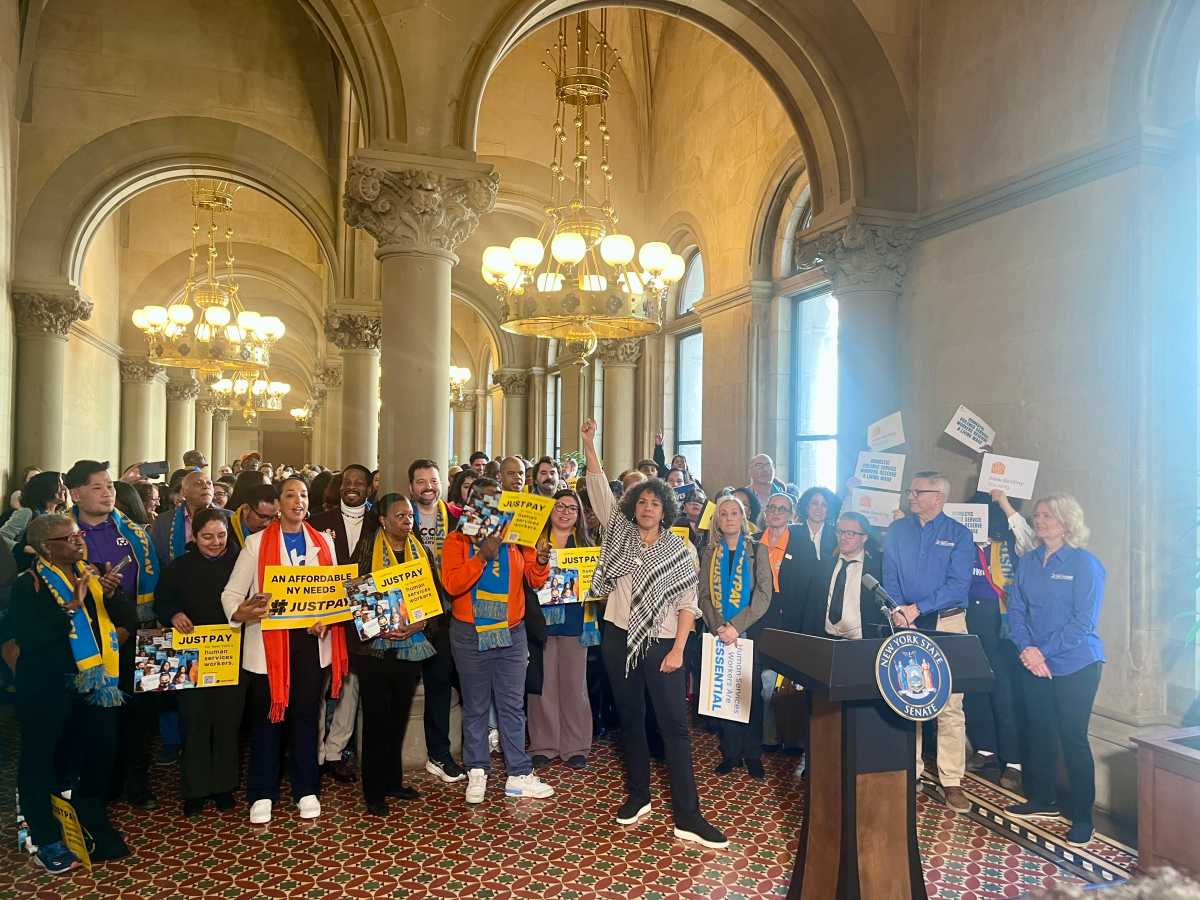
Photo: Human Services Council
Every morning in New York, before most of us have poured our first cup of coffee, hundreds of thousands of workers are already on the job. They are helping an elderly woman in Buffalo get out of bed. They are sitting with a child in foster care who had a bad night. They are supporting a man with a disability in Queens so he can live in his own apartment. There are 800,000 of them across this state, and without their labor, New York’s social safety net would not exist.
For decades, we have called these workers essential. Elected officials have applauded them and praised their dedication. What New York’s government has failed to do is pay them fairly. This is squarely in their control, as the New York State government sets contracts and wages for human services. And that failure is no longer sustainable.
Albany lawmakers now face an immediate test. Last year, the state approved a 2.6 percent inflation-based raise for nonprofit human services workers. This year, Governor Kathy Hochul’s proposed budget reduces that increase to 1.7 percent – even though inflation is currently 2.7 percent. Lawmakers should restore the full amount needed to match rising costs. Anything less is a pay cut.
But this fight is about more than one year’s budget.
New York’s nonprofit human services workforce is trapped in a long-running wage crisis caused by decades of underfunded government contracts. Each year, costs go up and wages fall behind. Legislators praise workers while failing to cover the true cost of their labor. Cost of living increases are pointed to as progress, rather than acknowledged as a simple inflation adjustment, and meanwhile no meaningful progress has been made to address the chronic underpayment of this workforce. Providers are asked to do more with less.
The recent history of home care wages shows how this pattern plays out. After years of organizing, home care workers, providers and advocates won increases that brought the wage in New York City to $19.65 per hour as of January 2026. That progress mattered. But the state did not fully fund the wage increase in their contracts..
When Albany mandates higher wages without increasing reimbursement rates enough to cover them, the burden shifts to nonprofit providers. Even a modest hourly increase can translate into millions of dollars in new costs for large organizations. Managed care companies take their share before state dollars reach providers – or workers. The result is predictable: program cuts, hiring freezes, and financial strain that destabilizes the very system New Yorkers rely on.
The human cost is just as stark. Women of color make up more than half of this workforce. Nearly one in six human services workers lives at or near poverty. Workers with bachelor’s degrees earn roughly one-third less than their private-sector counterparts. We have built our care infrastructure on the assumption that the people doing this work – disproportionately Black and brown women – will just accept low wages as the price of meaningful service. That is not sustainable. It is a moral failure.
The first step this year is straightforward: make sure workers’ wages keep up with inflation. Protecting pay from erosion is basic fairness.
But stabilization is not the same as solving the problem. The larger goal must be long-term wage parity. Workers employed by nonprofit organizations under government contract should be paid the same wages as government employees doing the same jobs. Equal work should mean equal pay – regardless of who signs the paycheck.
State and city leaders can achieve that through legislation, executive action, or clear wage standards. What cannot continue is the cycle of small adjustments that never close the gap at all.
Human services and home care workers are not asking to be celebrated. They are asking to be paid fairly. After decades of waiting, they are done accepting partial justice. Albany leaders must restore their full inflation-based raise this year – and commit to equal pay for equal work for the long term.
Wayne Ho, President and CEO, Chinese-American Planning Council
Maria Lizardo, Executive Director, NMIC
Damyn Kelly, President and CEO, Lutheran Social Services of New York