
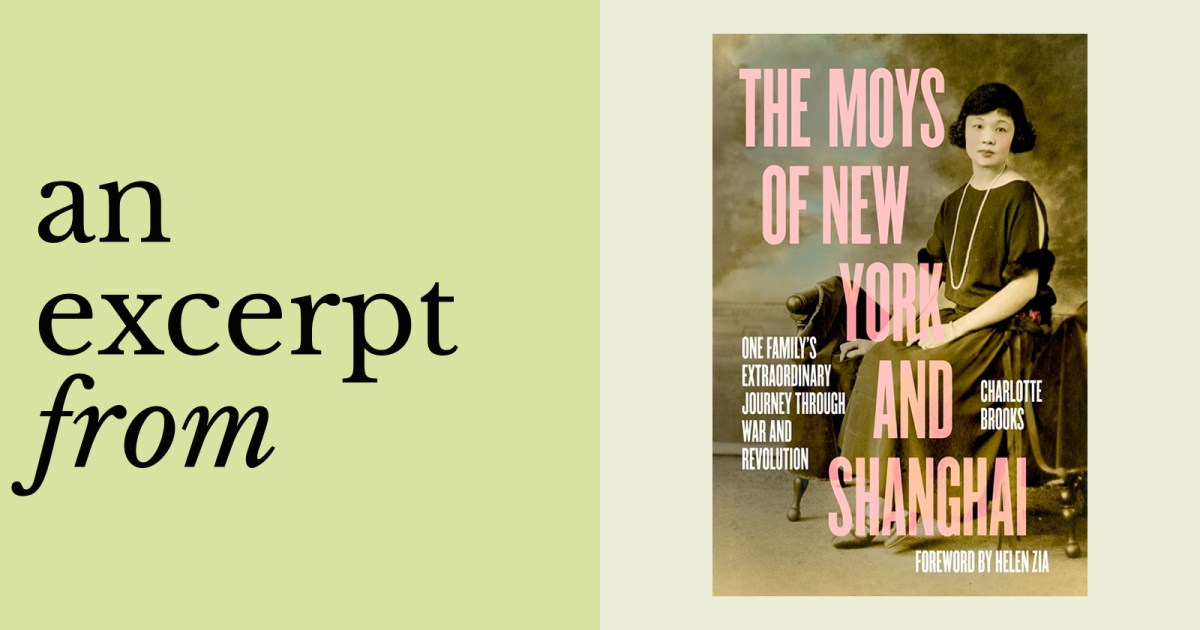
Excerpted from The Moys of New York and Shanghai: One Family’s Extraordinary Journey Through War and Revolution by Charlotte Brooks, courtesy of the University of California Press. Copyright © 2026.
Kay woke before dawn to the sound of rain rattling the windows. She rose, washed her face, and was just getting dressed when she heard a gentle rap on the apartment door. Han Ying had invited a matronly friend — selected because of her happy marriage and large family — to comb Kay’s hair from girlhood braids into a married woman’s bun. It was the first ritual of Kay’s wedding day, November 21, 1910.
Earlier that year, Moy Sing and Han Ying had decided to find their oldest daughter a husband. They waited until Kay turned seventeen but saw no reason for further delay. After all, Kay was already three years older than Han Ying had been at the time of her own marriage. So Moy Sing asked local merchant Lee Weenom, an amateur matchmaker, to find Kay a suitable mate. The task was formidable, but not because of Moy Sing’s lack of wealth or social prominence. In 1910, fewer than forty single or widowed adult Chinese women lived in New York City, compared to about fifteen hundred single or widowed adult Chinese men. The matchmaker spent weeks winnowing down the large number of proposals he received. That fall, Lee selected his top three candidates and, in the accepted fashion, sent an acquaintance’s wife to deliver the proposals to the Moy family.
After the woman left, Moy Sing and Han Ying discussed each candidate’s merits in detail. The first offer came from Chin Gin Hay, a prosperous local merchant. Seeing the man’s name, Moy Sing shook his head and wondered what Lee Weenom could have been thinking. Around Chinatown, people whispered that Chin Gin Hay was dating a white woman who taught piano in the neighborhood. That made his proposal not just questionable but dangerous. Only a year earlier, New York City police had discovered the body of a murdered white missionary, Elsie Sigel, stuffed into a trunk in the apartment of a Chinese man named Leon Ling. When the cops uncovered a trove of love letters from Sigel to Ling, racist white civic leaders and journalists whipped up a storm of anti-Chinese feeling. And though the police never caught Ling, they spent months harassing young Chinese men, like the Moys’ son Ernest.
Chin Gin Hay was trouble, no matter how much money he had. Moy Sing tossed the proposal aside, and he and Han Ying turned to the other two candidates. Thankfully, both were much better, especially Chin Shiu Wing, who seemed like an excellent prospect. He was a China-born youth just about Kay’s age — they had briefly attended Public School 23 together — and his father was the managing partner of a thriving store down the street. Chin Ming Tai was slightly less suitable, since he was a widower fourteen years older than Kay. His first wife had died in China just a year or two earlier, and their son, a boy named Chin Shau Hong, now lived in Hong Kong. Ming Tai did have one major advantage, though: He was reputed to be rich, since he owned shares in at least two local factories and a dry goods shop.
After comparing the proposals again, Han Ying and Moy Sing made an unusual decision: They would let their daughter choose which of the two men she wanted to marry. To strangers, Kay seemed demure, diffident, even shy, an impression her youthful appearance helped create. But her family knew better. Kay had definite opinions about what she wanted, what she liked, and what she would not tolerate. Her parents understood this, and they also trusted her judgment.
Kay had long assumed that when she grew up, she would marry and have a family of her own. From what she observed of her parents’ generation, that was the only option open to a virtuous woman. She did not object to this future, but she did not relish living the way her mother had. After all, Kay had spent her girlhood minding a growing brood of siblings in a series of small Chinatown apartments with a father whose income could not always sustain a family in much comfort. So while Moy Sing and Han Ying assumed Kay would choose Chin Shiu Wing, she surprised them by selecting Chin Ming Tai instead.
Kay’s choice was not merely, or even mostly, about money. To begin with, Shiu Wing lived with his parents, and she had heard plenty of stories, including from Han Ying, about domineering mothers-in-law. Besides, Kay had passed Chin Ming Tai in the street more than once, and he had made a good impression on her. He was not much taller than she, slight of build, and rather youthful looking. He kept his hair cut short and brushed back, had removed his queue, and usually wore Western clothes. Ming Tai was not particularly handsome — his small mouth pursed a bit, and when he smiled, she could see his crooked teeth — but he looked kind. And it was true that Kay also noticed his well-tailored and fashionable suits and heard about his wealth. She was not lazy — she had been cooking, sewing, cleaning, and taking care of her younger siblings as long as she could remember — but she was also tired of the economic insecurity that plagued her family.
Moy Sing informed the matchmaker that he accepted Chin Ming Tai’s proposal. Then he consulted a horoscope book to select proper days for the wedding and the prescribed events leading up to it. On the first chosen day, Ming Tai sent over the traditional gifts that signified the engagement, as well as a wholly unexpected one: a diamond solitaire engagement ring, a nod to American wedding practices that delighted Kay. Ming Tai then ordered the customary small cakes to distribute in the neighborhood as a formal announcement of the upcoming wedding. The more cakes a man distributed, the greater his prestige. Locals claimed that Ming Tai ordered almost ten thousand.
Chin Ming Tai believed in showing affection by spending money on his family and friends. This was a natural lesson for someone who grew up in a village where almost all the men between sixteen and sixty were absent, working overseas and sending money back home to support the families they rarely saw. Ming Tai’s father and uncles, who owned successful businesses in the United States, were no different. Originally, Ming Tai prepared to follow in their footsteps. When he turned seventeen, his family arranged his marriage to a Leong family woman, who in 1899 gave birth to their son Shau Hong. Ming Tai did not meet the boy for years, because he had already left to work abroad.
Sailing to Cuba just months after the Spanish-American War’s end, he disembarked at Havana, a major transit point for travelers from China. Smugglers and forgers in the Cuban capital did a brisk trade selling the documents and new identities that enabled Chinese men to claim US citizenship by birth or through US citizen fathers; these “paper sons” could then enter the United States despite Chinese exclusion laws. After purchasing the paperwork he needed to establish his supposed birth in San Francisco, Ming Tai traveled on to New York.
The older Chin men decided that Ming Tai would settle in Manhattan and work for his uncles, merchant Chin Sung Fung and cigar manufacturer Chin Sung Pan. The young man was a quick study, learning the ins and outs of the mercantile and cigar trade and showing a keen business sense. His uncles were duly impressed, and in 1905, when Sung Pan retired to China, Ming Tai took over the older man’s shares in two cigar factories and the dry goods store, Kwong Tai Chong.
Despite his success, Ming Tai felt deeply lonely as he read the letters from his loved ones in Toisan and looked at the photos of his wife and rapidly growing son. By the time he made his first trip back to China, he had decided that he did not want to live apart from his family. Before returning to the United States, he told his wife that he planned to bring her and Shau Hong to America soon, but she surprised him by resisting the idea. Though he did not hear from her again after he arrived in New York, he assumed she would come around — and then he received the letter from his mother, by way of a village scribe who wrote notes for the illiterate. As Ming Tai read and reread the news of his wife’s death, delivered in a stranger’s handwriting, he felt a mix of shock, sorrow, and disappointment. Months later, when his friend Lee Weenom approached him, he was ready.
After Han Ying’s friend finished combing up Kay’s hair, she whispered some words of reassurance in the young woman’s ear and then slipped out of the apartment. Han Ying had given her daughter a small mirrored vanity for her wedding day — “to reflect everything good,” her mother said — and Kay now examined herself, trying to reconcile her round, girlish face with the hairstyle she had seen so many older women wear. Finally, she buttoned herself into the white, high-necked, Western-style dress she had purchased for her wedding, while Han Ying herded the younger Moy children into their best Chinese formal clothing. Suddenly, they heard another rap at the door, which Moy Sing, balancing little Bill on his hip, answered. There stood Ming Tai in a stylish Western suit with a smartly knotted silk tie.
Brushing away tears, Kay tried to smile at her fiancé but could barely meet his eye. He guided her down the stairs and into the street, opening his umbrella to protect her from the rain. The rest of the Moys followed behind: Han Ying tottering slowly down on her bound feet, Ernest taking two steps at a time, and Helen and Alice bouncing off the stairwell walls, much to Moy Sing’s annoyance. Kay and Ming Tai stepped into a waiting cab, while the rest of the family and some friends followed in other cabs hired for the occasion.
A year earlier, New York State started requiring all couples to obtain a marriage license from a city clerk, even if they wed in a religious ceremony. Ming Tai and Kay planned to marry at City Hall that morning before their Chinese wedding later in the day. Neither realized that they were the first Chinese couple in the city to apply for a license under the new ordinance. When Ming Tai, Kay, and their entourage arrived at City Hall, they attracted so many gawkers that police arrived to clear the steps. Two officers finally guided Kay and Ming Tai into the building through the basement to avoid the rowdy throng. In a private office, an alderman wed the couple as their families and friends watched and translated the ceremony for those who did not understand English.
Ming Tai and Kay planned to marry at City Hall that morning before their Chinese wedding later in the day. Neither realized that they were the first Chinese couple in the city to apply for a license under the new ordinance.
Blushing behind a bouquet of lilies, Kay spoke in an almost inaudible voice, but she smiled reassuringly down at her two sisters, both of whom clutched her skirt folds. Helen wept quietly, believing her world had come to an end, while Alice, always comfortable with attention, cried more lustily. By then, a New York Tribune reporter had arrived and was furiously scribbling into his notepad. Within two days, the Moy-Chin nuptials became national news, the sort of story that editors of small-town papers liked to pluck out of the big-city dailies and run alongside items about the oldest living person or the length of the Nile River.
Kay returned to her parents’ apartment to dress for what she, Ming Tai, and the Moys all considered her real wedding ceremony. She exchanged her white gown for a red cotton blouse and trouser ensemble and red veil, which in China symbolized happiness and good fortune. When she left her parents’ apartment for the second ceremony, she climbed into a waiting horse-drawn wagon with a piece of red fabric tied to it — the closest the Moys could come to the red sedan chairs that carried brides to their new husbands’ homes in China. The wagon proceeded slowly down Mott Street as throngs of Chinese and white passersby stopped to watch. Then it made a sharp right onto Bayard Street and immediately stopped, because Ming Tai lived only about five hundred feet from the Moys’ apartment.
Dressed in a Chinese black silk coat and a dark blue robe, he stood waiting for Kay outside his apartment building. Using a ceremonial fan, he rapped on the door of the carriage, another Chinese wedding ritual. At the sound of his fan, Kay climbed down to the street and then followed Ming Tai up the stairs to her new home. After he lifted her veil, they burned incense, bowed to each other, and walked back around the corner to their wedding feast at Mon Far Low, where Ming Tai’s uncle Chin Sung Fung acted as master of ceremonies.
Local gossips claimed that Chin Ming Tai paid Moy Sing a bride price of $20,000, an astronomical sum for the time. The true amount was probably less, but Ming Tai was a successful businessman, and marriageable Chinese women were incredibly scarce in New York. Whatever the amount, the money brought a new prosperity to the Moy household, and by 1911, Moy Sing believed that another big payoff was within his reach.