
I go to New York City and I come back talking about a challenging play I saw, the food poisoning I didn’t get from eating delicious street meat, and the vibrance of a city teeming with all manner of humanity (even if I wish it/they would walk faster).
But there’s a subset of pundits and tourists — I’m still both, in some manner of speaking — that goes to New York and comes back talking about filth, misidentified aromas and marauding CHUDs.
The Madison
The Bottom Line
A good show and a bad show, smushed together.
Airdate: Saturday, March 14 (Paramount+)
Cast: Michelle Pfeiffer, Kurt Russell, Patrick J. Adams, Elle Chapman, Beau Garrett, Amiah Miller, Ben Schnetzer, Kevin Zegers
Creator: Taylor Sheridan
After watching six episodes of The Madison, Paramount+‘s new drama from Taylor Sheridan, it’s pretty clear that the Yellowstone creator fits squarely into that second group. It’s too bad. I bet he really would have enjoyed Ragtime at Lincoln Center.
The suppurating contempt Sheridan feels for the Big Apple oozes its way through much of the series, its condescending pus infecting stunning vistas, swelling musical compositions and at least one award-worthy performance, courtesy of Michelle Pfeiffer. Sheridan hates New York. He hates New Yorkers. He hates New York parents and he really hates New York children, though mostly because of what they’ve learned in New York schools and from New York parents.
It’s a laughable and embarrassing “perspective,” and it’s also a pity, because there are two shows clashing in The Madison and one of them is very good — perhaps the richest and most mature thing Sheridan has ever written for the small screen, thoroughly undermined by the laziest writing he has ever done.
If it were possible for me to extract the portion of The Madison that’s a somber, heart-filled meditation on loss and the healing power of the natural world — the one driven by Pfeiffer’s steely resolve, Kurt Russell‘s folksy charm and endless Montana sunsets — I would do so with enthusiasm, albeit a few reservations.
Unfortunately, that version of The Madison, which peaks in the season’s fourth and fifth episodes, arrives inextricably tied into Sheridan’s childishly constructed binary, which can be succinctly summed up as Country People Are From Mars, City People Are From the Deepest, Darkest Sewers of Hell. That version of The Madison is simplistic, amateurish and renders several key characters so unwatchably unpleasant that I couldn’t tell if the actors playing them were bad or just innocent victims.
Paramount+ is being very protective of the series’ plot, though before anything really happens, the offending binary is established.
In present-day Montana, Preston Clyburn (Russell) and younger brother Paul (Matthew Fox) are fishing, drinking coffee on porches overlooking the Madison River and living a divine life in God’s Country. Paul lives there, with an existence that’s simultaneously isolated and spiritually fulfilling. Preston is just an occasional interloper, but he yearns to be more. Back in New York, he’s a finance guy, chained to his family and shackled to the urban grind, but in Montana he’s at peace.
Back in New York City, Stacy Clyburn (Pfeiffer) is the matriarch of a splintering clan. Eldest daughter Abigail (Beau Garrett) is divorced — because that’s what New York City does to the traditional family — and struggling to raise daughters Bridgette (Amiah Miller) and Macy (Alaina Pollack), who are being indoctrinated by New York schools (even the PRIVATE schools) with woke ideas like how it it might be bad to call Native Americans/Indigenous peoples “Indians.”
The nefarious influence of New York City is so mind-warping that when Stacy and Preston’s youngest daughter Paige (Elle Chapman) is hilariously mugged in broad daylight in the middle of 5th Avenue, she’s literally unable to identify the race of her assailant out of what one assumes must be Mamdani-enforced white guilt. Paige, who’s in her mid-20s but acts like she’s 13, is married to Russell (Patrick J. Adams), innocent victim of the emasculating power of the New York City water. Sure, it makes great bagels, but at the cost of your gonads.
Preston loves Montana more than he loves anything other than Stacy (certainly more than he loves his kids, because they suck), but Stacy has refused to ever accompany him to Montana, because if you’re in a place where you can’t go see a former Real Housewives cast member making their Broadway debut as Roxie Hart in Chicago, life isn’t worth living. Nah, I’m kidding. Real New Yorkers are far too snooty to see Chicago. Stacy just doesn’t want to vacation in a place without indoor plumbing. SNOB!
Soon, Stacy and much of the rest of the family will arrive in Montana, where they will discover a land where every freezer is filled with with wild game, every cowboy (Kevin Zegers’ Cade) is gruff and kind, every law enforcement official is hunky and haunted (Ben Schnetzer’s Van) and every Native American practically insists that you call them “Indians.” Is this heaven? No. It’s Montana.
An important thing that has to be acknowledged about The Madison is that it’s gorgeous. Christina Alexandra Voros, who directed the entire season, is a veteran cinematographer who shot much of the series as well, and she captures every frame rapturously, using lens flares and even lens flare rainbows as optical punctuation. Even the scenes in the endlessly maligned New York City (played at least partially by Fort Worth, Texas) look beautiful, undermining the nightmarish declarations of Sheridan’s scripts.
The best illustration of Voros’ power and essential role in making The Madison less bad than it might have otherwise been comes in the second episode, when Paige gets stung by hornets in the Montana cabin’s outhouse. She gets stung in her nether-regions and a major scripted plot point involves Paige laying half-naked on a bed with ointment on her posterior. Now, Paige is already one of those patented Taylor Sheridan-created young blondes who bear no resemblance to actual humans and are played by attractive actresses with very little experience and zero ability to do anything to make the characters seem human. Think Michell Randolph’s Ainsley from Landman, only the entirety of Landman has been directed by men who objectify Ainsley (who’s supposed to be 17-18 in the series) relentlessly. It’s easy to imagine how Sheridan envisioned the “Paige gets stung on her butt and her ‘kitty’ (her words)” scene, but as Voros films it, it’s less drool and more like a 19th-century French painting.
No, really the best illustration of Voros’ achievement on the series is that when the first episode concluded with a dedication to Robert Redford, my first reaction wasn’t “Oh, Taylor Sheridan. You’re so silly,” but rather “You know? That actually tracks.” It’s isn’t just the direct referencing of A River Runs Through It in the 68-minute pilot, which features at least 5 to 10 minutes of poetic, macho fly-fishing. The Madison has extensive strains of DNA from Redford’s adaptation of The Horse Whisperer, with its emphasis on a rural escape as the ultimate salve for psychic wounds, but also Ordinary People, a film about the impact of grief on the family unit. The series has no resemblance to Quiz Show, a film about urban smartypantses, which I assume Taylor Sheridan watches like a pack of hyenas watch a wounded gazelle. But the Robert Redford prone to elegiac meditations on the human condition is well-evoked here.
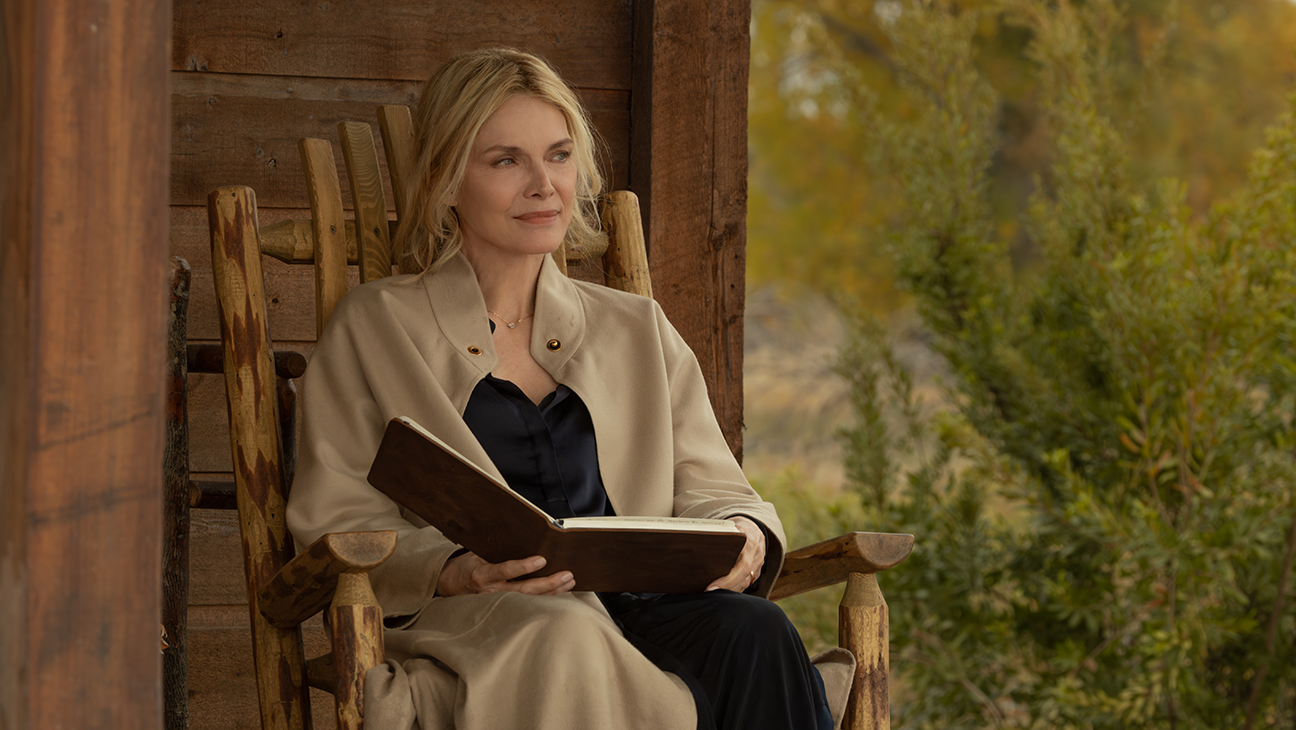
Though Russell provides ample rugged warmth, this is a Michelle Pfeiffer vehicle through and through — a reminder that at her best, very few actors convey the growing strength beneath external fragility better than she does. Playing a woman whose filter of snooty gentility (her “New York City”) has been temporarily disabled, she alternates between expertly played melodrama and no-nonsense candor and wisdom (her “Montana”) effortlessly. It’s a great performance marred only occasionally by the beats the script puts her through.
Of actors playing the New York-infected members of the Clyburn family, Garrett comes across the best, holding her own opposite Pfeiffer, as well as Schnetzer, who might become a breakout heartthrob if The Madison is a success. Adams deserves credit for at least retaining dignity and earning the laughs that are directed at a character who is probably described as a “NYC Beta” on every script page.
Will Arnett appears in the last two episodes as an unorthodox — think Judd Hirsch in Ordinary People, only less Jewish — New York City shrink whose attractiveness everybody randomly comments on, almost-but-not-quite saving the urban portions of those episodes.
The six-episode first season of The Madison, which has already been renewed, is really a 120-minute premium cable-style pilot padded out with Sheridan’s New York City cheap shots. Remove most of them, plus a few trimmed sunsets and sunrises over Montana hills and valleys, and it could-be a set-up for the ideal version of The Madison. As it stands, I have no idea whether a second season will do away with the New York City stuff and become the show I’m actually curious to keep watching, or if it will continue to be one of the most whiplash-y shows I can remember.