
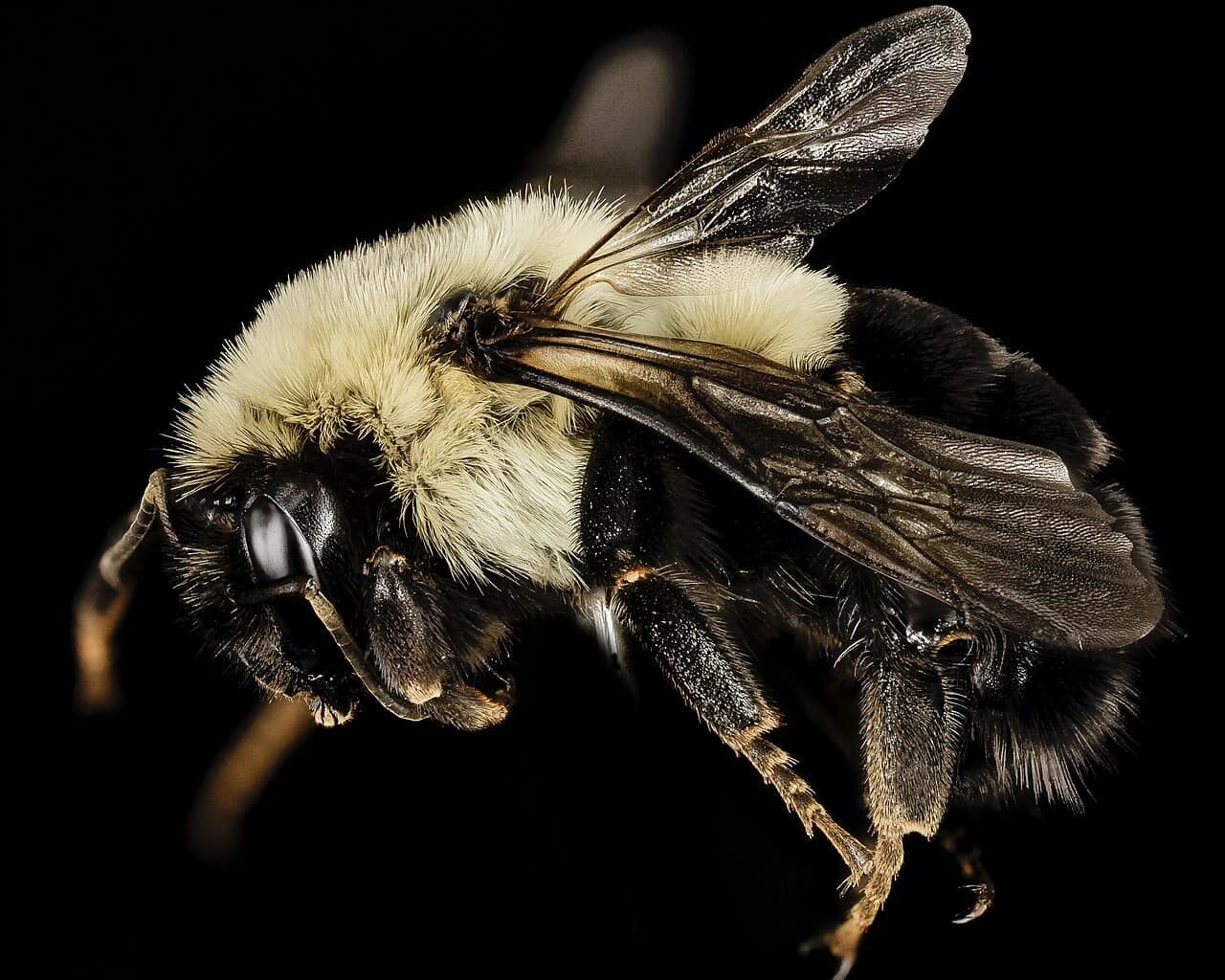
 Bombus impatiens queen. Credit: Wikimedia Commons
A newly mated bumblebee queen typically spends the winter alone underground.
After mating in late summer or fall, she burrows into the soil and slips into diapause, an insect state of suspended development. By spring, if she survives, she will emerge to found an entire colony.
Still, underground isn’t always safe. Heavy rain can soak the soil, snowmelt can trickle down, and rising water tables can flood a queen’s burrow.
A new study, published in Proceedings of the Royal Society B, shows just how tough these queens are. In lab experiments, researchers found that they could survive up to 8 days fully underwater by drawing some oxygen from the water, partly relying on a backup low-oxygen system, and slowing their bodies down to an extreme degree.
The discovery was sparked by a happy accident. The conservation biologist Sabrina Rondeau had been storing queens in soil-filled tubes in a lab refrigerator when condensation flooded some of them. She expected to find dead bees. Instead, the queens began to move once removed from the water.
That accident led to a more systematic test. In 2024, Rondeau and colleagues showed that about 90% of submerged queens survived a week underwater. The new study, led by Charles-A. Darveau of the University of Ottawa set out to learn how.
Entering Stasis
The work focused on the common eastern bumblebee, Bombus impatiens.
During winter, a queen’s body almost shuts down to save energy. The slowdown is greater than cold alone would cause, so the bees seem to enter a special low-energy state.
×
Thank you! One more thing…
Please check your inbox and confirm your subscription.
In the new experiments, researchers measured this shutdown by tracking carbon dioxide. They found that resting queens before submersion produced about 15.42 microliters of carbon dioxide per hour per gram of body mass. After eight days underwater, that rate had fallen to 2.35 microliters, a sign of what the researchers call “profound metabolic depression.”
This metabolic drop means the bee has effectively dialed her body’s energy demand down by roughly 85% compared to her normal winter state.
But that doesn’t mean the queens were holding their breath. The scientists measured low, steady carbon dioxide production during submersion and found that oxygen levels in the surrounding water dropped sharply when a queen was present. After eight days, water in tubes containing queens held less than 40% of the oxygen measured in control tubes without bees. Together, those measurements strongly suggest the queens were taking up oxygen from the surrounding water. So while they were submerged, the queens used much less oxygen than they normally used, but they still breathed some oxygen nonetheless.
“To my knowledge, this is the first study that shows a terrestrial insect like a bumblebee being able to get their oxygen out of water,” Jon Harrison, an environmental physiologist at Arizona State University who was not involved in the work, told Smithsonian.
 Submerged bumblebee queen. Credit: Charles Darveau
The bees also appeared to use a backup system. Their bodies accumulated lactate during submersion, which is a hallmark of anaerobic metabolism, the energy-making pathway cells use when oxygen is scarce. Lactate levels rose after four days underwater and remained elevated after eight days, then returned to pre-submersion levels after a week of recovery in air.
Once the queens were back in the air, their metabolism briefly shot up. That burst seems to reflect recovery from their time underwater, before their bodies gradually returned to normal winter levels over the next week.
Resilient Little Creatures
The study does not settle every mystery. The researchers suspect the bees may rely on a physical gill, such as a thin layer of trapped air that can exchange gases with the surrounding water. Many aquatic insects use such structures. But researchers have yet to directly confirm the mechanism in bumblebees.
But that actually makes the finding even more interesting. Bumblebees are not thought of as aquatic animals. Yet more than 80% of bee species nest in the ground and many may face at least occasional flooding. The paper points to another ground-nesting bee, Calliopsis pugionis, that has even been described as benthic—living on or near the bottom of a body of water—because it can emerge after enduring months of inundation.
 A common eastern bumblebee on a flower. Credit: Lucas Borg-Darveau
The study also points to a less-noticed part of bumblebee conservation. Researchers often focus on pesticides, disease and habitat loss. But queens spend winter underground, where flooding may pose a risk.
“When we think about bumblebee conservation, we mostly focus on having resources for them to forage in the spring and summer, but I’m not sure anyone is thinking about what kinds of conditions they need in the winter,” Elizabeth Crone, an ecologist at the University of California, Davis, told Smithsonian.
For now, the study suggests that at least one species is better able to survive winter flooding than scientists expected. Even if a burrow fills with water, a queen may still make it through.