
A provocative Brooklyn restaurant has reopened after upgrading its fermentation lab — and brings in its very own provocateur. Honey Badger co-owners and wife-husband duo Fjölla Sheholli and Junayd Juman hired Jason Ignacio White, the former head of fermentation at Noma. His recent sharing of candid accounts of the Copenhagen restaurant’s kitchen culture helped ignite the reckoning that ultimately led René Redzepi, one of the most famous chefs in the world, to step away from his restaurant.
After a prolonged temporary closing, Prospect-Lefferts Garden restaurant Honey Badger reopened on Wednesday, March 11, at 67 Fenimore Street, near Flatbush Avenue.
Sheholli says she and Juman reached out to White because people kept mentioning him when it came to the world of fermentations. “This guy seems super grounded,” she tells Eater. “He’s a wonderful person, professionally wise, and he’s one of the most knowledgeable people about co-ferments.”
With Honey Badger’s reopening after a year-and-a-half closure, Sheholli and Juman are still serving their “avant-garde” tasting menu rooted in contemporary American cuisine, focused on the Northeast. It’s a 13-course affair for $295, along with drink pairings like water ($85), teas ($100), nonalcoholic ($120), and general beverages ($245). But now, there’s a new a la carte menu reflecting micro-seasons (currently the sap moon) and that shiny fermentation lab.

Junayd Juman and Fjölla Sheholli at Honey Badger’s fermentation lab. Melissa Hom/Honey Badger
Originally, Sheholli and Juman opened Honey Badger in 2017, but in December 2024, they temporarily closed the restaurant to reboot entirely. The issue before, Juman laments, was that “no one got to see the magic” of the fermentations — everything was kept in the next-door storage.
Honey Badger 2.0 is now “like Dexter’s Laboratory,” Juman says, referring to the 1990s cartoon of a kid scientist with a tricked-out science lab. After meals, the couple can take guests through to show what they’re working on, from processing and dry-aging meats to the backyard with the yakitori grill. “It’s a more complete story without words,” he says.
Honey Badger’s nose-to-tail shrimp dish
When you get the Montauk red shrimp on the restaurant’s tasting menu, you’re getting all of the Long Island crustacean. The couple blast-freeze the shrimp, cure the tail, dehydrate the shells to make a dust, create a sauce from the head, and candy the feet. “That’s your dish, nose-to-tail, nothing but shrimp,” Juman says.
That’s the embodiment of the couple’s ethos of letting food shine without overcomplicating flavors. “When you have the right ingredient,” Sheholli says, “you don’t really have to put a lot of effort.”
White guided the couple on creating a smarter fermentation lab. “The major part of the formula is time and the effort it takes, and there are no guarantees in the end,” Juman explains the appeal of fermentations. “But with Jason’s calculations, you get a steadier, more sure product.” This applies to kojis (they’re sourcing hand-picked Bineshii Ghost wild rice from the Leech Lake Reservation in Minnesota), dashis, misos, garums, lacto-ferments, vinegars, teas, and much more.
The revamped space lets them be more thoughtful with how and what they do to ingredients. They forage for ramps from a specific hillside at Blue Sky Organic Farm in the Catskills. Back at the restaurant, they figure out what they’ll do with them: pickle, ferment, dry, keep fresh, etc., Juman explains.
Another example: they’ll turn certain types of fish eggs into bottarga by salt-curing and then shaving them like a cheese. “We choose to embrace what we caught at that moment at that time of the year,” Sheholli says, with the aid of fermentations to preserve for future use.

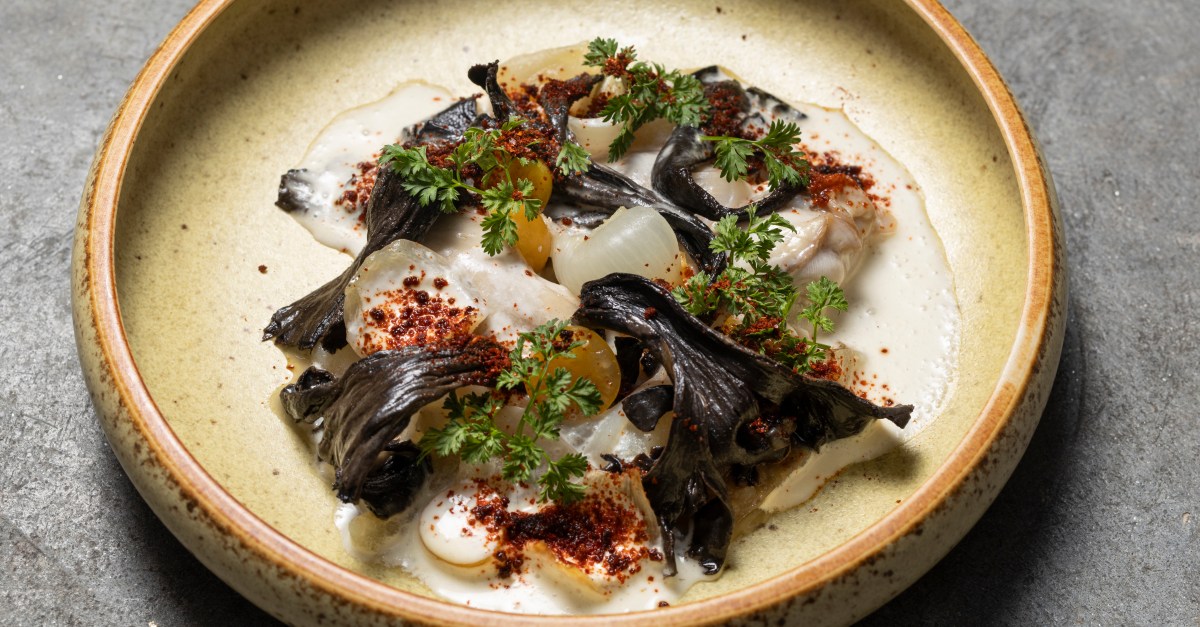
A dish with surf clams, matsutake mushrooms, kohlrabi, Meyer lemon kosho, and XO sauce at Honey Badger. Melissa Hom/Honey Badger
This idea of capturing and reflecting place and time extends to Honey Badger’s waters. “Water is really terroir driven,” Juman says, talking about how rainwater collects minerals specific to regions, leading to “unique flavors.”
Sheholli highlights the tree water season, a time “when the snow melts, and the trees absorb the most water, so we tap trees,” she explains, like maple, birch, shagbark, butternut (aka white walnut). They also serve iceberg water from Greenland, as well as the expensive Svalbard from Norway.
Waters shine in the custard ice cream aptly named A Take of Three Waters ice cream, made with water buffalo milk, maple water, and seawater. It’s topped with a tuile made out of acorn flour and dusted with mesquite seeds. Sheholli says that a la carte dessert has a “salted caramel taste.”

Fish at Honey Badger’s fermentation lab. Melissa Hom/Honey Badger
The couple decided to add a la carte as a way of opening up Honey Badger to more people who don’t want to spend three figures on a meal. The dishes are different and larger than those on the tasting menu, including the dry-aged flounder sourced from Shinnecock, Long Island, with crushed prickly ash berries; einkorn pasta with pheasant eggs, smoked pheasant, and fermented wild mushrooms; and aged tuna carpaccio with bagna cauda and toasted milkbread. There’s room for one-off surprise dishes, too — like tuna spine fluid — which will happen often, given the narrow sourcing they’re doing.
Honey Badger’s tasting menu takes place at 7:15 p.m. from Wednesday through Saturday, bookable on Resy and over the phone. A la carte is only available for walk-ins starting at the same times.