
City lawmakers just introduced proposed legislation in the New York City Council that would create a phased increase in the city’s minimum wage over the next several years to top out at $30 per hour by 2030. If enacted, the proposal also would phase out the tip credit for food service workers and impose new notice, recordkeeping and anti-retaliation requirements. Here are the top seven things employers need to know about the proposal.
1. The law would apply broadly to private employers in New York City.
The proposed minimum wage hike would apply to all private employers with employees in New York City. Federal, state, and local government employers would be excluded.
2. Larger employers would face a faster phase-in schedule.
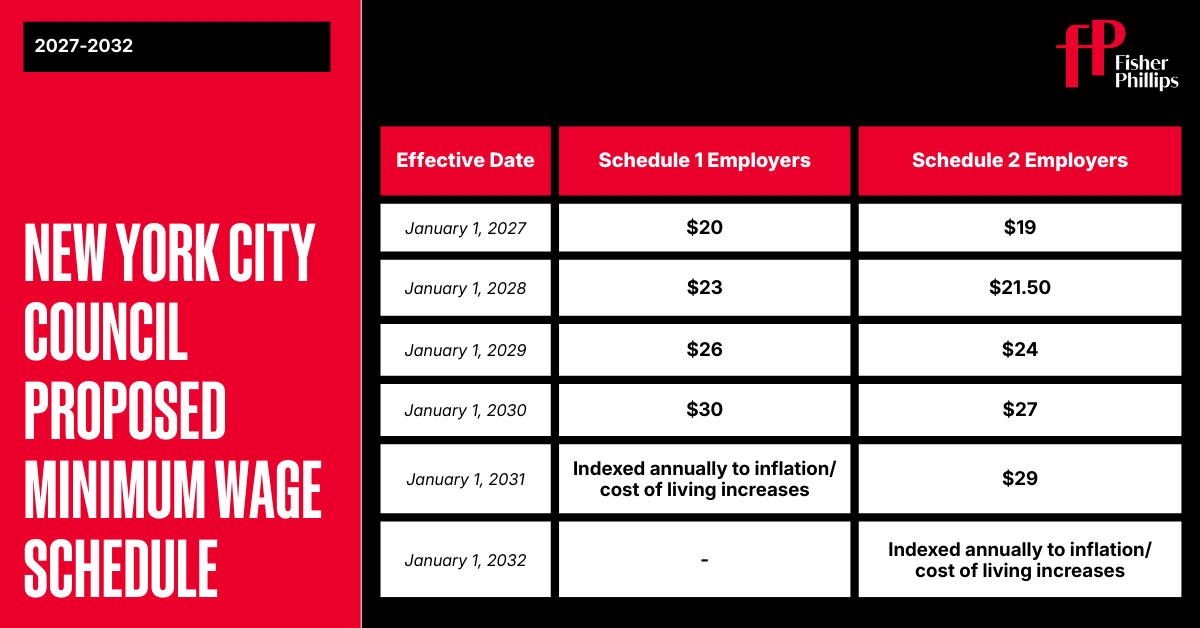
The proposed bill distinguishes between “Schedule 1” and “Schedule 2” employers.
Schedule 1 employers would include businesses with more than 500 employees nationwide, as well as franchisees associated with a franchisor that collectively employs more than 500 employees.
Schedule 2 employers would include employers with 500 or fewer employees across the country.
The proposed minimum wage schedule is as follows:
3. The proposed bill would phase out the tip credit for food service workers.
In addition to increasing the minimum wage, the proposed bill would phase out the tip credit for food service workers.
Under current law, tipped food service workers may be paid a lower cash wage so long as tips bring them up to the applicable minimum wage. Under the proposal, tipped workers could be paid a cash wage equal to at least two-thirds of the applicable minimum wage, provided tips bring them up to the full minimum wage. Beginning January 1, 2032, the required cash wage for tipped food services workers would increase by $1.50 each year until it matches the full minimum wage, at which point employers would no longer be permitted to claim a tip credit.
4. The proposed bill would impose robust notice, posting and recordkeeping requirements.
The proposal would impose substantial notice obligations. Each year, employers would be required to post a notice informing employees of the current minimum wage and their rights under the law. Employers would also need to provide the notice at time of hire hiring and annually thereafter.
In addition, employers would be required to maintain payroll and wage records for at least six years. Failure to maintain or produce those records would create a rebuttable presumption that the employer failed to pay the required minimum wage.
5. The proposed bill would prohibit retaliation.
The proposed bill would prohibit retaliation against employees who assert rights under the law, file complaints or assist in investigations. Adverse action within 90 days after an employee engages in protected activity would create a presumption of retaliation.
6. The proposed bill would authorize both administrative enforcement and private litigation – and penalties for violation would be steep.
The New York City Department of Consumer and Worker Protection (DCWP) would enforce the law through worker complaints, agency investigations, administrative proceedings and city initiated civil litigation.
Employees also would have a private right of action and could bring suit within six years of an alleged violation.
Available remedies would include back wages, interest, liquidated damages equal to twice the amount of underpaid wages, and additional civil penalties. Private plaintiffs could also recover attorneys’ fees. In retaliation cases, employers could face damages equal to the greater of three times the wages that would have been paid or $250 per day for each day the violation continued until final judgment. Additional penalties would apply to pattern-or-practice violations and to notice and recordkeeping violations.
7. You should begin preparing for this potential change now.
Although the proposed bill has not been enacted, employers with operations in New York City may want to begin evaluating the potential impact now, including by:
Reviewing workforce size and franchise relationships to assess whether they may fall within Schedule 1 or 2;
Modeling the payroll impact of the proposed wage increases;
Reviewing pay practices for tipped food services workers;
Evaluating whether current payroll, timekeeping and record-retention systems could accommodate the proposed requirements