
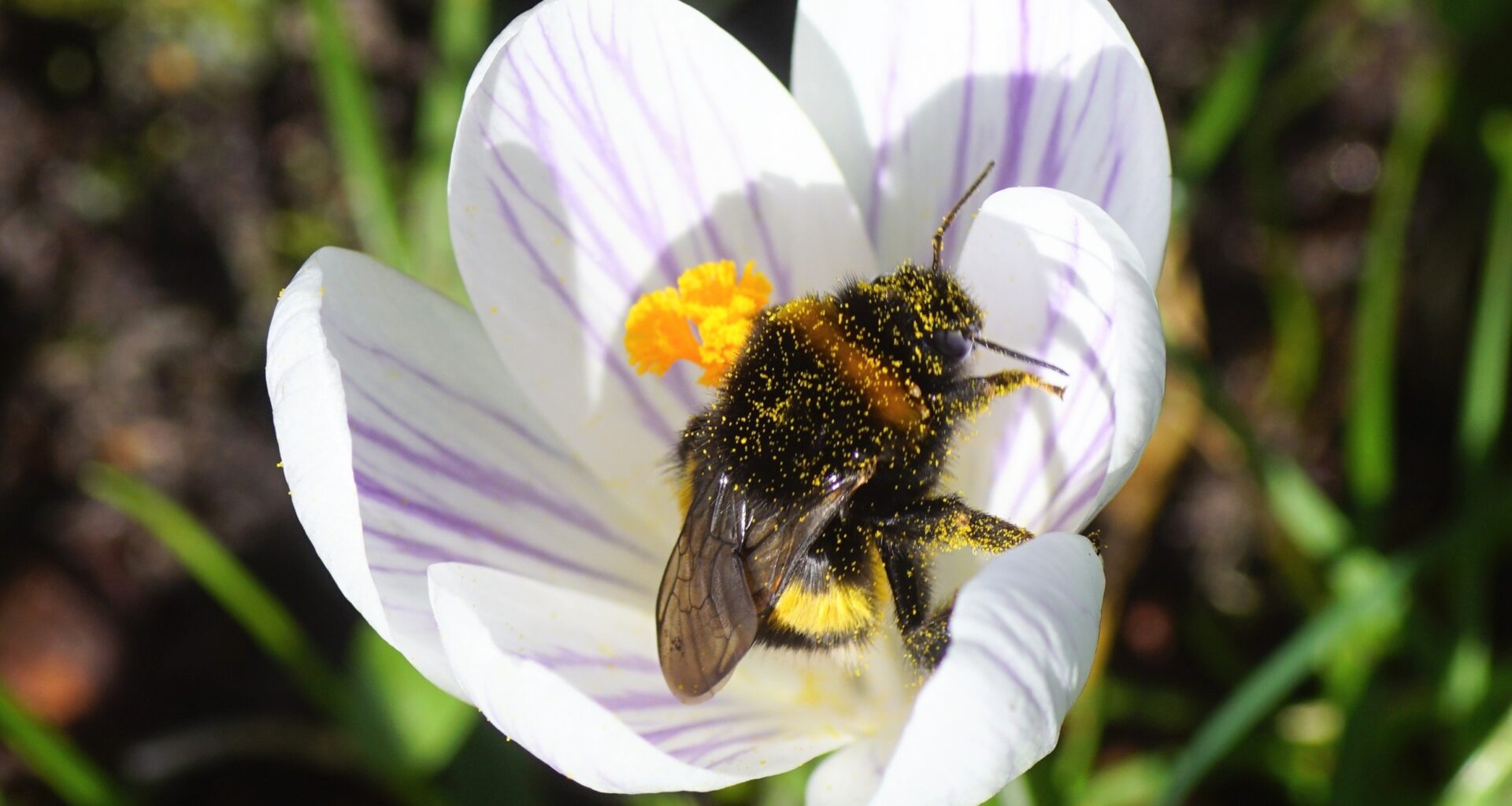
Spring floods can turn underground insect nests into temporary ponds. For most animals, that would mean certain death. But queen bumble bees appear to have an unexpected survival trick.
Researchers have discovered that dormant queens can stay alive for more than a week while completely submerged underwater.

The finding helps explain how these essential pollinators survive the flooding that often follows melting snow and heavy spring rains.
Because every bumble bee colony begins with a single queen emerging from winter dormancy, her survival determines whether an entire colony forms that year.
Understanding how queens endure flooding could therefore reveal how pollinator populations persist despite increasingly unpredictable spring weather.
Survival inside flooded nests
Buried beneath the soil during winter, dormant bumble bee queens can become trapped underwater when and seasonal rains flood their underground chambers.
Tracking what happened under those conditions, Dr. Charles-Antoine Darveau at the University of Ottawa showed that submerged queens continued releasing small amounts of carbon dioxide, evidence that gas exchange persisted even under water.
Those faint respiratory signals continued for days while the queens remained almost completely motionless in their winter dormancy.
Such endurance explains how queen bees can survive spring floods long enough to emerge later and begin building the next generation of colonies.
Dormancy helps queen bees survive
Months earlier, the queens had entered diapause, a programmed winter shutdown that slows the body after four to five months in cold darkness.
A 2024 study on Bombus impatiens found that this state pushes resting metabolism below five percent of normal levels. That extreme slowdown sharply reduces oxygen demand before the bees ever encounter water, leaving them with far less energy to sustain.
Once submerged, the queens did not rely on a single trick to keep their cells supplied with usable energy. Instead, they used a combination of strategies.
The insects continued taking in small amounts of oxygen from the surrounding water while also switching to anaerobic metabolism – a backup pathway that produces energy without oxygen.
That shift left chemical traces showing the bees had begun using the oxygen-free pathway. “They combine underwater gas exchange with anaerobic metabolism,” noted Dr. Darveau.
Evidence from underwater tests
Water around the insects changed in ways that strongly supported the breathing idea from a second line of evidence.
After eight days, tubes holding a queen contained less than 40 percent of the oxygen found in control tubes.
The team also detected carbon dioxide throughout the submersion period, even though the bees remained nearly motionless in their dormant posture.
Those measurements did not reveal exactly how gas crossed the body surface, but they ruled out simple breath holding.
Returning to air also carried a cost. Right after removal from the water, the queens’ metabolic rate shot upward and stayed elevated for two to three days.
“It’s essentially a recovery phase,” Dr. Darveau said, explaining that the spike matched the period when the bees cleared lactate – a residue produced during low-oxygen metabolism.
After about a week, the queen bees settled back to their dormant baseline, suggesting the flood imposed a temporary rather than lasting physiological cost.
One queen starts everything
In a bumble bee colony, everything begins with a single survivor. After winter, only a fertilized queen emerges from dormancy to start a new nest.
If spring flooding kills that queen before she lays her first eggs, the colony never forms. No workers, males, or future queens appear that year.
That is why the survival of one insect carries such weight. Bumble bees are key pollinators for crops and wild plants, so the fate of a single queen can ripple far beyond her underground chamber.
A queen bee that survives flooding protects more than herself – she safeguards the next generation of pollinators and the ecosystems and food systems that depend on them.
Past research suggested resilience
Earlier research had already hinted that bumble bee queens might be unusually resilient.
A previous study on the common eastern bumble bee, Bombus impatiens, found that submerged queens survived at remarkably high rates. Even after different depths and durations of submersion, about 89.5 percent of the queens remained alive.
But that result left scientists with an important question. Survival alone did not explain how the insects managed to stay alive underwater.
The new study fills in that missing piece. By linking survival to underwater gas exchange and chemical recovery after submersion, the researchers turned an unusual observation into a clearer biological explanation.
How queens breathe remains unclear
One part of the mystery still remains unsolved: exactly how the queens pull oxygen from the surrounding water.
The researchers suspect a thin layer of trapped air may cling to the bee’s body, acting like a tiny reserve of breathable air. Similar air films help some aquatic insects survive underwater.
At the same time, laboratory experiments cannot fully reproduce the messy conditions of real spring floods. Underground chambers may contain muddy water, very low oxygen levels, or fast-moving flow.
Because of that, scientists still do not know the true limits of this survival strategy outside the lab. The mechanism that allows queen bees to breathe underwater may ultimately determine how long they can endure flooding in the wild.
Weather raises the stakes
A major climate assessment has warned that warming intensifies rainfall and associated flooding in many regions. That broader pattern makes flood tolerance more than a curiosity – especially for insects that spend winter hidden in soil.
“Understanding these mechanisms helps us predict how bumble bee populations might cope with increasingly frequent spring floods,” Dr. Darveau said.
The study points to a compact survival system: deep winter slowdown, limited underwater breathing, and a short burst of recovery once air returns.
That combination will not spare every buried queen, but it helps explain why some colonies can still begin after a soaking spring – even when weather conditions threaten to erase a colony before anyone sees it.
The study is published in the journal Proceedings of the Royal Society B: Biological Sciences.
—–
Like what you read? Subscribe to our newsletter for engaging articles, exclusive content, and the latest updates.
Check us out on EarthSnap, a free app brought to you by Eric Ralls and Earth.com.
—–