
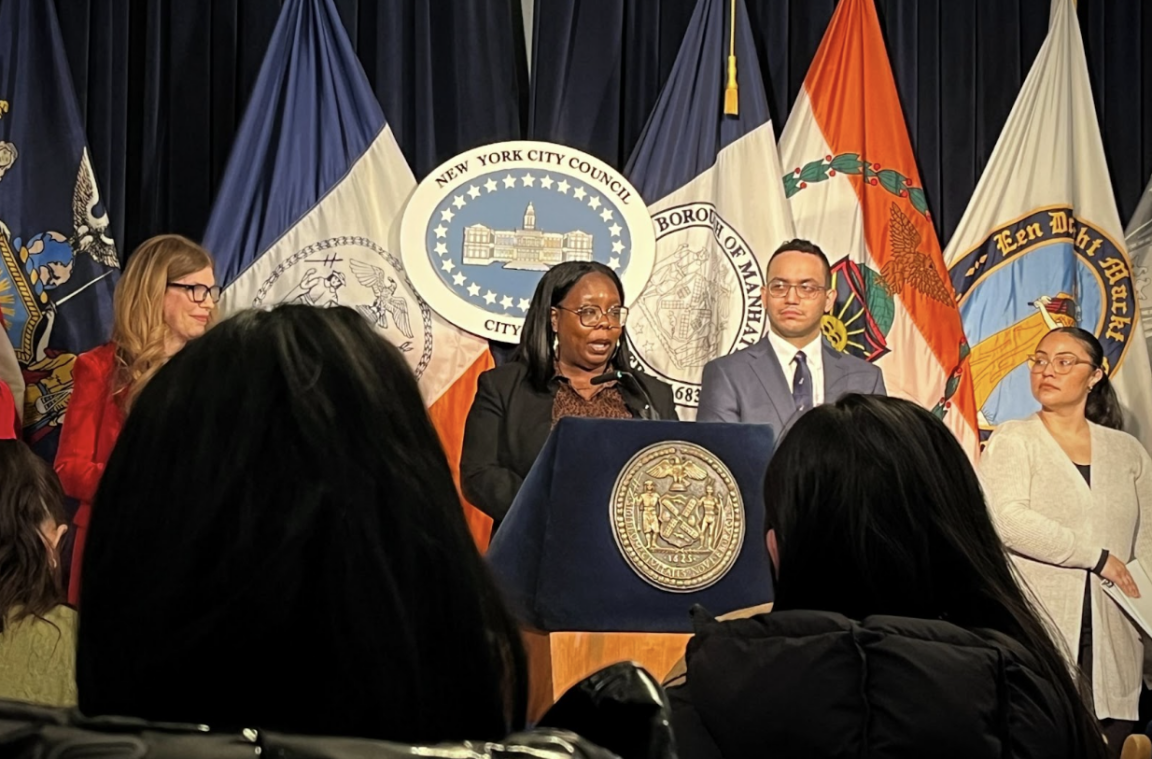
Mari Moss remembers her youngest child clinging to her leg when the caseworker came.
Eight years ago, Moss said the Administration for Children’s Services removed her three girls from their home. That was after she reported domestic violence from her husband, she said. Navigating court hearings and the child welfare system only added to their mental strain.
“It was compounded on and further traumatizing,” said Moss, who now serves as a community advocate in Harlem.
For kids, entering state custody is often traumatic. The New York City Council is considering legislation to improve mental health among foster youth. But by focusing on families already in the child welfare system, some advocates worry the city is missing a bigger imperative: preventing entry in the first place.
The Committee on Children and Youth is reviewing a new bill that would offer kids one year of free mental health care when they exit state custody. Councilmember Pierina Ana Sanchez introduced the legislation in January after a similar bill failed to pass in 2024. She did not return requests for comment.
Councilmember Althea Stevens, a co-sponsor, said transitioning out of foster care can disrupt health care routines, including mental health. She thinks the bill could help reduce that gap.
“We really need to be more creative,” Stevens said. “How do we get young people those services?”
Others are less keen on the idea. In 2024, senior ACS and health department officials testified that the bill’s services are already covered by public insurance programs like Medicaid. That includes psychotherapy, psychological testing, medication support and emergency psychiatric care, according to the bill’s text.
The bill specifies its services apply to children who exit foster care and “are unable to access mental health services at no cost,” but does not state whether children on public insurance programs would be ineligible. More than one-third of the nation’s youth rely on government-subsidized insurance, many of them from low-income families.
The bill would offer these services on a one-year pilot program. After, state officials would be required to assess the cost of expanding the program and making it permanent.
Meanwhile, some child welfare advocates worry the program would be ineffective for a different reason. Eligibility is tied to family history with ACS, an agency that families may associate with their separation.
“A lot of families want nothing to do with ACS at the time of reunification,” said Nora McCarthy, executive director of the NYC Family Policy Project. “That’s not to say parents don’t want reunification support. … But they wouldn’t really want support that seems close to the foster care system.”
ACS can take a child away if they have reasonable cause to believe their life is endangered. The city has a higher standard for removal than most, according to Richard Wexler, an anti-family removal activist.
Still, the agency is embattled with issues, including a mistake-prone call screening system and stark racial disparities. A 2025 report found that, by age 18, nearly half of the city’s Black youth underwent a child protective investigation. Most of those claims were later deemed unfounded.
“ACS workers almost always mean well. But if you’re five or six years old, that doesn’t lessen the trauma,” Wexler said.
Advocates like McCarthy and Wexler say the solution is to limit the agency’s power to monitor or separate families. Councilmember Stevens said calls to reduce the agency’s authority have become a familiar refrain, but that child welfare benefits from a continuum of support, including ACS.
“I don’t think it’s a problem that ACS is involved in this approach,” she said. “This is just another tool in the toolbox.”
Where activists, legislators and city administrators agree is that more must be done to improve mental health among foster youth. The debate, then, comes down to implementation. Since the bill is still early in the legislative process, there is time for public input and even revision.
For Moss’s part, adverse experiences with ACS have made her wary of engaging with the child welfare system at large.
“There’s a court to ACS pipeline,” she said. “And that to ACS pipeline is creating broken, traumatic individuals.”