
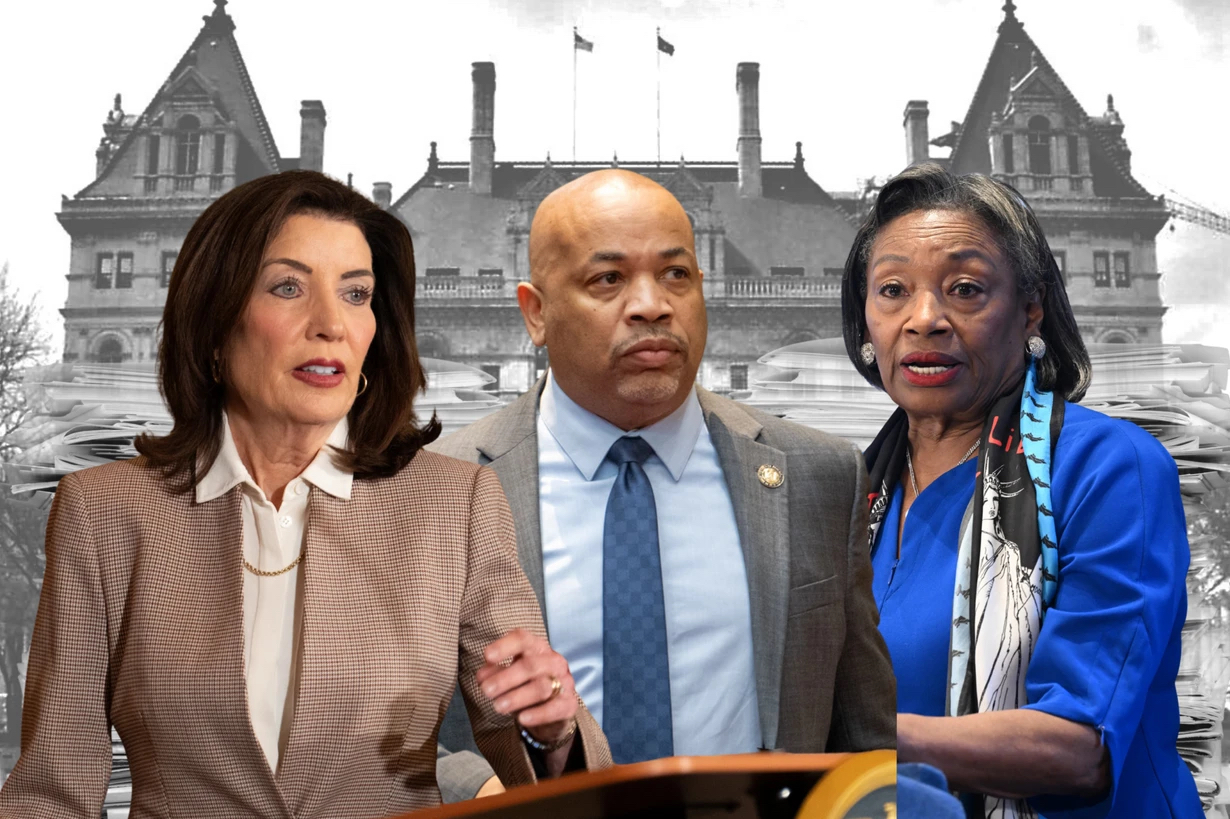
Gov. Kathy Hochul, the state Assembly and the state Senate have submitted their budget proposals. New York Focus compared the three spending plans to see how far apart the governor and legislators are.
By New York Focus
Albany’s leaders will hash out hundreds of policies in the next three weeks as they craft the state budget. Photos: New York state Assembly; Billion Images/Canva; Bill Badzo/Flickr; Aidin Bharti/Office of Governor Kathy Hochul | Illustration: Leor Stylar.
This story originally appeared in New York Focus, a nonprofit news publication investigating power in New York. Sign up for their newsletter here.
The Assembly wants to freeze your energy bills, the Senate wants to stop police from working with ICE, and the governor wants to slash auto insurance premiums. Albany’s leaders will hash out these and hundreds of other policies in the next three weeks, as they craft the state budget and decide how to spend $260 billion — and then some, if the legislature gets its way.
This week, the two legislative chambers released their counters to Governor Kathy Hochul’s executive budget. The biggest disagreement is on taxes; the legislature is once again proposing hikes on wealthy people and corporations to fund expanded social programs. This year, they have a notable ally in their corner: New York City Mayor Zohran Mamdani, who has aggressively pushed for more state revenue to help close the city’s budget gap. All eyes are on Hochul, who has so far resisted the idea.
But there’s much more to the battle than the headline numbers. Each of the three proposals are thousands of pages long, and they don’t make for light reading. We’ve been working around the clock to break them down for you.
In the chart below, you can see where each party stands on the highest-profile issues. Below that, you can find written descriptions. Happy budget season!
FISCAL POLICY
Where they’re split:
TAX THE RICH? The governor and the legislature are butting heads on whether to raise taxes in order to fund more programs and help cities plug their budget holes. The Senate and Assembly each proposed raising taxes statewide on wealthy individuals and corporations, as they have for the last few budget cycles.
The Senate proposed increases of 0.5 points on individuals earning above $5 million and 1.75 points on corporations earning at least $5 million. The Assembly backed a 0.2-point increase on individuals above $5 million, bigger hikes on the highest income brackets, and a 2-point hike on corporations with at least $10 million in income. The Assembly also proposed cutting income taxes for filers earning below $323,000.
Hochul did not propose new tax increases or income tax cuts, although she did propose extending a temporary increase on corporations through 2029.
Where they’re close:
TOTAL SPENDING: The total sizes of the three budget proposals differ by about $10 billion, less than a 3 percent difference in a budget over $260 billion.
Where they agree:
RAINY DAY FUND: The Senate, the Assembly, and Hochul all want to keep $14.6 billion in the state’s cash reserve. Building it to that level has been a significant accomplishment of Hochul’s first term.
SOCIAL SERVICES
Where they’re split:
MEDICAID: Hochul proposed $49.1 billion in state spending on Medicaid. The Senate proposal added $660 million in state-share Medicaid spending beyond Hochul’s proposal, according to a spokesperson for the Senate Finance Committee chair. The Assembly’s total proposed Medicaid spending was not immediately clear.
Hochul proposed $1.56 billion in increased funding for hospitals, nursing homes, and health clinics collectively. The Assembly proposed $862 million more than Hochul for the same providers.
The governor’s executive budget did not include a clear path forward for those who will be disenrolled this summer from the state’s Essential Plan — and neither do the Senate’s nor the Assembly’s proposals. The Senate proposed a new commission to make a plan by July outlining paths forward for the state’s health care system after cuts. The Assembly proposed a contingency fund to offset costs for a subset of Essential Plan enrollees that it is legally required to cover. That fund would not support the 470,000 individuals that the Fiscal Policy Institute estimates are set to lose coverage.
HUMAN SERVICES RAISES: The governor’s budget proposed a 1.7 percent bump in payments for human service providers contracted by the state — an amount that advocates say doesn’t match inflation from the past year.
Both the Senate and Assembly want to see an overall 4 percent increase, but they disagree on how much of that should go toward worker raises. The Senate wants 1.3 percent, while the Assembly wants to see 2.3 percent.
Hochul’s proposal did not specify how much of her increase would go to salaries. Nonprofit providers, which make up the backbone of New York’s safety net, have long complained of stagnant wages that have fueled high turnover and persistent vacancies.
FOOD ASSISTANCE: The governor proposed minor increases to New York’s nutrition programs, which support the state’s vast network of emergency food providers.
The Senate and Assembly want bigger investments to account for massive cuts to the federal Supplemental Nutritional Assistance Program. Both chambers want to boost funding for the state’s two feeding programs to $75 million each — $9 million more than the governor’s proposal — and call for a total of $8.5 million — up from Hochul’s $3.7 million — to support community navigators, which help residents enroll and renew their SNAP benefits.
IMMIGRATION
Where they’re split:
IMMIGRANT LEGAL SERVICES: Hochul proposed keeping funding for the Office for New Americans — a state body that funds immigrant legal services, job readiness programs, and language access — flat at $72.4 million. The Senate and Assembly proposed increasing that figure to $183 million, to fund emergency legal services and invest in providers’ long-term capacity.
BIVENS ACT AND SENSITIVE LOCATION PROTECTION ACT: Hochul proposed legislation that affirms the right of sensitive locations, such as churches, hospitals, and schools, to refuse entry to federal officers without a judicial warrant. Her budget would also enshrine the right of people to sue federal officers after an alleged violation of their constitutional rights.
The Senate and Assembly did not include those policies, but indicated they would work on the issues outside of the budget process.
SANCTUARY POLICY: The Senate said it was prepared to negotiate “comprehensive” new protections for immigrants. Senate Majority Leader Andrea Stewart-Cousins told reporters that she hopes to get “as close as possible” to New York For All, which prohibits formal and informal collaboration between local police and federal immigration enforcement.
In the past, Hochul has strongly opposed sanctuary legislation. But after ICE activity in Minnesota resulted in the deaths of two US citizens, Hochul put forth her own policy in January to restrict collaboration, the “Local Cops, Local Crimes” Act. It bans formal contracts between local and federal agencies, but not informal collaboration.
CHILD CARE
Where they’re split:
WORKFORCE RAISES: Lawmakers largely backed Hochul’s sweeping child care proposal, but a central fight in the coming weeks will likely be over pay and staffing challenges for providers. For the second year in a row, the Senate earmarked $500 million to raise pay for child care workers, who earn an average of $38,000 a year.
Neither Hochul nor the Assembly proposed funding boosts. Advocates have said the child care sector can’t grow without addressing staffing shortages.
Where they’re close:
STATEWIDE PRE-K: New York has long subsidized public pre-K, but thousands of children still lack access because their districts have limited seats or don’t offer the program at all. Hochul wants to invest $1.6 billion to nearly double per-pupil funding for 4-year-olds to at least $10,000, and to impose a universal pre-K mandate on school districts for the 2028–29 school year.
Lawmakers accepted the plan with modest tweaks: The Senate wants to provide transportation aid for pre-K, and the Assembly wants to cover 3-year-olds under Hochul’s proposed per-pupil amount.
CHILD CARE ASSISTANCE PROGRAM: Hochul called for a $1.2 billion boost for the state’s child care voucher program, which helps families with children between 6 weeks old and 13 years old afford care. Funding shortfalls in the past year have forced many counties to halt enrollment in the program or delay payments to recipients.
The Senate accepted Hochul’s proposal without adding funds, while the Assembly added $18.7 million to remove minimum wage eligibility requirements for voucher recipients.
Where they agree:
NEW YORK CITY CHILD CARE: Lawmakers signed onto Hochul’s $1.2 billion proposal to fund child care and early education in New York City, including $73 million to launch 2,000 2-K seats in four neighborhoods this fall.
The plan would also invest $205 million to expand access to the city’s 3-K program, which has struggled with uneven seat distribution, accessibility gaps for students with disabilities, and funding cuts under former Mayor Eric Adams.
CLIMATE, ENERGY, ENVIRONMENT
Where they’re split:
CLIMATE ROLLBACKS AND FUNDING: Hochul has made clear she wants to relax New York’s climate mandates, but has not put new legislative language on the table. The Senate and Assembly did not do so either and instead proposed renewing a $1 billion clean energy fund created last year, signaling that they want to stay the course on climate.
Hochul said on Wednesday she still intends to propose rollbacks in closed-door talks with legislative leaders over the coming weeks. For now, the two chambers’ unified $1 billion push sets up this year’s clearest fight over the next steps in the green transition.
UTILITY BILL RELIEF AND REFORMS: The three chambers agree that energy affordability is a priority this year, but diverge on how to address it. Hochul proposed a package of four bills reforming how the state’s Public Service Commission regulates utilities, which would tie executive pay to affordability metrics; reform the rate hike process, with the aim of making it more transparent and limiting increases; and prevent certain utility shutoffs, among other changes. The Senate largely took Hochul’s proposals on board, with modifications. It also wants to put $200 million toward the utility-managed Energy Affordability Program.
The Assembly wants to take more drastic measures. It cast aside Hochul’s reform proposals in favor of a two-year moratorium on electric and gas rate hikes, during which a new commission would study longer-term reforms to contain costs. And it wants to distribute $2.6 billion in rebate checks to customers, giving $300–$500 to households earning less than $300,000.
EMPOWER+: Hochul put $50 million in her budget for Empower+, a key program that helps low- and moderate-income households pay for home efficiency upgrades. She said that should be enough to keep the program stable, along with additional funds coming from outside the budget. But the legislature wants a bigger boost. Both chambers accepted Hochul’s number and put an additional earmark for Empower+ in their $1 billion climate fund, with the Assembly proposing at least an extra $80 million each this year and next, and the Senate an extra $150 million this year.
Where they’re close:
EXCELSIOR POWER: Hochul wants to give New Yorkers $300 worth of bill credits to install smart thermostats and allow their utilities to adjust them when the grid is strained. It’s a step toward achieving a more flexible energy system, which experts say could save money and cut pollution. The Senate and Assembly are on board, but they want additional guardrails to protect privacy and guarantee customers’ ability to override utility control of their thermostats.
ENVIRONMENTAL PROTECTION AND CLEAN WATER FUNDING: Hochul proposed renewing last year’s $425 million for New York’s Environmental Protection Fund, a flagship program to conserve state lands and waters. The legislature, like last year, is seeking to increase the amount to $500 million.
As usual, the Senate and Assembly are also seeking more funding for clean water. Hochul proposed maintaining funding for the state’s core water infrastructure program at $500 million; she also wants to add $250 million for sewer infrastructure tied to housing initiatives, with $50 million of that reserved for upgrades in rural areas. The Senate is largely on board but proposed about $140 million more, with the bulk of that earmarked for replacing lead pipes. The Assembly wants to scrap most of the sewer funding, match the Senate’s proposal on lead pipes, and adjust the other allocations, for a total of $800 million.
NEW YORK CITY
Where they’re split:
CITY TAXES: In addition to the statewide tax hikes, the Senate and Assembly proposed raising taxes on wealthy people and corporations in New York City, helping Mayor Zohran Mamdani close the city’s budget deficit.
Both houses want to raise the city’s corporate tax rates by about 1.8 points and increase the tax on unincorporated businesses by 0.4 points. They would also raise the mansion tax for homes sold for over $5 million; cut the city’s Pass-Through Entity Tax credit from 100 percent to 75 percent; and end a sales tax exemption on gold bars. Those actions would raise a combined $3.1 billion per year.
The governor did not propose any new taxes for the city.
Subscribe to our free weekly newsletters
FREE BUSES: The Assembly proposed putting $15 million toward a pilot of the fare-free buses Mamdani wants, and the Senate voiced vague support for a similar program. (Citywide free buses would cost many times that amount — close to $1 billion annually.)
Hochul did not offer any support for free buses.
Where they’re close:
STATE AID TO THE CITY: Both Hochul and the legislature want to send the city more money. Hochul proposed giving the city $1.5 billion through a mix of basic aid and reversals of previous cuts and cost shifts. The legislature agreed with that proposal and went further, with each house proposing more than $1 billion total in additional aid for education, shelters, and low-income families, plus more open-ended funds through the Aid and Incentives for Municipalities program.
HOUSING
Where they’re split:
CUTTING RED TAPE: Hochul and the Senate both proposed making it easier to build new housing through significant changes to the State Environmental Quality Review Act, which governs New York’s environmental review process. This is a top priority for the governor, and also a goal of New York City Mayor Zohran Mamdani.
There are differences between the proposals. The Senate wants to focus the exemptions on cities, allow bigger buildings to take advantage of the change, and maintain screenings for “minimum environmental and infrastructure standards” even when the longer review is skipped.
The Assembly left this measure out entirely.
PUBLIC HOUSING FIXES: The Senate and Assembly put hundreds of millions toward repairs for New York City’s public housing, which needs an estimated $80 billion’s worth. Hochul didn’t push any new money for this purpose.
AFFORDABLE HOUSING TAX BREAK: The governor and Senate proposed an expansion and extension of a key tax break, known as J-51, that funds repairs and upgrades for affordable housing. The measure would allow owners to seek a property tax reduction equal to the full cost of improvements, up from the current 70 percent rate.
Though the Assembly has supported similar measures in the past, it did not include one in its budget proposal this year.
EDUCATION
Where they’re split:
FOUNDATION AID: The governor and legislature are divided on how to best fund New York schools.
Hochul’s proposal would keep the Foundation Aid school funding formula unchanged and includes a 1 percent minimum bump over last year for all school districts, bringing her total to $27.1 billion. The Senate and Assembly both want to amend the formula to increase funding for students experiencing homelessness, those in foster care, and English language learners. They also proposed a minimum 2 percent funding boost for districts.
The Senate’s plan would cost $285.3 million more than Hochul’s, while the Assembly’s would add $630.6 million.
SUNY FUNDING: Hochul proposed allocating $14.7 billion to the State University of New York system, roughly $1 billion less than last year. The Assembly would increase that amount by nearly $11 billion — largely for capital projects. The Senate called for a smaller funding boost, adding $1.8 billion to the executive budget.
CUNY FUNDING: Lawmakers proposed boosting funding for the City University of New York system, mostly for capital projects. Hochul’s budget includes $6.4 billion for the system, about $211 million more than last year. The Senate would add another $1.9 billion, while the Assembly proposed $8.7 billion more than the governor.
MAYORAL CONTROL: While Hochul backed Mamdani’s request for a four-year extension of mayoral control of city schools, neither the Senate nor the Assembly included it in their budget proposals.
Where they agree:
BACK TO BASICS: The Senate and Assembly both gave their stamps of approval to Hochul’s Back to Basics math initiative, which would require the State Education Department to provide school districts with best practices for teaching math to elementary school students.
The proposal builds on the “science of reading” legislation, enacted in last year’s budget, which requires districts to align their curricula and instruction with evidence-based reading instruction.
CRIMINAL JUSTICE
Where they’re split:
PRISON REFORMS: Hochul proposed no prison reforms in the budget, and wants to eliminate state funding for the Correctional Association of New York, a prison oversight body that got a resource boost in last year’s budget.
The Senate proposed re-upping funding for CANY and included a version of the CARE Act, which would establish a bill of rights for pregnant incarcerated people, in its budget proposal. The Assembly included neither of those measures, but proposed ordering the State Commission of Correction, another oversight body, to hire a chief medical examiner to conduct independent investigations into jail and prison deaths.
HOUSES OF WORSHIP PROTESTS: In her executive budget, Hochul proposed a bill that would ban protests within 25 feet of the entrance of a house of worship. The proposal garnered pushback from free speech proponents, including the New York Civil Liberties Union, and neither legislative chamber kept it in their budget legislation. The Assembly fully axed the measure, while the Senate proposed a different bill that would make it a misdemeanor to obstruct the entrance to a house of worship.
Where they agree:
NEW YORK CITY SUBWAY POLICING: New York City’s reported subway crime hit a 16-year low last year. Hochul, who has funneled tens of millions of dollars to increasing subway patrols and deploying the National Guard in subway stations, still proposed giving the New York City Police Department $77 million to ramp up subway patrols. The Senate and Assembly both kept that funding in their proposals.
PAROLE AND SENTENCING REFORMS: Parole and criminal sentencing laws have, for years, been a top target of New York’s criminal justice reform movement. But none of advocates’ flagship bills have made it into past years’ budgets or moved to a vote in the legislature during the regular session.
This year, so far, is no exception: Neither Hochul nor the Assembly or Senate used their budget proposals to put forward legislation that would release elderly prisoners, let incarcerated people earn time off their sentences, or make it easier for the parole board to grant parole.
CAR INSURANCE
Where they’re split:
LIMITING INSURERS’ LIABILITY: Hochul is seeking to reduce auto insurance premiums by curtailing insurance companies’ liability for car accidents in some circumstances. Both the Senate and the Assembly omitted Hochul’s proposals.
The Senate also proposed cutting half of the $2 million in new funding Hochul wants to spend on combatting insurance fraud. Both chambers rejected Hochul’s planned reorganization of a 12-person board that distributes funds for local law enforcement grants, with the Senate saying that the issue was best addressed outside the budget process. The Senate said the same about Hochul’s proposal to increase penalties for crimes involving insurance fraud, and the Assembly also omitted that proposal.
Zachary Groz and Elsie Carson-Holt contributed research.
posted 5 hours ago – March 13, 2026