
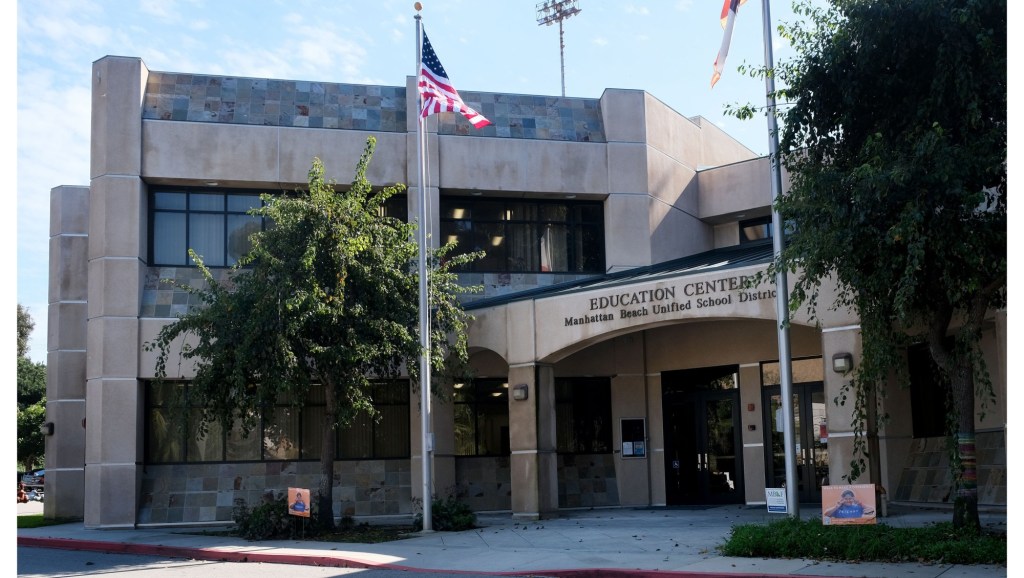
Some Manhattan Beach Unified School District employees could soon lose their jobs so the district can free up some money.
The district’s Board of Trustees recently approved nearly 60 potential layoff notices as it looks to reduce expenses to balance the budget after years of deficit spending.
At a meeting this week, the board approved the district’s second interim budget report, a snapshot of finances from November through January. Although budget projections can change in the coming months, layoffs still loom as district revenue remains uncertain until the state education budget is approved this summer.
Last month, the board approved the potential layoff notices. Those employees were recently notified via pink slips ahead of the Sunday, March 15, state deadline for districts to do so.
Of those, about 40 are certificated positions, which include roles like special education, math and science teachers, substitutes, and counselors and specialists. Around 15 are classified positions, which include support staff like assistants, secretaries, custodians, bus drivers, food service employees and information technology. Three are administrative positions like program directors and principals.
Notice of the layoffs has been “demoralizing, depressing and feels like educational malpractice,” Manhattan Beach Unified Teachers’ Association President Aaron Kofahl said in a Friday, March 13, phone interview. “If we care at all about education in this community, we cant do it.”
Teachers were in tears at association meetings after the notices were handed out, Kofahl said, worried that their job performance had brought them to this point.
“The real impact is on the stability of the district and the experience of the students,” Kofahl said. “Our educational services are being undermined and compromised by the way this district is making choices about its budget.”
But everyone may not hold out to see what happens. When teachers are told they might lose their positions, Kofahl said, many of them look for new jobs.
“We can’t expect them to stick around and wait to see if they have a job next year,” Kofahl said.
There are teachers who have worked in the district for 12 to18 years who received notices, Kofahl said. To fill veteran educators’ roles with cheaper, newer teachers does not suffice, he added.
“While we do some great hiring here,” he said, “there’s no replacement for experience.”
Those who received pink slips earlier this month will find out on April 29 whether they’ll get final layoff notices.
“While improved conditions may allow the district to reconsider preliminary notices,” MBUSD Superintendent John Bowes said in a recent announcement, “any decisions will be made only after thoughtful evaluation of the budget outlook, staffing needs and long-term financial stability.”
All employees who received a notice have the right to request an administrative hearing to verify the accuracy of the seniority list and the procedural execution of the notices, Bowes added.
Kofahl, who has worked in MBUSD for 12 years himself, said, “seeing folks I started (working here) with get pink sipped — that’s a scary thing.”
MBUSD last considered nearly 40 layoffs in 2024 to prepare for anticipated future funding reductions.
A multiyear projection shows that without reductions, Deputy Superintendent Dawnalyn Murakawa-Leopard said at this week’s board meeting, there will be an ongoing deficit that grows year after year as expenses rise. As of now, the district wouldn’t have enough money to cover economic uncertainties or anything else without cuts, she said.
Without reductions to the budget, the district anticipates being more than $6 million in debt by the 2027-28 school year. With the reductions, it projects having a more than $8 million surplus by that time.
“We have to do something to change this picture,” she said. “With reductions, we show a surplus rather than a deficit. That brings us in line to show a positive budget.”
Three-fourths of the budget is spent on employee salary and benefits, Murakawa-Leopard said, including pensions, workers compensation and social security. Costs of employee health benefits have also been on a steep increasing trend, she said.
Morale, however, also drops among teachers who are pink slipped, said Kofahl, a social studies teacher at Mira Costa High School.
“Teachers are coming to work every day,” he said, “but it’s hard to feel that push to give 110% when you feel the district doesn’t value you.”
MBUSD teachers want to see the district make better decisions, Kofahl said, and not look to employees as the first piece of fat to cut from the budget.
“Our big question right now is, ‘Where is the money going?’” Kofahl said. “(Layoffs are) collateral damage of poor decision making at the district level.”
Kofahl also said he has colleagues who have gotten pink slipped six times while they’ve worked at MBUSD.
“We’ve been doing this dance a long time,” he added.
The students, he said, are the ones who will ultimately be the most impacted. Class sizes have increased over the years, from the high 20s when Kofahl arrived at the district in 2014, to now up to 37 children in a typical class.
“People are looking at how they could possibly fit any more desks in their classrooms,” Kofahl said.
That’s likely to jump to at least 40 next school year, if more teachers are cut, he added.
“It hurts our ability to deliver the best possible service to our students,” Kofahl said. “It’s hard to get to know a student in a room of 36 other kids.”
It’s very difficult to get to know a student, give them individualized instruction and leave meaningful feedback on classwork, Kofahl said. Teachers are having to work longer hours at home late at night to deliver the same level of instruction.
The teachers’ association, Kofahl said, is trying to convince district officials that reductions in force are not a viable solution to budgetary issues.
“If we actually care about the quality of educational services in this district, there needs to be another way to address this,” Kofahl said. “Our district’s apporach has always been layoffs as a temporary fix, and we need to figure out a better way.”
Teachers’ association members plan to attend the March 25 board meeting to speak about the consequence of the layoffs, Kofahl said.
Since the first budget report of the 2025-26 year, the district has made $1.05 million in revenue and has $665,000 in expenses.
Even with a bit left over for the current year, continuing to spend without cutting any costs will keep digging the district into a hole, Murakawa-Leopard said at this week’s board meeting. Expenses, she added, often grow at faster pace than revenues.
MBUSD, Murakawa-Leopard said, is among the lowest-funded districts in California.
“We get thousands (of dollars) less per student than other districts in the county or state,” Murakawa-Leopard said.
All school districts across California receive the same amount of money in base education grants, but “high needs” districts get larger supplemental grants.
MBUSD is not one of those, so it relies on local funding on top of state education funds to maintain programming.
MBUSD has faced an ongoing deficit for the past eight years. In the 2024-25 school year, for example, revenue grew by $20 million, while fixed costs grew by $23 million.
Over time, the amount of positions paid for by Measure MB funds has steadily declined from 27 in the 2018-19 school year, according to the budget report, down to an anticipated 17 for the rest of the 2025-26 school year. Measure MB is a 2024 parcel tax extension that collects $2.5 million annually to maintain programs and small class sizes for six years.
Financial decline has also affected MBUSD’s credit rating, a score used to determine districts’ ability to pay back bonds. MBUSD’s rating has dropped to AA- from a previous AAA, Murakawa-Leopard said, because of the impact on reserve fund levels.
“When reserve levels fall and we have ongoing deficit spending,” she said, bond issuers are “concerned about our financial health.”
New bonds may need to be issued as soon as next year, she added, so the district has to get busy ramping that back up as well.
MBUSD may be able to hold back on cuts if the state equalizes special education funding, Murakawa-Leopard said, and if the state’s proposed $2.8 billion Student Support and Professional Development Discretionary Block Grant passes.
The board has until June 17 to adopt its final budget, while the state has until June 30. MBUSD will have 44 days after the state budget approval to make any changes to its own budget — reflecting the uncertainty around upcoming state funding.
The board is also looking at reducing the contribution to its reserve fund from 5% to 3%. Board member Jen Fenton, however, said that the board needs to find ways to increase reserves rather than reduce them.