
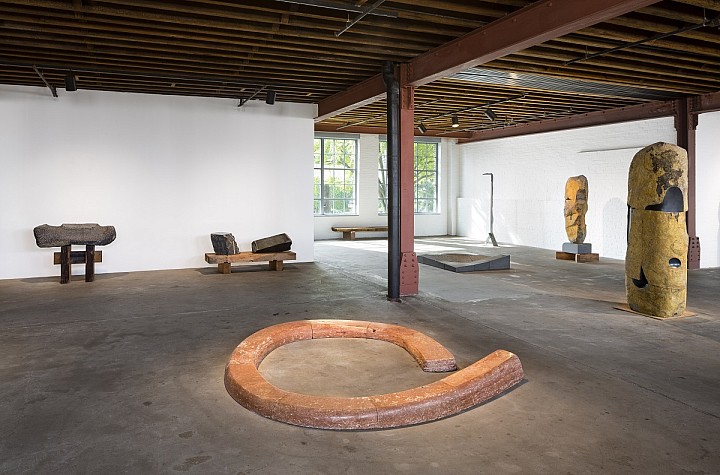
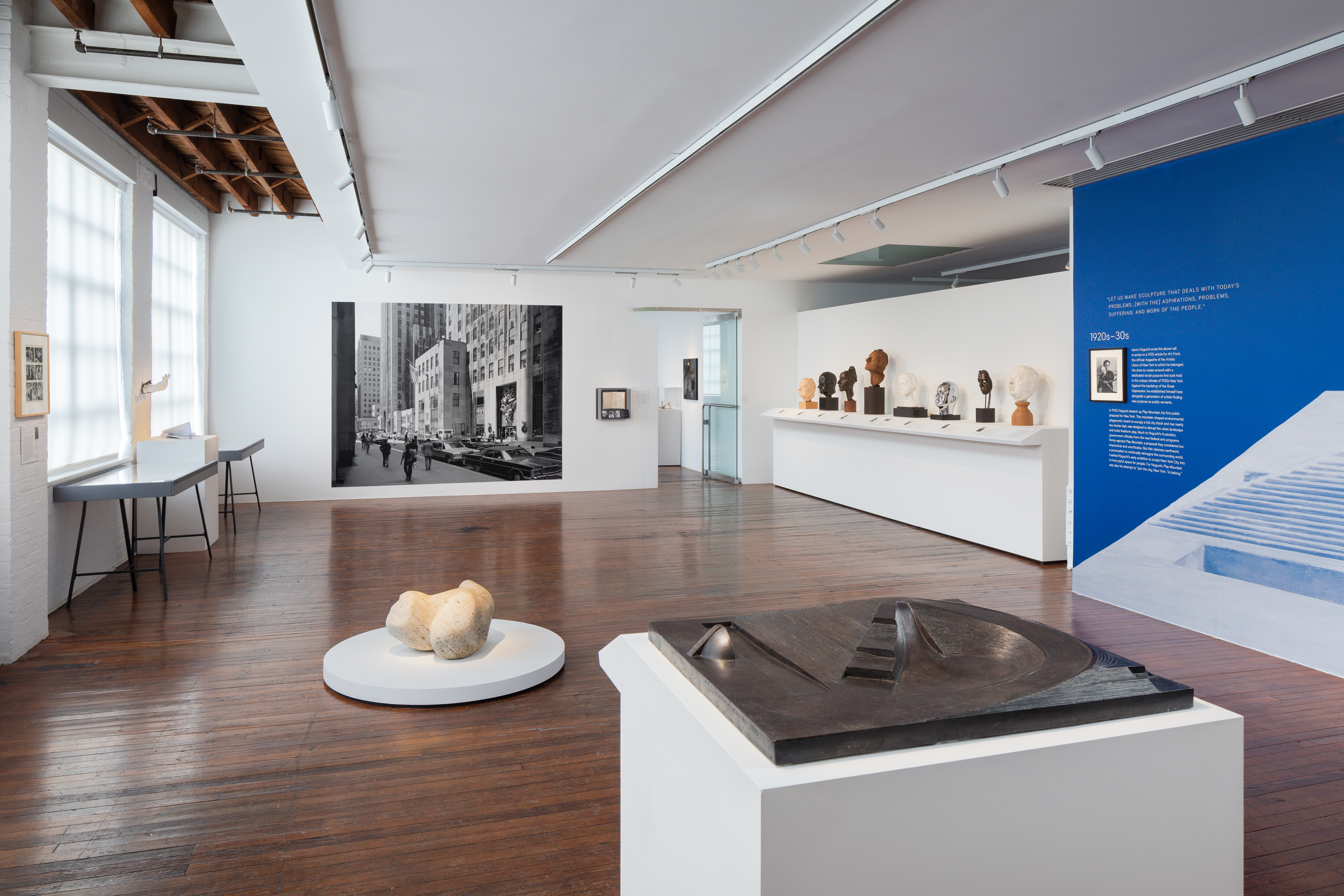
 Installation view, Noguchi’s New York, The Noguchi Museum, New York. Photo: Nicholas Knight. © The Isamu Noguchi Foundation and Garden Museum, New York / Artists Rights Society
By KUN SOK, March 14th, 2026
“Noguchi’s New York,” currently on view at the Noguchi Museum, unfolds on the museum’s second floor. Through plans, correspondence, photographs, models, and animated reconstructions of unrealized playgrounds, the exhibition presents Isamu Noguchi as a civic idealist- an artist who reimagined public sculpture as an active social force, capable of reshaping the city into a more humane and joyful environment.
The show is dense with archival material. We encounter the 1933 proposal for Play Mountain, successive revisions of the Riverside Park playground developed with Louis Kahn, and multiple schemes for sculpture gardens that never materialized. Projected animations imagine children traversing sloped terrains and sculptural landscapes. Together, these materials situate Noguchi’s practice not merely within the domain of sculpture, but within an expanded field of urban thought.
The curatorial emphasis on documentation is deliberate and illuminating. The second floor reveals the structure of Noguchi’s thinking—his repeated attempts to negotiate with administrators, planners, and institutions in order to introduce radically different forms of public space. It clarifies the scale of his ambition and the persistence with which he pursued it. Yet after spending time among these documents, I found myself drawn elsewhere.
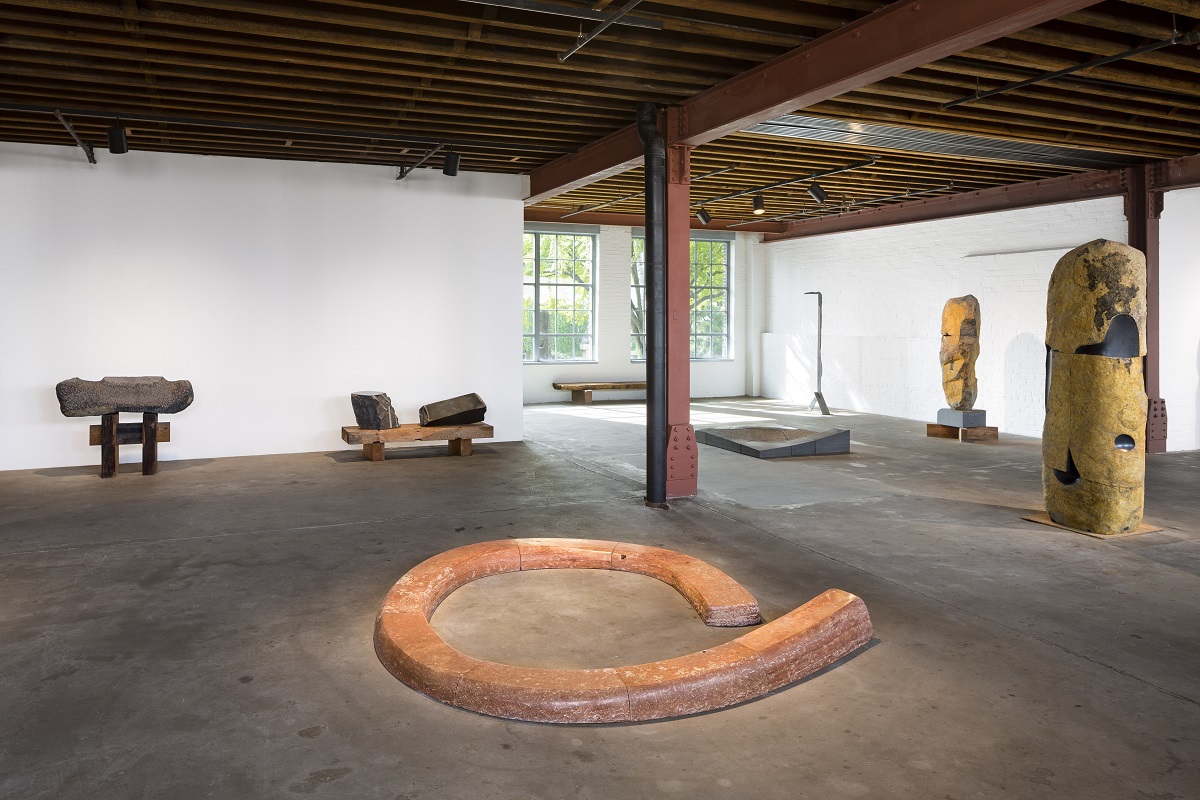 The-Noguchi-Museum-New-York-Area-3–photo-Nicholas-Knight Photo: Nicholas Knight. © The Isamu Noguchi Foundation and Garden Museum, New York / Artists Rights Society
That movement was not a departure from the exhibition but its continuation. To more fully understand what New York meant to Noguchi, one must descend. On the museum’s ground floor and in its garden, Noguchi’s sculptures stand without animation or explanatory diagrams. There are no projected futures here—only stone, bronze, marble, and wood. These works demand movement rather than interpretation.
What becomes immediately apparent is their refusal of a single orientation. There is no privileged front, no stable center. Each piece must be circled in order to be understood. A polished surface yields to a rough fracture; a solid mass reveals precarious equilibrium when viewed from another angle. Smooth and jagged planes coexist. Volume shifts with each step. These sculptures resist summary. In this, they resemble New York itself. The city is not symmetrical. It offers no singular viewpoint. It requires continual adjustment and negotiation. It is abrasive and refined at once, fragmented yet strangely coherent. Diversity does not dissolve into chaos; tension does not negate balance.
It is here that the exhibition’s two floors begin to interact productively. If the second floor articulates Noguchi’s civic imagination through archival narrative, the first floor materializes that imagination spatially. The documentation provides context; the sculptures provide embodied experience. Moving between them, the exhibition feels less like a historical account and more like a dialogue between proposition and presence.
The archival material reveals ambition on a grand scale. Noguchi repeatedly proposed playgrounds, plazas, and sculpture gardens for New York. Some were rejected outright. Others were altered or postponed indefinitely. It is tempting to read these unrealized works solely as evidence of institutional shortsightedness. Yet civic space operates within constraints—engineering, funding, maintenance, compromise. Idealism does not automatically translate into policy.
What is striking, however, is how little of that uncertainty enters the sculptures themselves. In stone, Noguchi was exacting. The weight of granite, the density of marble, the tensile quality of bronze—these materials are handled with disciplined intelligence. The variety of forms does not feel scattered but exploratory, as though each work tests a different relation between gravity and openness. Instability is measured; asymmetry is deliberate.
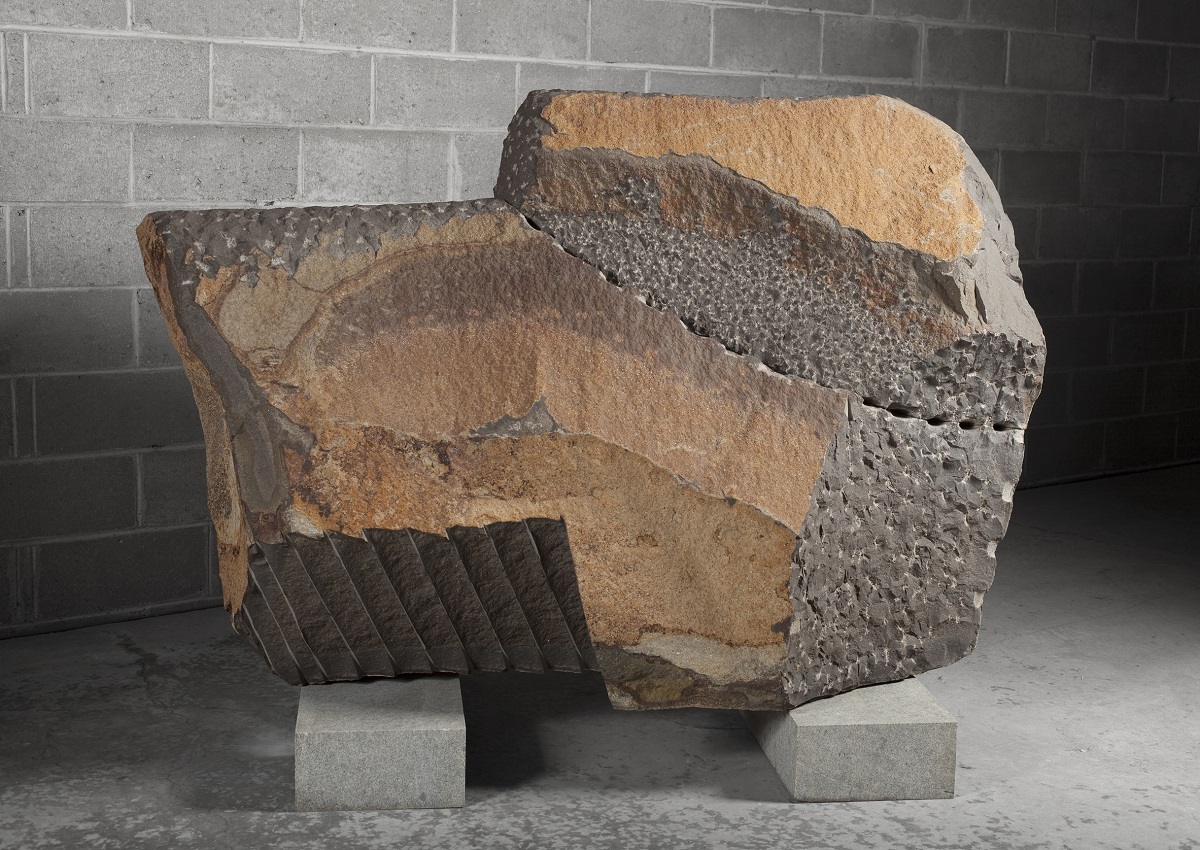 Isamu Noguchi, Give and Take, 1984. Basalt. The Noguchi Museum Archives, 1071. © The Isamu Noguchi Foundation and Garden Museum, New York / Artists Rights Society (ARS)
Noguchi once declared that he was “not Japanese, not a citizen of the world, just a New Yorker.” The statement can sound declarative, even defiant. For him, New York was not merely a residence but a chosen identity—something asserted rather than inherited. A century later, such confidence feels more complex. For many people living in New York in the twenty-first century, that certainty may seem unfamiliar. The city remains multilayered and magnetic, yet it is also rough, uneven, and saturated with cost and competition. Whether one chooses to persuade the city or to depart from it is no longer a simple matter.
Noguchi did not depart. He continued to propose, to revise, to insist. There is something almost childlike in that persistence—not naïve, but grounded in the belief that the world can be reshaped through form. There is something quietly radical in that insistence, though it manifests less as rhetoric than as structure. The absence of a fixed front, the invitation to circle, the equilibrium that holds without symmetry—these are not merely formal decisions. They constitute a spatial ethic.
Ultimately, “Noguchi’s New York” may be located on the second floor, but his New York emerges most fully through the exchange between floors. The exhibition narrates what he hoped the city might become. The sculptures demonstrate what he had already achieved: a spatial language capable of holding multiplicity without collapse.
Walking through the museum, one moves not simply between objects but between imagination and embodiment. In that movement, New York becomes less an abstract ideal and more a lived, sculptural condition.