
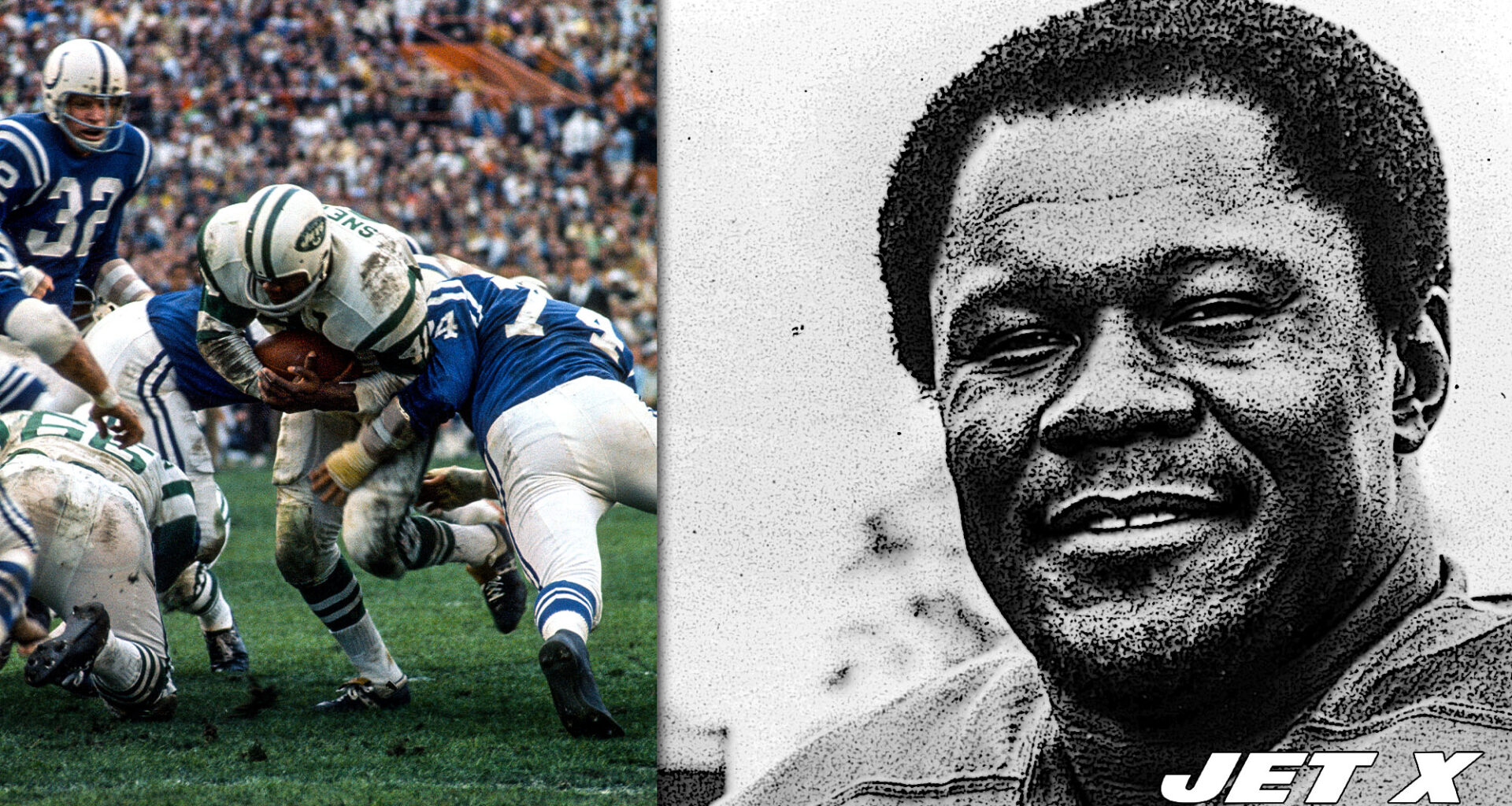
Matt Snell’s passing — at age 84 — on Tuesday, March 10, 2026, nearly marks the end of an era that features the New York Jets’ birth as a football franchise. It leaves Joe Namath as the only larger-than-life surviving figure among the 20 still-breathing members of the 1968 team.
Matt, Joe, Gerry Philbin, Larry Grantham, and a few others were crucial figures in the first decade of the Jets, but it was Matt who led the way to Jets respectability.
Learn More about Beyond Broadway Joe: The Super Bowl TEAM That Changed Football
Origins
In 1964, Ohio State stand-up defensive end and fullback (collegians played both sides of the ball back then) Matt Snell became one of the first significant college players to sign with the American Football League’s New York Jets football club. His decision was powerful evidence that Jets Principal Owner Sonny Werblin’s strategy was workable.
Werblin planned to lavish big money in front of leading college players to entice them to join the AFL’s New York franchise. Werblin’s owner syndicate had acquired the team out of bankruptcy early in 1963, and it needed star power to attract attention.
One afternoon, Matt’s Mom called him to say the Jets from something called the American Football League had drafted his rights; later, the New York Football Giants claimed his NFL rights in the third round.
Matt had no idea what a pro football draft was.
The Giants rolled out their big gun, Emlen Tunnell — the Giants’ first African-American player, six-time All-Pro defensive back, and member of the Pro Football Hall of Fame — to negotiate for them. But Matt was more impressed that he was dealing with Werblin, the Jets’ owner, a charismatic, influential marketing executive.
He offered Matt substantially more money: $20,000 for one year, plus a $30,000 signing bonus, versus the $12,000 salary and equal bonus from the New York Football Giants’ offer.
In addition, Werblin guaranteed Matt the opportunity to immediately start for the Jets. The Giants told him he’d sit, watch, and learn from their stable of undistinguished, yet tough, veteran running backs like Alex Webster, Joe Morrison, Dick James, and younger hopefuls Steve Thurlow and Ernie Wheelwright.
Snell’s choice was obvious from the money, and he hadn’t been swayed by NFL pronouncements that the AFL was a Mickey Mouse league. The young, impressionable Snell was also told by Werblin that if he signed with the Jets and the team won the championship within five years (the idea of the Super Bowl was three years in the future), he would have a job for life in the Jets organization.
Incredibly, the counsel of Matt’s coach at Ohio State, the irrepressible Woody Hayes, also played a part in Snell’s decision. According to NCAA regulations, Matt was not permitted to employ an agent to retain amateur status. So, Hayes took on the role of agent and personally guided Matt through the pros and cons of the competing offers.
Snell was the 1964 AFL Rookie of the Year, playing fullback, although few remember that the Jets drafted him as a linebacker because he was more highly regarded as a standup defensive end. (He would be named in 2000 to OSU’s All-Century team at that position.)
Matt told me that his explosive running (117 yards and 4 touchdowns) in the Southwest College Bowl, a ridiculous USA-versus-Texas college football All-Star Game, convinced the Jets’ Pro Personnel Head, George Sauer, Sr., to throw away the team’s defensive playbook.
Better yet, he communicated to head coach Weeb Ewbank that it was crazy not to make Matt the Jets’ new fullback.
The 941 yards on the ground and 393 through the air that Snell totaled in his first AFL campaign turned out to be his best career statistical performances. The dropoff from subsequent numbers was nothing he ever cared about because, as he pointed out, the quality of AFL competition got increasingly better, more physical and robust, year by year.
Snell was a leader among the growing number of Jets’ African American players, and he gained Werblin’s support concerning racial equality on the Jets. Like many of the Jets, Matt had his differences with Namath over the $400,000 quarterback’s focus on his social life rather than his professional responsibilities to improve his play.
Champions
Namath’s throws in 1965 had led some pro scouts to call him the best quarterback prospect of all time, while his arm and sex appeal had NBC showing as many Jets games as possible across America. But it was apparent from Joe’s dramatic interception rate that his decision-making was subpar.
Matt told me he didn’t think Joe was serious about out-and-out preparation every Sunday.
That all changed in the 1968 Jets training camp when Namath, led by Ewbank, defensive head Walt Michaels, and a handful of influential players pushed the team to elect Namath the team’s offensive captain. Except for two horrendous early-season losses, highly attributable to Namath’s five interceptions in games against the Buffalo Bills and Denver Broncos, he finally became a dedicated team leader.
In addition, the inauguration of a regular weekly post-practice outing — organized by Snell and teammates Winston Hill, Pete Lammons, Dave Herman, and Curley Johnson — at a local Flushing pizza joint helped cement the previous void in team camaraderie.
Namath was the most popular and publicized Jets player. As NBC sportscaster Curt Gowdy would observe on the Super Bowl 3 telecast pregame show, whenever Joe had a big performance, the Jets could beat anybody.
That did come to pass that day, but while Namath had been publicly predicting a victory, Matt was psyching himself into a game that would also be remembered. Snell was incensed by a degrading review by an oddsmaker of the Jets’ running game in comparison with that of the Baltimore Colts.
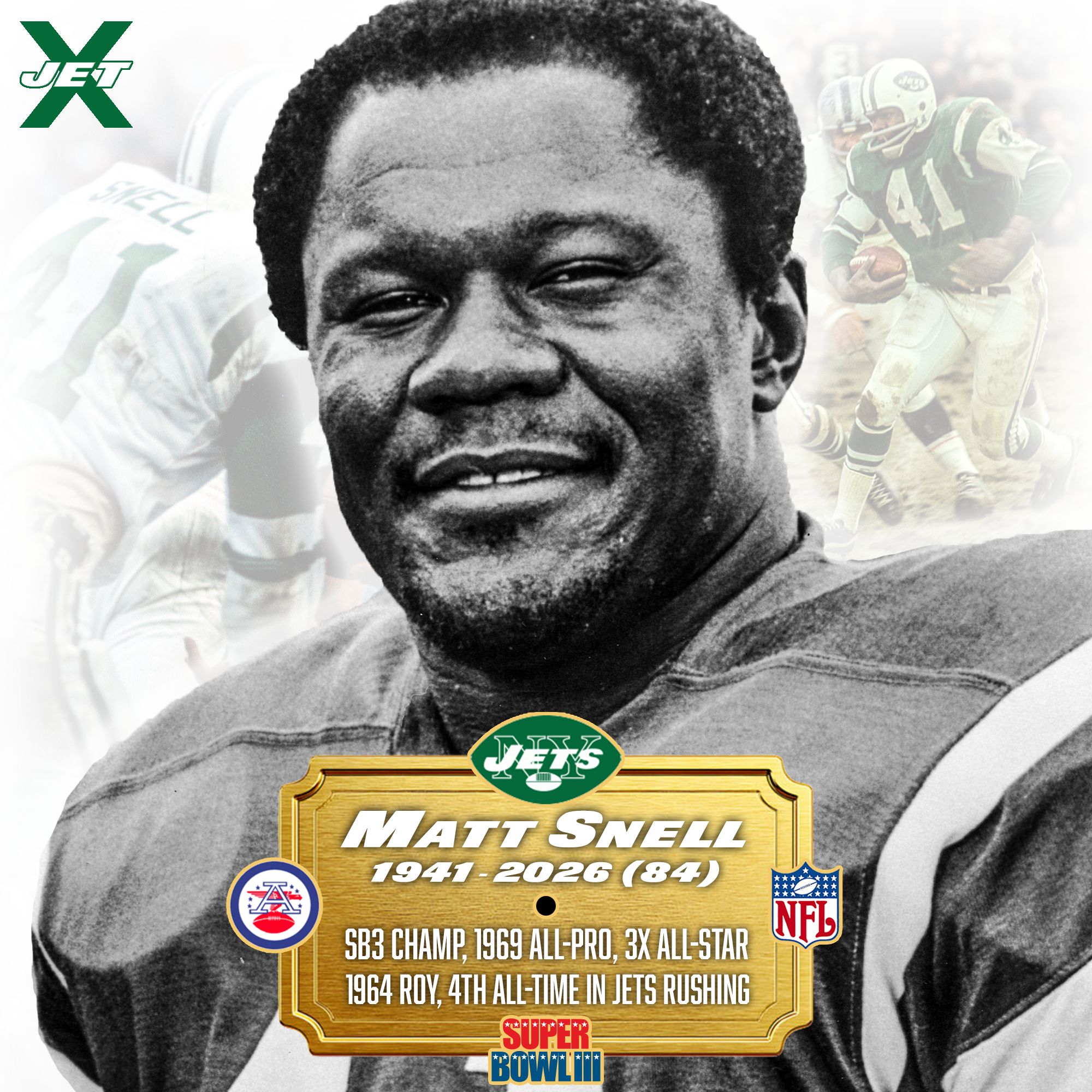
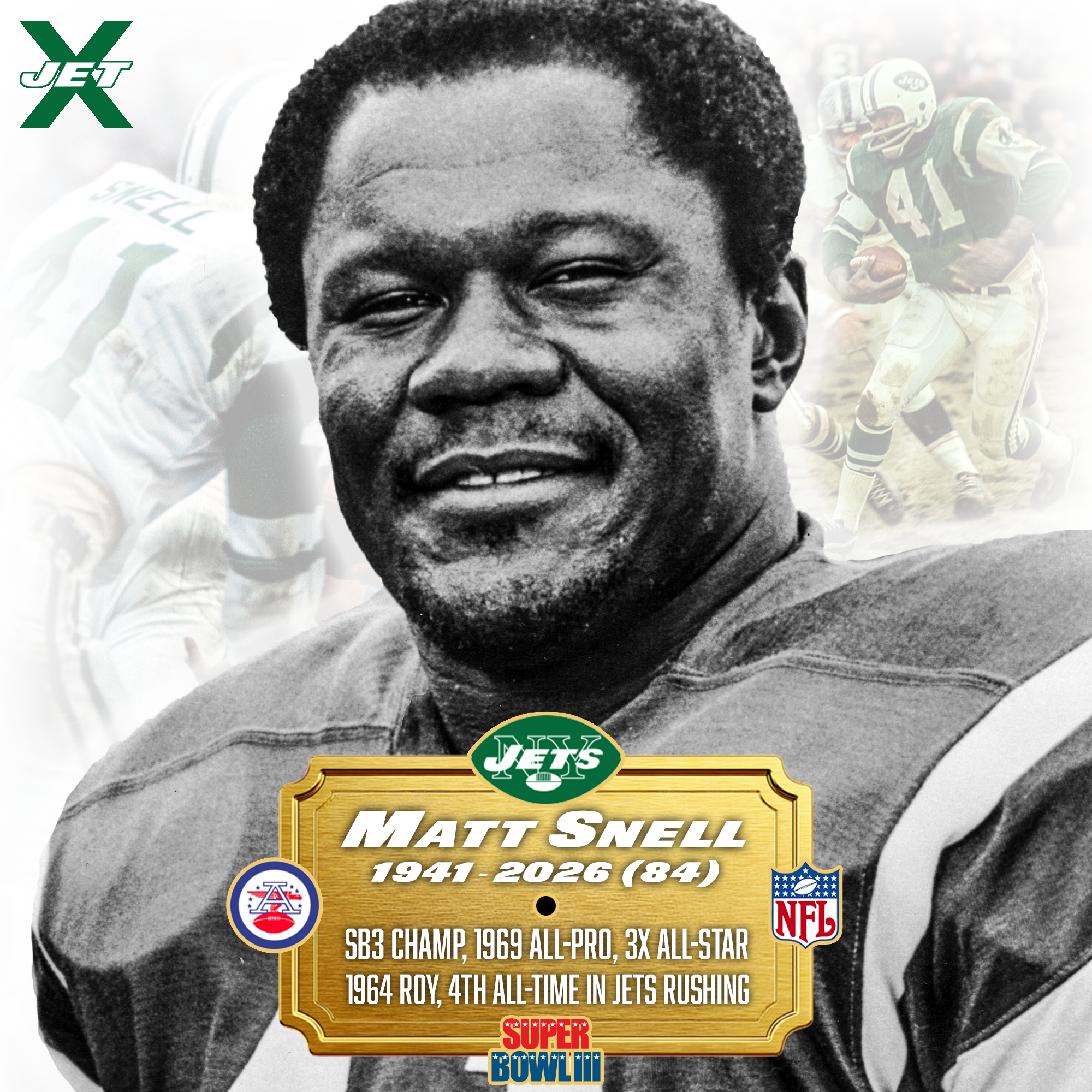 Matt Snell, New York Jets, Getty Images
In their room on the Friday before the game, Snell and halfback running mate Emerson Boozer, who were already known for their solid rushing and exquisite blocking skills, committed themselves to blocking for each other like never before so that either could dominate on the ground on Super Bowl Sunday.
Of course, on Jan. 12, 1969, Namath’s arm and brain startled America as he led the Jets to an astounding Super Bowl upset. However, it was Snell’s rushing and receiving exploits that sustained the Jets’ offensive engine.
He ran like an unleashed bull, accounted for the Jets’ only touchdown, and, at the time, compiled a record 121 rushing yards. Matt also made a touchdown-saving special-teams tackle on a Baltimore punt return, a role he was not called on to participate in during the regular season.
Werblin, whose partial ownership had been bought out by his syndicate partners before the 1968 season, surprised Matt by buying him a Mint Green Cadillac a few weeks after Super Bowl III. Shocking Matt, he explained to Snell that he had been the co-MVP of the big game.
Despite that accolade, Matt disputed any such evaluations for the rest of his life.
Snell had only one notable post-Super Bowl season — 1969. Thereafter, injuries wore down his body. Special teams was a dreaded role, designated for expendable fringe players, but in 1972, Matt had been displaced as the starting fullback by rookie John Riggins.
Assigned to what most players of his stature would have refused as disrespectful, Snell played out his contract in that new role. But he incurred a ruptured spleen on special teams that nearly cost him his life and ended his career.
Legacy
After football, Matt didn’t know if he could expect the lifetime job that Werblin had promised in 1964. He didn’t know if Werblin ever communicated that promise to his fellow owners when he relinquished control of the team. Apparently not. So, Matt returned to an earlier job interest, the construction business.
He had served as a laborer during the construction of Shea Stadium; now, a job as a construction company foreman was all but locked up, needing only a reference from the Jets. To his amazement, the Jets, now majority-owned by Leon Hess, informed him that the team’s policy was never to provide a recommendation for a former player … not even for the star of Super Bowl 3.
At age 31, a dispirited Snell could not understand why. He was visibly hurt, and beneath the surface, his anger began and grew, year by year, against the organization he had starred for over nine seasons.
For decades, he deliberately separated himself from anything having to do with the Jets.
The situation became newsworthy and prompted unsupported, wild speculation. Matt refused to reveal to the curious New York media his reason for the split. Still, reporters from New York sports media made an annual trek to Matt’s home in Jersey City, NJ, seeking an explanation.
None was forthcoming; most of the time, Snell didn’t even come to the door.
The split between Snell, the Jets’ first legitimate star and team leader, and the team widened over time to the point that Snell admitted to me that he ignored invitations to attend an induction into the Jets Ring of Honor in 2015 and an ultimate hoped-for appearance, arm-in-arm, with his Super Bowl 3 teammates in a 50th Anniversary Reunion (in 2018).
Every year for as long as anyone can remember, Joe Namath is the only Jets player to present memories and comment about Super Bowl 3. Matt Snell — a likely choice to join Joe on any such occasion — became an afterthought about such possibilities, having chosen to disassociate himself from the Jets.
Most of the members of the 1968 squad – a group that included one dozen representatives in that season’s AFL All-Star Game – have completely fallen from the spotlight and recognition, even by Jets fans. Stars like Winston Hill, George Sauer, Jr., Emerson Boozer, Gerry Philbin, and Randy Beverly are largely forgotten and have fallen into what I call the “dustbin of history.”
Sadly, they were joined for the most part by the impossible-to-forget Snell. Ask Jets fans who are 40 years old or younger about the man’s accomplishments, and the chances are strong that mere shrugs are returned.
That is the unfortunate legacy of Matt Snell — the original New York Jets superstar, who left only 1960s videotapes to remind anyone of his contributions to the franchise — and faded out of its most memorable team history.
For untold anecdotes about Matt Snell’s exploits and memories of his New York Jets career — as well as individual offerings from his 44 teammates and 6 coaches — read “,” published by Dey Street, an imprint of William Morrow. Available on Amazon and other book providers. To acquire a personally-autographed copy from the author, please contact rflbob[at]gmail[dot]com.