
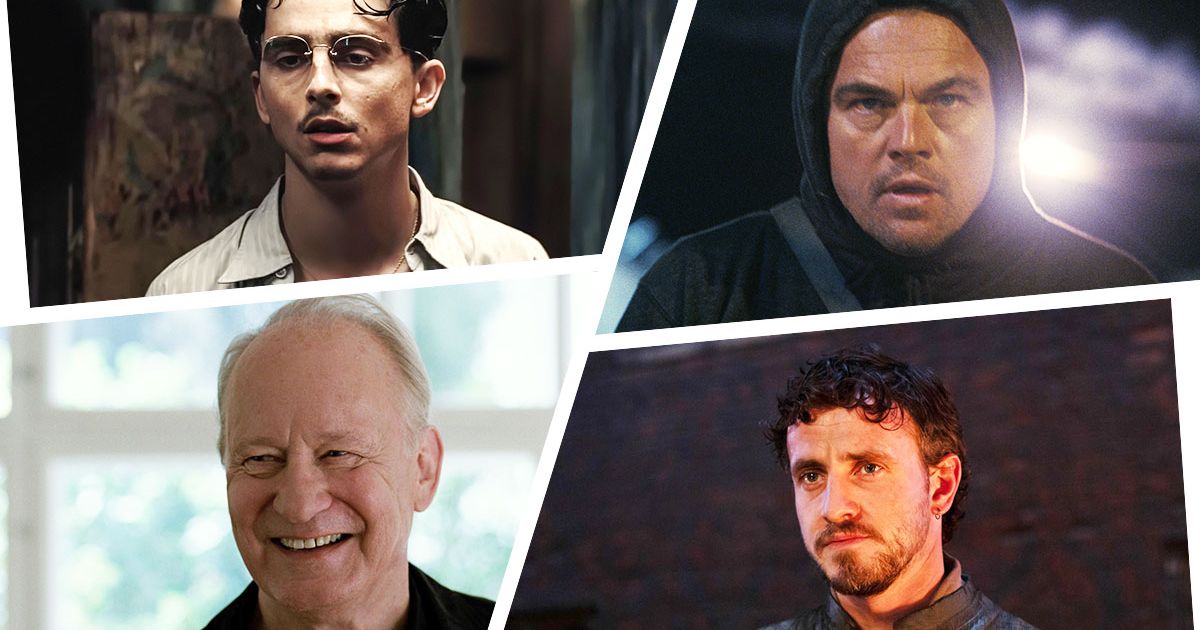
This year’s big nominees are full of anxieties about fatherhood and whether we’re doomed to repeat the mistakes of those who’ve raised us.
Photo-Illustration: Vulture; Photos: A24, Everett Collection, Warner Bros.
I’ve gotten into more arguments over the ending of Marty Supreme than any other of the major contenders this award season. This won’t come as news if you’ve seen it — and if you haven’t, be warned that I’m considering all the Best Picture nominees fair game for discussion in this piece, the Oscars are this weekend! — but Josh Safdie’s table tennis epic comes to an end not with its climatic match in Tokyo, but with would-be champ Marty Mauser (Timothée Chalamet) standing in a New York City maternity ward, overcome with emotion at the sight of the newborn child he’s spent most of the runtime insisting he wanted nothing to do with. Chalamet knows how to give good cry, as previously established by the famous shot of him weeping into a fireplace over the closing credits of Call Me By Your Name. But these particular tears — gasping, wrenching, and accompanied by the anachronistic strains of “Everybody Wants to Rule the World,” have proven to be surprisingly divisive.
I’ve spoken to people who’ve scoffed at them as insincere, or written them off as an instance of an otherwise bracingly stressful movie surrendering to unwarranted sentimentality. I’ve run across theories online that those tears are grief-stricken evidence of Marty realizing that the baby isn’t actually his, that it somehow unmistakably resembles Emory Cohen instead. I had a friend defend them fiercely as proof that the character has emerged from his previous form as though from a chrysalis, no longer a self-interested little shit, but a man capable of showing up for other people. For the record, I think Marty’s feelings in that moment are heartfelt, and also that the film’s conclusion only works if you believe he’s just as likely to bang down the door of the International Table Tennis Association president the next morning as he is to start a new life as part of a family. But I understand why everyone feels invested in their personal readings of the scene, because the proposition that fatherhood is transformational — not just a shift of status but something more profound, a sort of irrevocable state change — is as contentious a topic as it is compelling.
This has been an Oscars season of daddy issues, which might be easy to overlook in light of all everything else these Oscars have become — a referendum on the durability of cinema, a fight over the ability to make art in an industry beset by corporate consolidation and the looming threat of AI, and a study in how much Chalamet is too much over the course of an extra long award season. But while parenting and being parented are central facets of life never absent from the movies, this year’s Best Picture crop has been notably concerned with fatherhood — consumed with fears about being a failed or absent father, or haunted by experiences of growing up with one or the other. The way that Marty treats his pregnant lover as akin to the creature in It Follows, poised to slaughter his dreams if she manages to get hold of him, is only the most outsized version of these concerns. Bad dads cast long shadows over Ryan Coogler’s vampire drama Sinners, as well — from the abusive one that Smoke (Michael B. Jordan) killed after the man beat his brother one too many times to the pastor whose acceptance of Sammie (Miles Caton) is contingent on the young man following in his footsteps. One of The Secret Agent’s final reveals is that it has been the record of a vanished father all along, that Armando Solimões (Wagner Moura) never made it out of his hometown of Recife, to which he returns in hopes of retrieving his son and fleeing the country.
Train Dreams and Hamnet are about fathers mourning children, and struggling to articulate their grief through the limited outlets offered to them by traditional masculinity. Sentimental Value’s Gustav Borg (Stellan Skarsgård) is a filmmaker who can only express his love for his estranged oldest daughter by writing her a role in a movie. He’s not unlike the William Shakespeare (Paul Mescal) of Hamnet, whose grief can only be understood by his wife Agnes (Jessie Buckley) when she sees the play he’s channeled it into. Frankenstein gives its monster (Jacob Elordi) a very contemporary gloss: he’s the incel son of a tyrannical control freak, played by Oscar Isaac, who’s managed a kind of wombless reproduction, and grows enraged when his child shows signs of what he interprets as developmental shortcomings. Marty and Bugonia’s Teddy Gatz (Jesse Plemons) have fathers who don’t merit a mention, while Joshua Pearce (Damson Idris) and Sonny Hayes (Brad Pitt) are both sons of fathers who died when they were 13, a commonality that’s thrown out as a shorthand for their respective hangups. And One Battle After Another is one long ode to feelings of fatherly inadequacy, with Leonardo DiCaprio’s Bob Ferguson having spent the main part of his teenage daughter Willa’s (Chase Infiniti) life in a haze of pot and booze, waiting for her mother to miraculously return.
Movies move too slowly and come from too many divergent sources, including two other continents among this particular Oscar contingent, for anyone to make real causal connections between what they’re about and what’s going on in the world. But there’s no denying that the anxieties threaded through these movies feel like reflections of ones in our current culture, with its worries about toxic masculinity, inadequate role models, and the influencers and politicians peddling everything from a return to calcified gender roles to entirely undisguised misogyny. When Trump attended the NATO summit last summer, the White House posted a video of the footage proclaiming “Daddy’s home.” When David Ellison led the charge to acquire Warner Bros. in a heated corporate battle for control of one of the largest remaining media companies, it was widely interpreted as the efforts of a failson to earn his father’s respect by leveraging his father’s enormous amount of money. To fret over fatherhood is to fret about men, both future and fully grown. And watching all ten Best Picture nominees gives you a varied tapestry of paternal concerns, including ones about the degree to which traditional masculinity and loving parenting are incompatible, the former mandating stoicism and authority while the latter asks for vulnerability and openness.
To fret over men is to fret over the state of the world controlled by them. Yet this year’s movies aren’t sounding an alarm, even about a character like Teddy, who may be a conspiracy-addled serial killer, but who’s also not wrong about aliens’ presence on Earth. Teddy was molested by his babysitter and functionally abandoned by his mother in her struggles with drug addiction, and still remains a creature of pathos; he’s responsible for Bugonia’s only streak of tenderness in his relationship with his autistic cousin Don (Aidan Delbis). One Battle’s Bob, for all his clownish panic, paranoia, outdated sensibilities, and genuinely mournful admission about not knowing how to do the biracial Willa’s hair, has raised a daughter so capable and dedicated to idealistic causes that she makes the final needle drop of “American Girl” not just tolerable but touching. Sinners’ Smoke and Stack, over the course of that long, bloody day, take on different postures of surrogate fatherhood to their cousin, offering encouragement, protection, sex ed, and even the instrument he makes music with — these two sons of a nightmare situation offering the kind of nurturing that Sammie’s actual father withholds.
Armando’s father in The Secret Agent is revealed to have been the scion of a bourgeois household who impregnated the maid’s teenage daughter and then took the child when he emerged looking white enough. But even he grows beyond these brutal beginnings into an adoring (if maybe less than faithful) husband and loving parent. The scenes of him with his son, Fernando, driving in his little yellow VW and talking about Jaws, exude such effortless warmth that they give the eventual coda, in which a grown Fernando confesses to not really remembering his dad, an added tragedy. Even then, Fernando himself appears to have blossomed into a stable adult in the care of his grandfather; when he thinks about his father at all, he does so with the remove of someone who doesn’t feel like the man he’s become has seriously suffered due to his lack. It’s a cold kind of comfort, but a comfort all the same, to counter all those paternal fears with the possibility that you might not be needed at all — that it is, of course, possible for someone to come out just fine despite the lack of a loving dad in their life. Which lets Marty off the hook, I suppose, if the win that he believes is all he needed turns out not to be enough, and if he can’t actually see a compromise between his calling and being around for his kid. But I’d like to believe that he settles down, not because he laid eyes on his baby and was forever changed, but because he decides to, and keeps making that decision, day by day. That’s something ultimately more meaningful than any amount of tears, but it’s a lot less easy to distill into the final scenes of a movie.
Sign up for the Vulture Daily
An entertainment newsletter for the pop-culture obsessed.
Vox Media, LLC Terms and Privacy Notice