
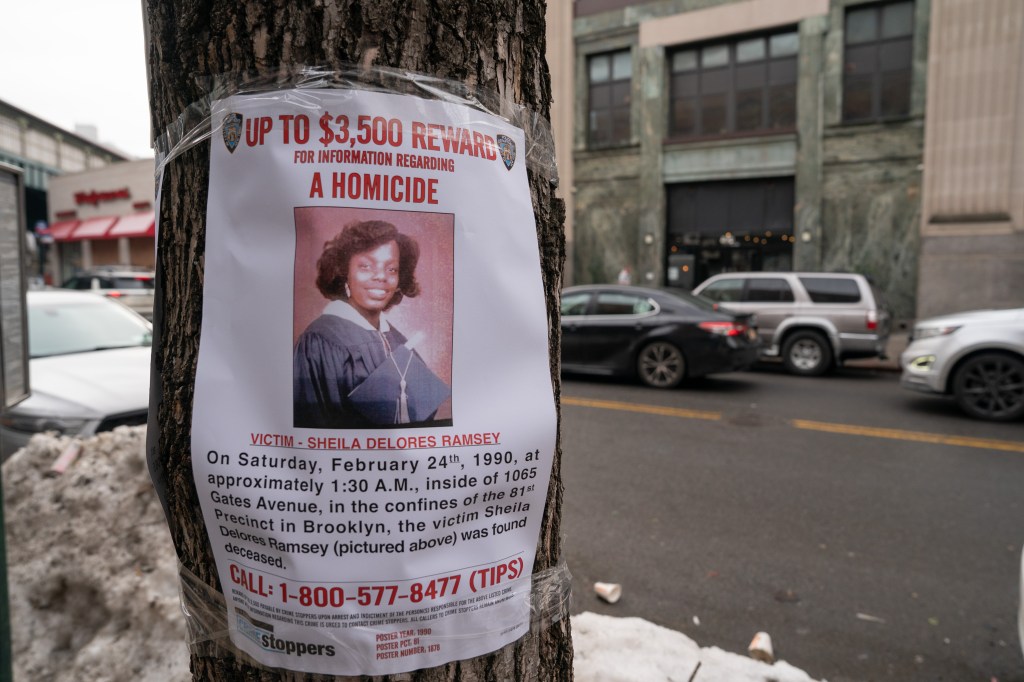
A mystery woman found bludgeoned to death in an abandoned Brooklyn building in 1990 finally has a name, investigators using DNA research to reach back generations and build a family tree that ultimately led to her identification.
But now comes the hard part — figuring out who murdered 21-year-old Sheila Ramsey.
And no one wants an answer more than her son, Rashard Ramsey, now 36 but just eight months old when his mother was killed.
“Honestly, it’s hard to put it into words,” the son told the Daily News from Houston, where he lives with wife and two young children. “When I found out the news I didn’t know how to absorb it. I knew of [my mother] but I never got to know her. I have a few pictures but no recollection of her.
“I’m still trying to sort it out — but obviously I want to know who did this to her.”
The case dates back to Feb. 24, 1990, when, at about 1:30 a.m. a man called 911 and reported that he had slipped into a vacant Bedford-Stuyvesant store on Gates Ave. near Broadway to relieve himself, only to find a dead woman in the basement boiler room.
“Her clothing was up around her head and she was naked from her shoulders down,” said NYPD Cold Case Squad Det. Robert Dewhurst, who at the time was two years away from becoming a police officer. “She was face down and she was bludgeoned to death.”
The woman, known only at the time as Jane Doe, was killed by blunt force trauma to her head and neck, the Office of the Chief Medical Examiner said. It is not clear if she was sexually assaulted.
The murder was the ninth logged at the 81st Precinct that year — out of what would be a record 2,262 citywide killings by year’s end, as the crack epidemic raged across New York.
Dewhurst said the case file shows detectives interviewed a number people with no luck. With no name for the victim, the case quickly turned cold and she was buried later that year at Potter’s Field on Hart Island.
All Rashard Ramsey knew was what his grandmother had told him when he was about nine. Mary Ramsey, with whom he and his mother lived, sat him down and explained how one night he had a fever. His mother left the family’s Williamsburg apartment to get medicine, but never returned.
His grandmother also said she had filed a missing person report at some point and that Sheila Ramsey was later declared dead by the state.
DNA roadmap
The NYPD stayed on the case.
A detective took a shot at solving the case in 2007 but no serious leads were developed.
Then, in 2018, as the advent of DNA testing to unearth clues to one’s ancestry grew in popularity, a California case shed light on a new avenue for investigators.
The notorious Golden State Killer, Joseph DeAngelo, was busted, due in large part to investigative genetic genealogy, a modern detective tool that helps police identify nameless victims and suspects by first identifying their relatives. DeAngelo in 2020 was sentenced to life in prison for 13 murders and 13 rapes from the 1970s and 1980s.
In New York, the ME’s office, working with the NYPD and private labs specializing in genetic genealogy, has helped developed leads for 11 unidentified people, 9 of them murder victims.
Most notable among the 9 is the “Midtown Jane Doe,” who in 2024 was finally identified, 21 years after she was found by construction workers breaking up a concrete floor and some 50 years after she was actually murdered.
“Think about it in terms of the impact on the families,” said Angela Soler, the OCME’s director of forensic anthropology. “These are people who have been waiting decades to find out what happened to their loved one and while it’s a painful realization to know that their loved one is now dead or has been dead this whole time there’s also a sense of relief because that question in the back of their mind about where their loved one is and what happened to them has finally been answered.”
In the Ramsey case, the NYPD in early 2024 decided to try genetic genealogy, the Cold Case unit collaborating with the department’s forensic experts. Within about three months, they’d developed a DNA profile for Jane Doe.
Then, working with two private labs that analyze DNA samples from people who’ve agreed to let law enforcement access their information, a clue to Jane Doe’s family tree emerged.
“We start looking at their ancestors and build it back as far as we think we need to go,” said Sarah Sciortino, a criminalist with the NYPD’s Investigative Genetic Genealogy Squad.
“For this particular case we had to build back to grandparents, great grandparents, second great grandparents, that dated back to the late 1800s. Once we build back as far as we need to we now need to build forward in time and that’s referred to as descendancy research.”
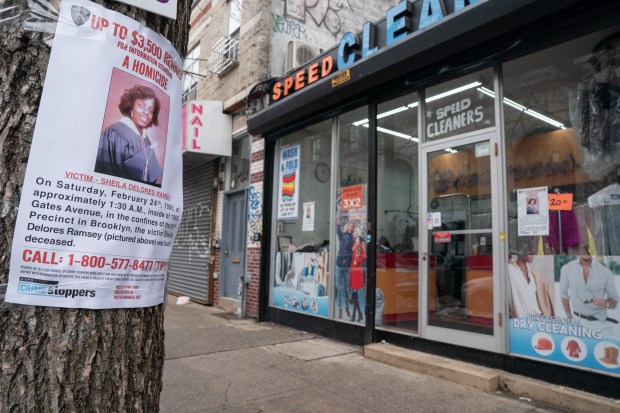 The building where Sheila Ramsey was found dead in 1990, now a cleaning shop, is pictured Wednesday, March 3, 2026 in Brooklyn, New York. (Barry Williams/ New York Daily News)
An obituary in Alabama
At some point as the investigators followed the genetic trail, signs pointed to Alabama.
The cops uncovered an obituary for a woman named Mary Ramsey Crawford, who was 67 when she was killed in 2014 by a hit-and-run driver. The obituary said she had a son, Rashard Ramsey, and that her daughter, Sheila Ramsey, had died before her. (Rashard was actually her grandson.)
“I had nothing,” Dewhurst said. “Now we have a name.”
Rashard agreed to meet. Dewhurst and his partner flew to Texas on Jan. 12, 2025, meeting him in the middle of cattle country, Marquez, population 198, where Rashard, who repairs and maintains cell phone towers, was between assignments. They swabbed the inside of his cheek and flew back to New York City,.
Less than two months later, the DNA tests came back — Jane Doe was indeed Sheila Ramsey. Rashard is her son, the obituary error notwithstanding. Years after her disappearance, he had moved to Alabama with his grandmother, Mary Ramsey Crawford, who’d been killed in the hit and run.
Since then, Dewhurst has been able to track down some family members and a family friend, confirming that Sheila Ramsey had left home to buy her son medicine — and, perhaps more critically, that “she was accompanied by an unknown man.”
“I’d like to find out who that man is,” he said. “I’d also like to find out who the father of [Rashard] is.”
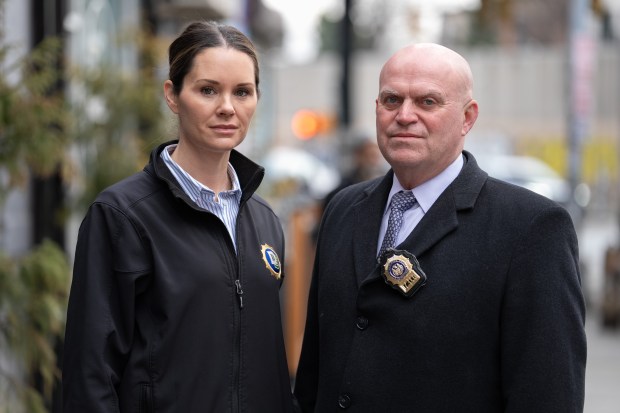 NYPD Cold Case Squad Det. Robert Dewhurst, right, and NYPD Criminalist, Sarah Sciortino stand by the building where Sheila Ramsey was found dead in 1990, on Wednesday, March 3, 2026 in Brooklyn, New York. (Barry Williams/ New York Daily News)
Rashard, in fact, had last year signed up for ancestry.com in an attempt to learn the idenitity of his father, whom his grandmother had described as essentially absent from his life.
Now, he’s optimistic his mother’s killer can be found.
“I do think it’s possible to solve the case,” he said. “I watch all those shows. I think that’s part of the reason why I’m addicted to them, because of what happened to my mother.”
Lt. Robert Balacki, head of the Cold Case Squad, said the NYPD’s embrace of new and ever-evolving technologies makes it increasingly possible “to get back in time” and solve cases from decades ago.
To that end, Dewhurst and Sciortino recently visited the murder scene, now Speed Dry Cleaners, and posted in the window a reward poster adorned with a photo of Sheila Ramsey, dressed in the gown she wore to her high school graduation.
“Now, hopefully, someone will see this and remember something from back then,” Dewhurst said. “Sheila Ramsey was a good person.
“Somebody has to know what happened to her.”