
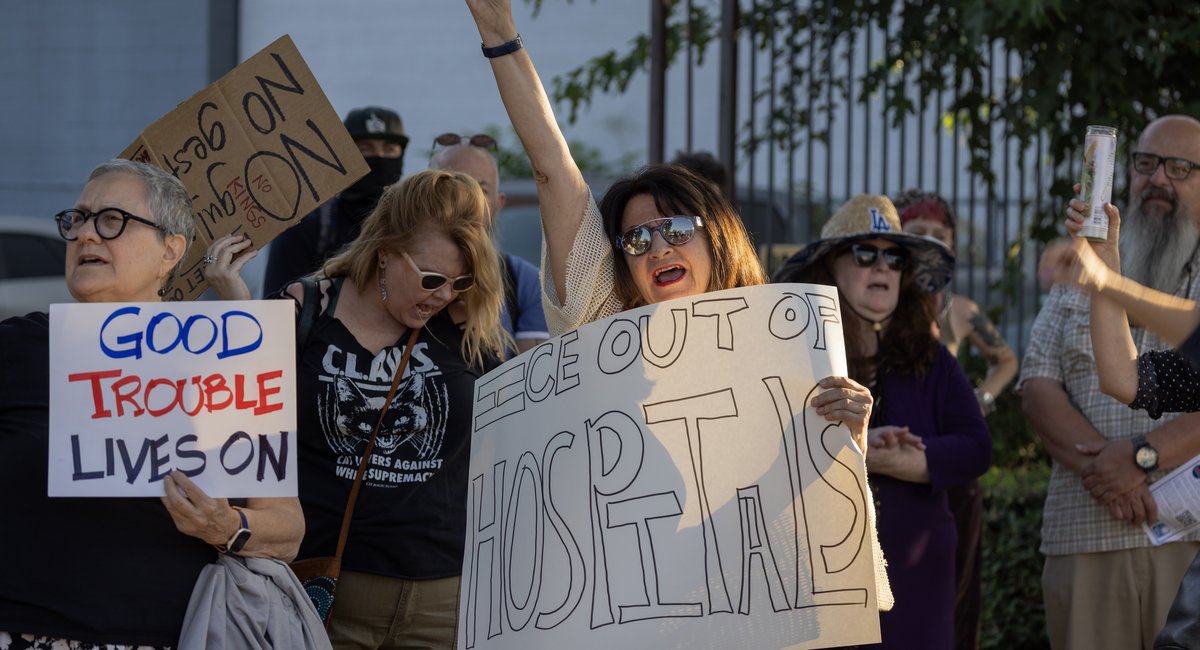
Fears of immigration enforcement have made some New Yorkers more hesitant to access health services under President Donald Trump, according to health care workers and immigrant rights advocates. But reports of U.S. Immigration and Customs Enforcement conducting enforcement actions at city hospitals have so far been the exception.
The Trump administration in January 2025 lifted restrictions on enforcement actions at “sensitive locations,” such as hospitals, fueling fears of ICE officers roaming the halls of health care facilities. Coupled with that change, the administration has more recently allowed ICE to access certain biographical information about people receiving public health benefits, perhaps offering another enforcement tool.
The Greater New York Hospital Association told Gothamist that ICE activity in hospitals has not increased during Trump’s second term. Immigration lawyers say enforcement in hospitals still appears to be uncommon. But worries over enforcement — and how hospitals should respond to the threat — are an ongoing concern for health care workers, including New York City nurses who went on strike earlier this year.
Some doctors and nurses report they have occasionally seen ICE agents on their campuses. They also cite media reports of greater ICE presence at hospitals in cities targeted in recent federal crackdowns, including Minneapolis and Los Angeles.
Some immigration lawyers and advocates say their more pressing concern is advising undocumented New Yorkers about the risks posed by the federal government’s data-sharing initiative. The information is associated with programs such as emergency Medicaid, which covers emergency care for undocumented immigrants.
Still, concerned health care workers at public and private hospitals across New York City are pushing for stronger policies and legislation to ensure patients’ rights are protected if an ICE agent shows up. An incident at the city-run Elmhurst Hospital in Queens in January 2025 gives some health care providers and advocates pause.
In that case, an ICE agent was initially refused entry to the hospital, but after a call from their supervisor, the agent was escorted upstairs by a hospital police officer and an administrator and allowed to serve a patient a notice to appear in immigration court at 26 Federal Plaza, according to an internal report Gothamist obtained through a Freedom of Information Law request.
The patient spoke Spanish and it was unclear if he understood the notice, which was in English, according to the report. It did not detail circumstances surrounding the enforcement or identify the patient.
The report stated the ICE agent did not have a judicial warrant — a document that would have legally required administrators to cooperate in allowing the agent into a non-public part of the hospital. The incident took place on Jan. 22, 2025, two days after Trump took office and reversed his policies around immigration enforcement in sensitive locations.
“New York obviously does have some of the strongest sanctuary policies, but we need to make sure that they’re getting followed the right way to ensure that instances like the one [at Elmhurst] don’t happen,” said Becca Telzak, deputy director of Make the Road, a nonprofit immigrant rights group.
City Hall spokesperson Sneha Choudhary said NYC Health and Hospitals, which runs Elmhurst, is not covered by local “sanctuary city” laws because it is a public benefit corporation established by the state.
Still, Choudhary said the public hospital system has adopted operating procedures that largely mirror the laws covering other city agencies. Sanctuary laws prohibit city staffers from allowing federal immigration officials into private areas of city property, except in limited circumstances, including emergencies and when they have a judicial warrant.
In an executive order issued last month, Mayor Zohran Mamdani “encouraged” Health and Hospitals to “conduct an audit, disseminate policies and protocols, and implement training consistent with” New York’s sanctuary city laws.
“Our administration is aware of what happened last year,” said Joe Calvello, the mayor’s press secretary. “That is exactly why the mayor signed his executive order on February 6th and agencies are working to review and strengthen their protocols.”
Adam Shrier, a spokesperson for NYC Health and Hospitals, said the system is partnering with the mayor’s office to review its policies related to interactions with non-local law enforcement. He added that the hospital system hasn’t seen any additional ICE enforcement actions since the incident at Elmhurst, but has provided care to patients in ICE custody.
“NYC Health and Hospitals is committed to providing safe, high-quality care to all New Yorkers, regardless of their immigration status,” Shrier said. “Our patients’ safety and well-being are our highest priority, and that commitment does not waver based on federal policy changes or enforcement activity.”
Helen Arteaga, the CEO of Elmhurst at the time, was consulted by the hospital’s director of risk management before the ICE agent was allowed upstairs, according to the report Gothamist obtained. She is now the city’s deputy mayor of health and human services.
Asked about ICE’s current policy on immigration enforcement in hospitals, agency spokesperson Marie Ferguson said, “ICE does not conduct enforcement at hospitals — period.”
She added, “We would only go into a hospital if there were an active danger to public safety” or if an officer was accompanying a patient in their custody to receive medical care.
Keeping ICE out of hospitals
NYC Health and Hospitals and many private hospitals across the city already have internal policies around how to handle ICE, but some health care workers say the policies aren’t strong enough.
Gov. Kathy Hochul and state lawmakers are weighing measures to restrict federal immigration agents from public hospitals and other sensitive locations, except under exigent circumstances. And health care workers with the Health Justice for New York coalition have called on the City Council to explicitly include Health and Hospitals in legislation aimed at bolstering city sanctuary laws.
One local bill would require signs to be placed on city property informing people of their rights and indicating which areas are private — and therefore, off limits to federal agents in most circumstances.
“Patients are delaying care, ending up in critical conditions because they’re worried they’ll encounter an [immigration] agent,” Dr. Jasmeet Sandhu, an internal medicine physician at Elmhurst, said during a City Council hearing on the legislation this month. “Family members are too afraid to visit sick loved ones for the same reason.”
Dr. Damien Archbold, an anesthesiologist at Elmhurst, said he and other doctors have been hungry for training around ICE protocols, including concerns that might arise if a patient arrives in ICE custody.
Archbold said a group of doctors organized a “know-your-rights” training with local community groups that was scheduled to be held on Elmhurst’s campus in December. But the training was canceled by Mount Sinai Services, which employs Elmhurst doctors through an affiliation agreement with the public hospital.
“We have been advised that due to the political nature of this meeting, we cannot authorize the use of the space until the presentation has been completely reviewed and vetted by the Mayor’s Office and NYCHHC legal team,” a Mount Sinai representative told the doctors in an email shared with Gothamist.
Mount Sinai did not respond to a request for comment on that incident.
“We continue to provide trainings to our staff to ensure all employees understand their responsibilities to and the rights of our patients,” said Shrier, the NYC Health and Hospitals spokesperson.
Keeping patient data away from ICE
For some patients, the fear of going to the hospital has more to do with concerns that their health data will be shared with ICE than the presence of physical agents, Telzak of Make the Road said.
ICE struck a deal with the U.S. Centers for Medicare and Medicaid Services to access a massive trove of patient data last summer. In late December, a federal judge rejected a challenge from New York and other blue states, ruling ICE could continue to access more limited biographical, location and contact information.
Danielle DeSouza, a spokesperson for the state Department of Health, said the state must report monthly Medicaid enrollment data to the federal government — but those enrollees who are most vulnerable to deportation are not included.
Some New Yorkers are eligible for Medicaid, even though they’re undocumented, including those who have low incomes and are older than 65. That insurance is paid for only by the state, so the data doesn’t have to be sent to the federal government, DeSouza said.
When it comes to the program known as emergency Medicaid, the matter is a little trickier.
Emergency Medicaid is not insurance, but is rather a way for hospitals to get reimbursed if they provide emergency care to someone who cannot access insurance because of their immigration status. DeSouza said New Yorkers can sign up for emergency Medicaid ahead of time, and the simple act of enrolling won’t transmit any data to the federal government.
But once someone uses emergency care and files an emergency Medicaid claim to pay for it, their information will go to the federal government.
Filing a claim, however, is not mandatory in order to receive emergency care. Hospitals must get patient consent before filing an emergency Medicaid claim on their behalf, said Drishti Pillai, director of immigrant health policy at the nonprofit KFF.
New Yorkers with varying legal statuses who are enrolled in Medicaid, Child Health Plus or the Essential Plan could have immigration information shared with the federal government — a reality the New York State of Health insurance marketplace acknowledged in a notice posted online last week.
But advocates say no one should pre-emptively forgo benefits or care before speaking with an immigration lawyer about their situation. The notice from the state also emphasized New Yorkers can help others sign up for insurance without disclosing their own immigration status.