

Abdullah Bozkurt/Stockholm
A Turkish national has been charged in the United States with terrorism offenses linked to the Islamic State in Iraq and Syria (ISIS) after authorities say he attempted to carry out a bombing near the official residence of the New York City mayor, according to federal court documents.
The suspect, Emir Balat, was arrested on March 7, 2026, after allegedly throwing an improvised explosive device into a crowd during a protest near Gracie Mansion in Manhattan and attempting to deploy a second device moments later. Prosecutors say the attack was inspired by ISIS ideology and could have caused mass casualties had it succeeded.
The case marks yet another instance of a suspect with Turkish connections appearing in a US terrorism investigation linked to ISIS, following previous federal indictments that highlighted Turkey’s continuing role as a key logistical hub for jihadist networks operating between Europe, the Middle East and North America.
Balat was charged in a criminal complaint filed in the US District Court for the Southern District of New York together with Ibrahim Kayumi. The charges include attempted provision of material support to a designated foreign terrorist organization, use of a weapon of mass destruction, transportation of explosives and unlawful possession of destructive devices.
An affidavit submitted by Jennifer Gioia, a special agent with the Federal Bureau of Investigation, to the US District Court for the Southern District of New York details Emir Balat’s ISIS-inspired terrorist attack in New York City:
According to the FBI affidavit supporting the complaint, the incident occurred during two simultaneous demonstrations outside Gracie Mansion, the official residence of the New York City mayor, where one protest opposed Muslim public prayer while a counter-protest denounced far-right groups.
At approximately 12:15 p.m., Balat allegedly ignited and threw a device toward the crowd of protesters. Immediately afterward he ran down the block and received a second device from Kayumi. After igniting the second device, Balat dropped it near a group of New York Police Department officers and attempted to flee before being tackled and arrested.
FBI bomb technicians later determined that the devices were homemade explosives roughly the size of mason jars and fitted with fuses, nuts and bolts taped to the exterior to increase their lethality.
A preliminary analysis found that one device contained triacetone triperoxide (TATP), a highly unstable explosive often used in terrorist attacks and known among investigators as the “Mother of Satan.” Authorities say the devices were capable of causing serious casualties if they had detonated in the crowd.
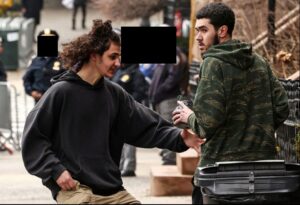 Immediately after throwing the first IED, Emir Balat ran down the block and received a second explosive device from another ISIS suspect, Ibrahim Kayumi.
After his arrest, Balat allegedly made several statements referencing ISIS.
While being transported in a police vehicle he declared that believers should take action rather than remain silent, saying: “We take action! If I didn’t do it someone else will.”
At the police precinct, after waiving his Miranda rights, Balat asked for a pen and paper and wrote a message pledging allegiance to the Islamic State.
“All praise is due to Allah lord of all worlds! I pledge my allegiance to the Islamic State,” he wrote, adding a phrase calling for the death of “kuffar,” a term used by jihadists to refer to non-believers.
Investigators said Balat also expressed a desire to carry out an attack even deadlier than the 2013 Boston Marathon bombing. When asked if that attack had inspired him, he reportedly replied: “No, even bigger. It was only three deaths.”
At the time of his arrest Balat was carrying a Turkish government identification card bearing his name along with a Pennsylvania driver’s license with the same identity.
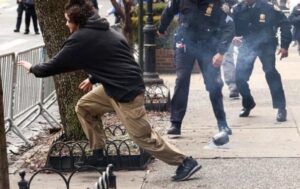 After igniting the second IED, Emir Balat dropped the device near several NYPD officers, fled the scene and jumped over a barricade before officers tackled him and took him into custody.
Police later located a vehicle linked to his family parked several blocks from the scene. Inside the vehicle investigators recovered items consistent with bomb-making activity, including hobby fuse, a metal container similar to the one used in the explosive device and a notebook containing handwritten instructions referencing “TATP explosive” and chemical ingredients such as hydrogen peroxide, sulfuric acid and acetone.
The Balat case follows another recent US terrorism investigation involving a suspect with Turkish ties that shed light on the role Turkey continues to play as a staging point for ISIS operations.
In November 2025 US authorities charged Tomas-Kaan Jimenez-Guzel, a triple US-Turkish-Spanish national, with plotting to join ISIS after traveling to Turkey as part of a broader international network of recruits.
According to the FBI complaint in that case, the conspirators planned to fly to Istanbul and then travel to the southeastern Turkish city of Diyarbakır, which they described as a logistical hub where recruits could obtain weapons, vehicles and contacts for smuggling fighters across the Syrian border.
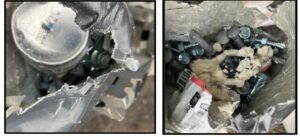 The contents of the IED thrown by Emir Balat in New York are shown after the device was opened by law enforcement officers.
In encrypted chats with accomplices in Europe and North America, Jimenez-Guzel reportedly described Turkey as the “easiest” route into ISIS territory because of its borders with Syria and Iraq. The group planned to move Western recruits into Turkey first, settle temporarily in southeastern provinces and then cross into Syria with the help of smugglers.
Investigators said the cell included members based in the United States, Sweden, the United Kingdom and Finland who intended to gather in Turkey before entering ISIS-held areas.
Western intelligence agencies have long identified Turkish border provinces such as Diyarbakır, Gaziantep and Şanlıurfa as transit points used by ISIS facilitators to move foreign fighters and supplies into Syria.
The FBI complaint in the 2025 case confirmed that extremist networks still view Turkey as the most accessible corridor to jihadist territory despite official claims that the border is tightly controlled.
The arrest of Balat in New York now adds another chapter to the pattern of cases in which individuals with Turkish connections have surfaced in ISIS-related investigations in the United States.
If convicted on the terrorism charges, Balat and his alleged accomplice could face serious prison time under US federal law.