
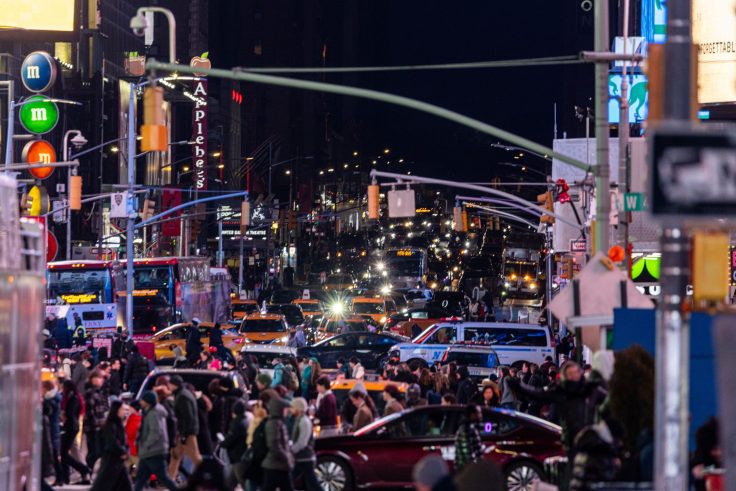
New York City’s controversial congestion pricing program, which charges drivers a toll to enter midtown and lower Manhattan, contains several “mitigation efforts” and carveouts designed to limit the punitive impact of the new tax on ethnic minorities—without offering the city’s non-minorities comparable treatment, a Washington Free Beacon review found.
Critics warn such allowances could potentially expose the program to litigation from the Trump administration, which has been keen to kill congestion pricing and shown a willingness to sue or take administrative action against anti-white discrimination promoted in the name of social justice.
“I think it would appeal to the Trump administration that the way the analysis was done was improper,” Randy Mastro, a Democrat and one-time top deputy to former New York City mayors Eric Adams and Rudy Giuliani, told the Free Beacon.
The so-called mitigation efforts include installing pricey air filtration systems and roadside vegetation near certain ethnic neighborhoods, as well as preferential tolls for taxi drivers, who are overwhelmingly South Asian and black.
Mastro, who led legal efforts by the State of New Jersey to kill the new tax, said the focus on limiting impact to “environmental justice communities” had been a particular fixation of the Biden administration as congestion pricing sought federal approval during his term.
“Because the Biden administration in particular, if you were an environmental justice community, there had to be particular mitigation provided in those communities,” Mastro said.
New York City’s congestion pricing program charges a $9 toll on most cars coming into Manhattan’s major business districts during peak daytime hours, with lower tolls on nights and weekends. The area covers the entire island south of 60th Street, excluding highways.
The tolls are designed to ease congestion in Manhattan and reduce auto emissions by pushing more drivers to switch to public transportation—but congestion pricing is primarily a tool to raise billions of dollars for the city’s troubled subway and bus system.
The city spent years fending off legal challenges and securing approval from the Federal Highway Administration in June 2023 before the tolls went into effect in January 2025. As part of the federal approval process, the city’s congestion pricing plan was required to adhere to Executive Order 12898—authorized by then-president Bill Clinton in 1994.
“Each Federal agency shall make achieving environmental justice part of its mission by identifying and addressing, as appropriate, disproportionately high and adverse human health or environmental effects of its programs, policies, and activities on minority populations and low-income populations in the United States and its territories and possessions, the District of Columbia, the Commonwealth of Puerto Rico, and the Commonwealth of the Mariana Islands,” the order mandates.
In public literature, the MTA notes that “environmental justice communities” refer to minority neighborhoods in New York City.
When the final details were hammered out, the MTA explained its aims.
“The proposed toll structure prioritizes keeping the base toll as low as possible, avoiding unnecessary traffic diversions, supporting equity goals and environmental justice, and keeping the Program simple, easy to understand, and easy to administer,” the agency said. “Our recommended toll structure is designed to minimize these diversions, and thus minimize adverse impacts of Congestion Pricing on environmental justice communities with existing pollution and/or health burdens.”
The MTA did not respond to a request for comment.
Even though the city’s famous yellow cabs are a major source of traffic in the Big Apple, something the report noted, it included a special carve-out for taxi drivers because the lion’s share of drivers came from “environmental justice communities.”
“Nevertheless, in an effort to reduce the economic impact of the congestion toll on taxi and FHV drivers, many of whom are considered an environmental justice population, the Final EA provides that those vehicles not be subject to more than the daily toll for automobiles,” the MTA said.
Uber drivers now pay a larger congestion toll than taxi drivers. A much larger proportion of Uber drivers are white, compared with taxi drivers.
“There have been several suits filed against New York’s congestion pricing scheme, but none of them noticed this issue,” Jacob Linker, an attorney who conducted research on the policy for the Rockland County District Attorney’s Office, told the Free Beacon. “And it’s not just that they racially gerrymandered the pricing, but they were also pretty dumb about it. The city’s environmental assessment assumed that all cab drivers were non-white because they’re almost all immigrants. A lot of Eastern European cab drivers would be surprised to learn that New York City considers them to be persons of color.”
The city set up an Environmental Justice Community Group that met quarterly with municipal and state officials to argue for the favorable treatment, and the MTA ultimately singled out 13 overwhelmingly minority communities to receive $100 million in mitigation services. Those projects took the form of new air filtration systems near highways and schools, park renovations, and new roadside vegetation, among other goodies.
An additional $230 million went toward more nebulous “regional mitigation.” Rather than direct place-based mitigation, regional mitigation includes a reduction in overnight tolls and an expansion of the city’s clean trucks program.
One regional mitigation effort, a toll discount for low-income drivers, was also designed with “environmental justice” as its prime motivation, the MTA said.
While the place-based mitigation measures aim to minimize congestion pricing’s effects on areas that “could potentially experience increases in highway traffic as a result of the Program,” they leave out majority-white Staten Island, the city’s only Republican borough.
“So many of us kept bringing up the environmental devastation on Staten Island that was reported in their own study, but since the Island is only about 10 percent black and the population is not centered near the highway, the MTA didn’t give a crap and the funding went elsewhere. The exhaust fumes are apparently fumier in the Bronx,” one former Staten Island lawmaker fumed to the Free Beacon.
On his first full day in office, President Donald Trump reversed the 1994 Clinton executive order—calling it “illegal discrimination”—raising questions about the viability of the program.
“The short answer is yes, it is discriminatory, in that they specifically include ‘minority’ as part of the definition of an environmental-justice community,” said Nicole Gelinas, a senior fellow at the Manhattan Institute who has studied the issue.
“It shows the long-term perils of government by executive order,” she added. “It would be perfectly valid for a plaintiff to claim that under traditional definitions of discrimination, that this is discriminatory.”