
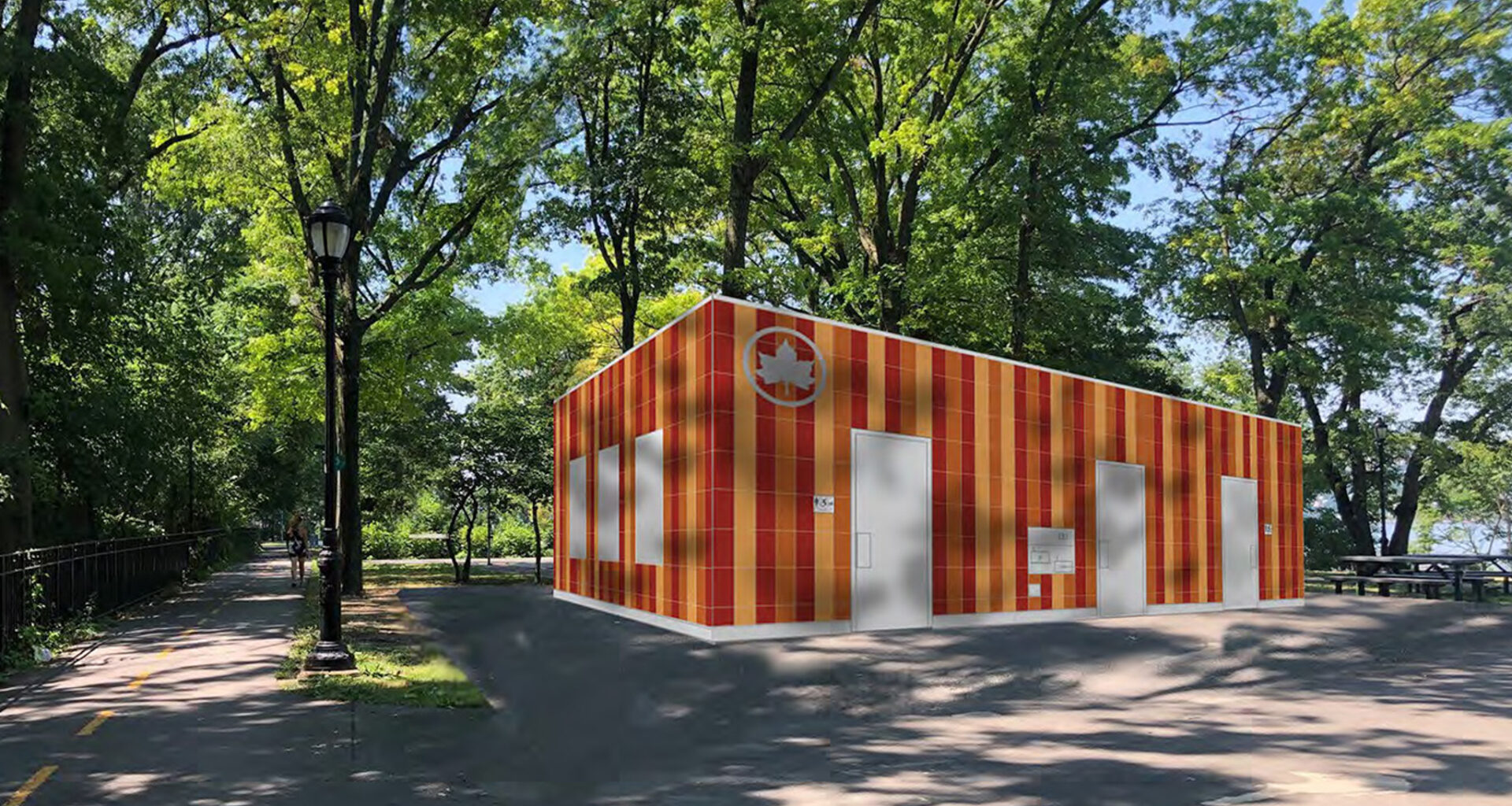
Since 2022, city officials — flush with excitement — have been touting a modular bathroom planned for the busy Discovery Playground in Fort Washington Park as a faster, cheaper way to build public restrooms.
The new prototype will be “less expensive to build and can be installed more quickly and with less disruption,” members of Manhattan Community Board 12 wrote when they approved the design in September of that year.
The idea was simple: a prefabricated comfort station built offsite and installed atop a large septic tank, eliminating the need to connect to city sewer lines.
But nearly four years later, the project remains stalled in bureaucratic red tape.
“This bathroom has been in purgatory with design changes and legal reviews,” Merritt Birnbaum, president and CEO of the Riverside Park Conservancy, told THE CITY. That group helps manage the river-adjacent green space.
“Meanwhile construction costs are going up, and there’s still no bathroom at this location,” she added.
The delays come as Mayor Zohran Mamdani announced a plan to push the prefab potty concept even further.
During a press conference in Harlem in January, he directed the New York City Economic Development Corporation to begin soliciting bids within his first 100 days for modular, high-quality public toilets.
“In a city that has everything, the one thing that is often impossible to find is a public bathroom,” he said.
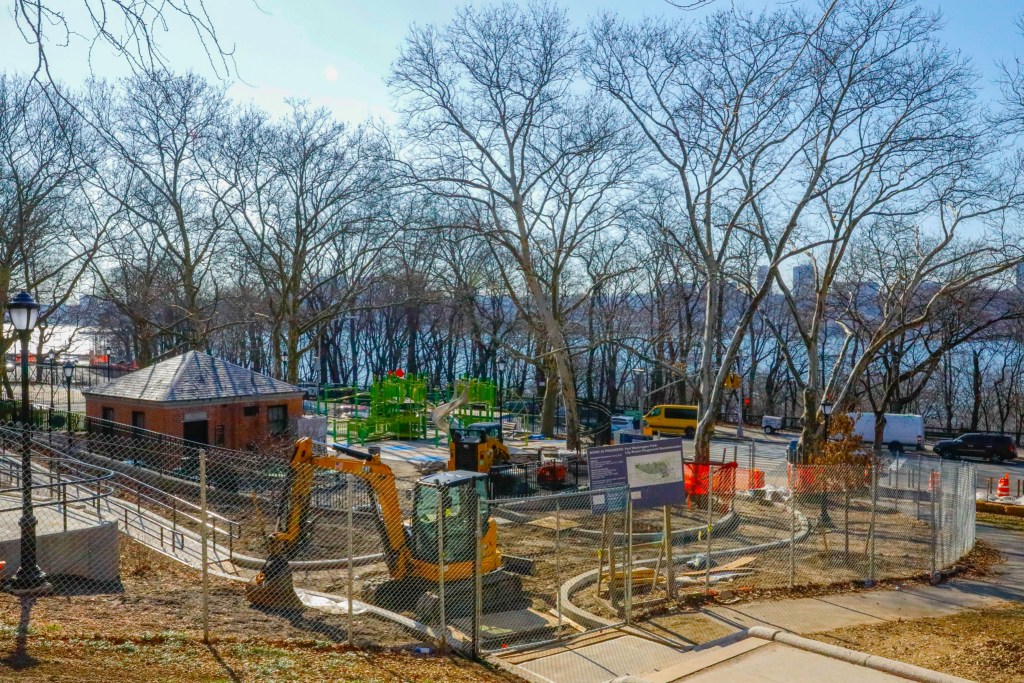 A playground and public bathroom in Fort Washington Park were closed off while the city made upgrades, March 10, 2026. Credit: Alex Krales/THE CITY
But if the still-unbuilt Fort Washington Park bathroom is any example, Mamdani’s modular loos may be years away.
Originally included in the 2022 city budget at the urging of then-Councilmember Mark Levine, who represented parts of northern Manhattan, the project was slated to cost an estimated $3.5 million.
The project’s design hit some early snags.
The design work — all done in house by Parks Department employees — was initially slated to conclude by April 2023. But it ultimately took longer, wrapping up in March 2024, according to the Parks project tracker.
The facility would include two small restrooms, a drinking fountain and storage space inside a modest cube-like structure.
Other parts of the plan got backed up, too.
Because the bathroom site sits close to the Hudson River, the New York State Department of Environmental Conservation had to weigh in on environmental regulations tied to the watershed.
City officials also ended up changing technical elements of the design.
Parks engineers raised concerns about the original air-conditioning system based on issues in other projects, prompting a redesign of the HVAC system, city records show.
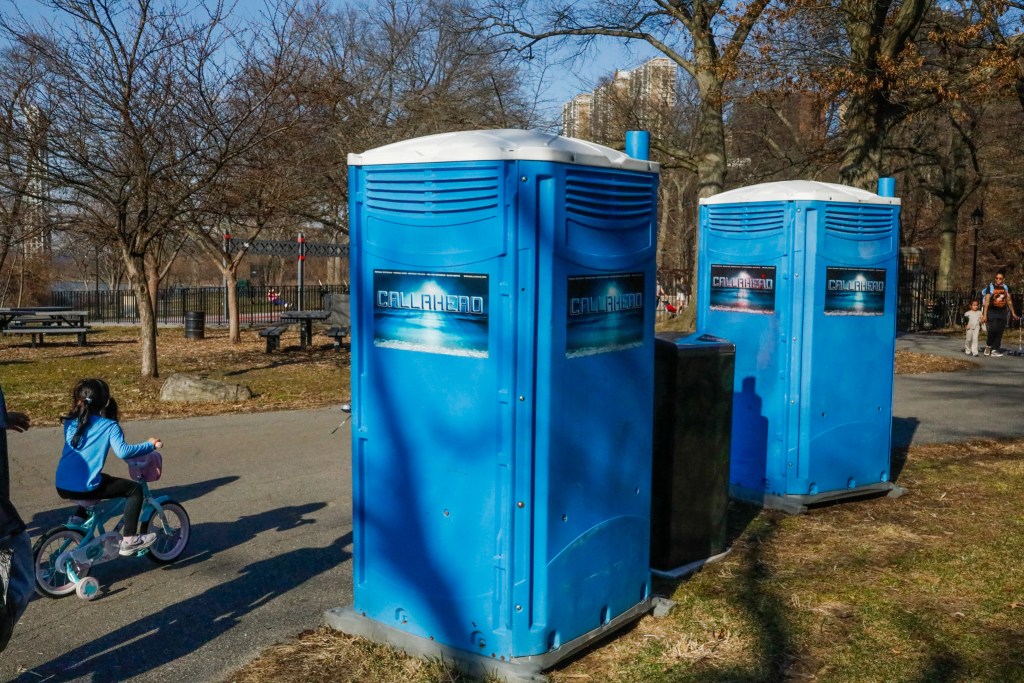 Porta-potties sat near Discovery Playground in Fort Washington Park as there was a years-long delay in construction a modular bathroom, March 10, 2026. Credit: Alex Krales/THE CITY
The result: years of design revisions and regulatory reviews while construction costs climbed by approximately 12% to 15%, according to industry estimates.
Today, the Fort Washington Park playground still doesn’t have public toilets.
“Living in the neighborhood, there has never really been one around here,” said Jovanny W., who grew up in Washington Heights and was at the park with his baby daughter Tuesday. In an emergency, he’d use the nearest bathroom, which is about a 15-minute walk away, he explained.
“It’s kind of odd that there isn’t one, to be honest,” he said.
A spokesperson for the city Department of Parks and Recreation said the project is part of the agency’s $150 million “Better Bathrooms” initiative aimed at upgrading aging facilities and building new restrooms in parks across the city.
Parks officials noted that the agency has successfully installed modular bathrooms elsewhere. A prefabricated restroom at Lopez Playground on Staten Island, which opened in 2024, recently won an American Institute of Architects New York Design Award for its modular construction.
A spokesperson for Levine, who now serves as the city’s chief financial watchdog, said he “cares deeply” about the Fort Washington Park project but declined to discuss the delays or any possible ways to speed it along.
The park’s location near a flood zone also required additional structural design and regulatory approvals, officials said.
The next phase — “procurement” — began in March 2024 and was originally expected to conclude in a year. The city has since pushed that timeline back another two years, estimating the contracting process will now stretch through March 2027.
And the city still hasn’t selected a contractor.
Parks officials estimate the construction phase typically takes 12 to 18 months for projects of this type. They have long struggled to keep routine capital projects on schedule and within initial budget assessments.
Former Parks Commissioner Adrian Benepe, who led the department from 2002 to 2012, said restroom projects were the most frustrating part of his tenure.
“Bathrooms — or as we used to call them, comfort stations — were the bane of my existence,” Benepe told THE CITY. “And this goes back decades. It’s nothing new.”
Even relatively small projects must navigate a thicket of approvals, he said, including reviews by community boards, the Design Commission, city lawyers, the comptroller’s office and budget officials.
“There are at least a dozen bureaucratic steps even a simple project has to go through,” Benepe said.
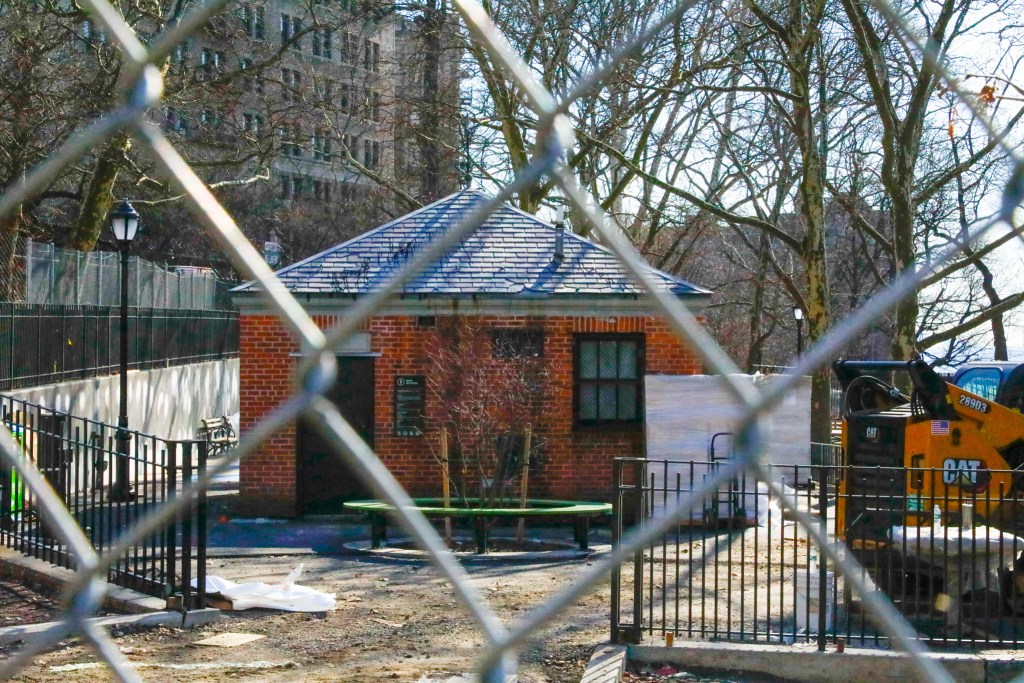 A playground and public bathroom in Fort Washington Park were closed off while the city made upgrades, March 10, 2026. Credit: Alex Krales/THE CITY
Complicating matters further is New York’s Wicks Law, a state statute that can require separate contractors for plumbing, electrical, heating and general construction work once projects exceed certain cost thresholds.
“That’s a nightmare for a simple project,” Benepe said. “You can have one contractor be bad and three be good — and that will delay everything.”
Benepe recalled one renovation of a small park restroom that dragged on for a decade.
“I used to say they figured out how to get people to the moon faster than we can fix a simple toilet,” he said.
Still, Benepe said new approaches such as “design-build” construction — where architects and builders work together from the outset — could help speed up projects if the city applies them to park infrastructure like restrooms.
The Manhattan bathroom saga echoes a notorious restroom project in San Francisco that became a national punchline after officials estimated a single public toilet could cost about $1.7 million to build.
The proposal sparked a political uproar and was eventually replaced with a donated prefabricated unit that cost a fraction of the original price.
On Tuesday afternoon at Discovery Playground, one father said the lack of a nearby restroom is a regular frustration.
Alejandro Quintero, 35, said families often end up leaving the playground if someone needs to use the bathroom.
“We go over there,” she told THE CITY, pointing toward a nearby facility several blocks away. “But it’s very dirty.”
With additional reporting from Lilly Sabella.
Related