
There was a moment, in the not-too-distant past, when you couldn’t walk through New York’s Lower East Side without encountering makeshift murals composed of Xeroxed flyers. Artists who patronized local institutions like Todd’s Copy Shop used Xerox technology to advertise shows, compile grant applications, and seek studio assistance. Now, we’ve mostly moved our notices online. But a trace of the previous practice can currently be glimpsed downtown, through the third-floor windows of the International Center of Photography on Essex Street.
The Xeroxed mural viewable from the sidewalk is actually a collage of digital photographs by Daniel Arnold that have been run through a photocopier and reproduced on letter-size paper. As was often standard in the 1980s, the “copy guy” here is not Arnold, but a third party: curator Aaron Stern. An artist himself, Stern has reinterpreted the works of fifteen contemporary photographers as photocopies for the group exhibition “HARD COPY NEW YORK.” The second element of the title grounds the exhibition both geographically and artistically, evoking Carter-era curatorial projects—Brian Eno’s 1978 compilation No New York, Diego Cortez’s 1981 “New York/New Wave” exhibition—that sought to express the unique energy of the downtown scene. Only now, the New York we see is a ghost.
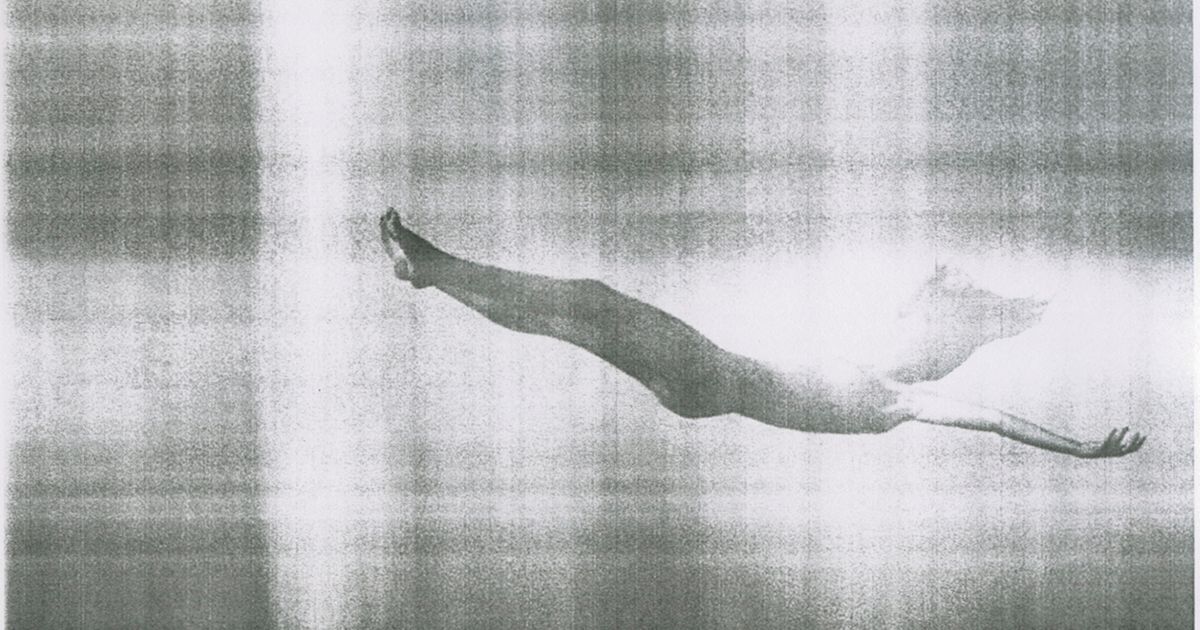
“HARD COPY NEW YORK” reflects a past image of the city back to itself in the present. Arnold’s content hews to this form—his collage is entirely composed of archival photographs documenting a decade of urban bustle. The rest of the show mirrors this marriage of process and product. Before my viewing, I anticipated that I might encounter a selection of works interrogating the formal differences between photographic and xerographic technologies. Instead, I was met by an exhibition that, in almost every moment, felt acutely attuned to Xerox’s cultural history: its typical content, modes of proliferation, and place in debates about authenticity, activism, and intellectual property.
Committed to the materiality of Xerox, Stern has hung the works with neither glazing nor framing—small nails fasten each to the wall, DIY style. The series that opens the exhibition reveals both the rigor and playfulness of the curatorial approach. In Pages from the script of Akerman Ballet (2019), Collier Schorr presents a selection of images documenting her choreographic interpretation of Chantal Akerman’s Je, Tu, Il, Elle (1974). These works tether xerography’s commercial use as a tool of replication to its personal use as a tool for recording intimacy. Amorous embraces and bare-breasted dancers abound, hinting at adolescent urges to moon, kiss, and flash the Xerox machine’s illuminated glass. Given the copy room’s association with office romance and illicit pas de deux, I’ve always found xerography to be a curiously sexy technology. And “HARD COPY NEW YORK” is certainly filled with plenty of sex. Thomas Ruff serves it to us quite explicitly, through blurry blown-up JPEGs drawn from early internet pornography in his series “Nudes” (1999–2012).
Contra the kisses in Schorr and Ruff, Zoë Ghertner gives us bodies—particularly women’s—which, while physically isolated, also forge connections through feminist art history. Leaning into xerography’s association with citation, Ghertner’s bodies are ensconced in earth à la Ana Mendieta (warm sand (or is it dirt?), 2022) or obstructed by objects à la Barbara T. Smith (Untitled (shell and belly), 2021). Other works celebrate xerography as a form of copyright infringement. Jerry Hsu’s Untitled (2011) foregrounds a wall graffitied with the words “GETTY IMAGES,” hidden behind a gate. For many, Getty’s stock images are too expensive to license—but its moniker, it would seem, is fair use. Democratic impulses zip through the exhibition. In the diptych 2.0 (2025), Ari Marcopoulos captures two buildings graffitied with the words “DESTROY/ABOLISH ICE.” Defying institutions that seek to restrict and reinforce, Hsu and Marcopoulos echo those activists who have prized both graffiti and xerography for their ability to proliferate beyond the bounds of typical written media.
The show ends on the ICP’s second floor with a series drawn from John Divola’s “Dogs Chasing My Car in the Desert” (1996–2001). Though one dog bares its teeth and casts an aggressive gaze at the camera, it is another machine—Divola’s car—that seems to have incited the canine’s response. Photocopiers are known to arouse similarly strong reactions. They jam and break down, prompting us to lose our professional cool, to curse and kick. Like an intractable lover, they are, to quote one machine technician, “notorious for not giving you what you want.” While researching a project exploring the artistic and quotidian uses of photocopy technology, I have found that two groups of people were particularly passionate to talk: teachers and photographers. The teachers, who still rely on photocopies to distribute information to students, told me that they are engaged in “daily wars” with their schools’ machines.
But the photographers were less combative, more reparative. One told me, simply, that she really loved the feel of copy paper. Her statement evinces what I take to be the central thesis of Stern’s show. In our digital age, it can be tempting to reduce photographs to mere images. But they are also objects, razor-thin as their third dimension might be. Whether made with the Xerox machine’s dry pigment or the dark room’s gelatin silver, they can be touched, rolled up, torn. As in Arnold’s photographs of packed subway cars, languid park hangs, and buzzy art openings, they can also be collaged into a flurry of populist energy—resplendently social, yet raw and unrefined, like the xerographic antidote to a solitary selfie perfected with Facetune.