
The state is adjusting its income eligibility criteria for Empower+, which helps tenants and homeowners pay for energy-saving building upgrades. Previous rules made it hard for city households to qualify: since 2010, only 7 percent of the program’s retrofit projects were in the five boroughs.
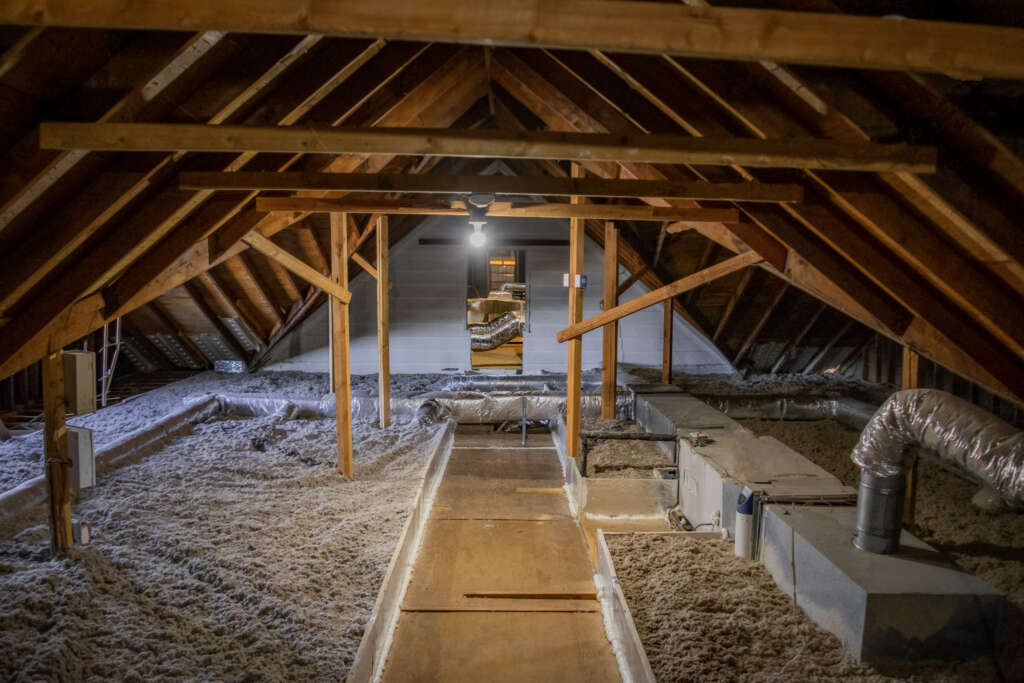
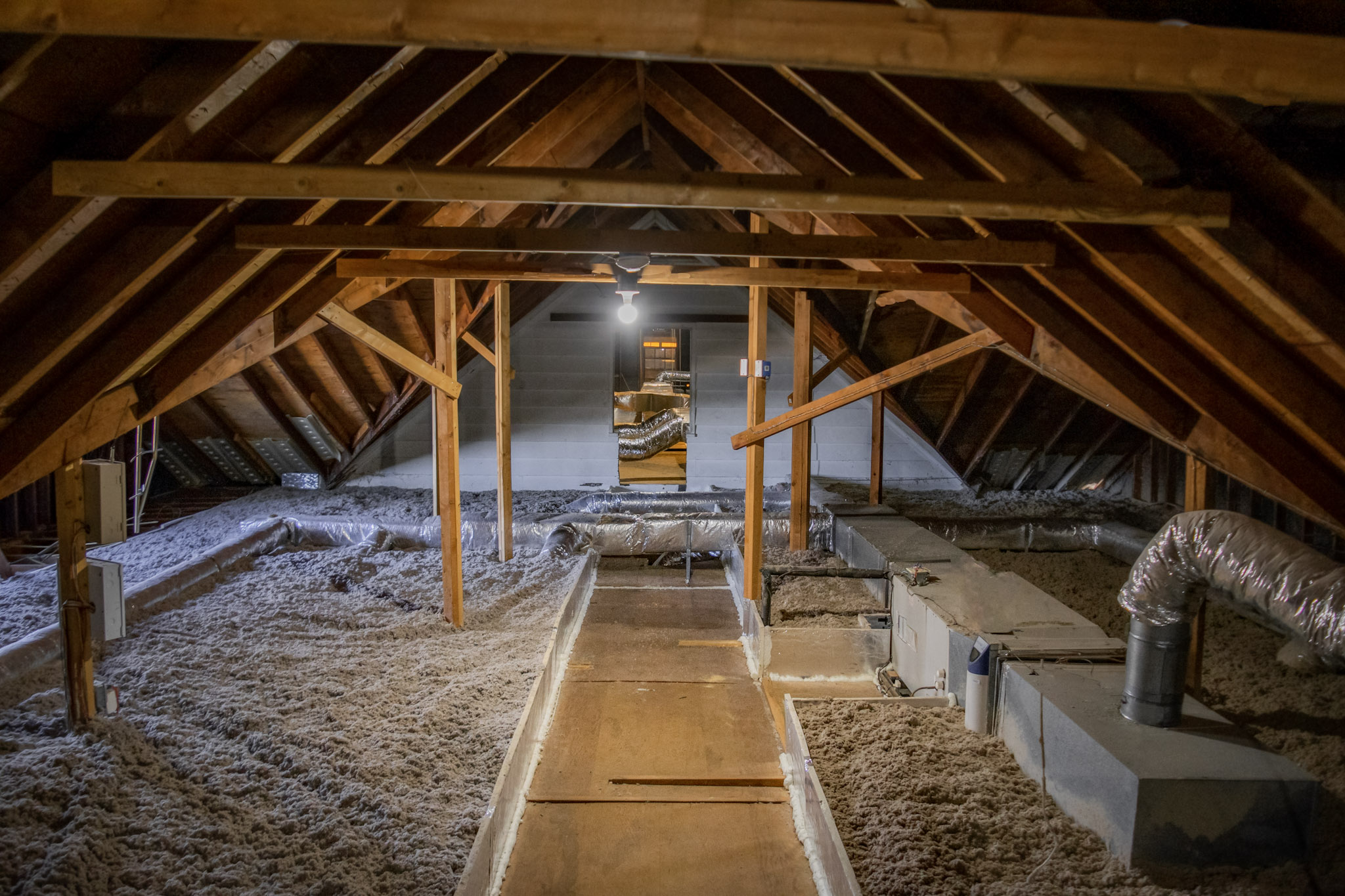 EmPower+ funds energy-efficiency projects, like new insulation. (Photo via Energy Management Solutions)
Mona Abu Rayyan has lived in her 1940s-era house in Kingston, New York, on and off for the past seven years. When she moved back in 2022, she noticed the house was very drafty, her heating bills were extremely high, and no matter how much she turned up the thermostat, it didn’t get warm, she said. At the time, she was also earning less income because she wasn’t working full-time.
Rayyan is one of thousands of New Yorkers, including city residents, who have suffered through cold winters without adequate heat.
New York State has implemented several policies and programs to help residents who are spending a large chunk of their income on electricity and gas to heat, cool and power their homes. The most prominent is EmPower+, run by the New York State Energy Research and Development Authority (NYSERDA), which provides single- to four-family households that qualify with energy-efficient upgrades, like adding insulation and air sealing and installing clean heat pumps.
These upgrades are provided at either little or no cost to residents. They lower people’s utility bills by reducing the amount of energy they use. They also provide a climate benefit, reducing the amount of greenhouse gases properties emit by enabling residents to switch to electric energy. The city’s residential buildings produce almost 20 million tons of carbon dioxide, most of which comes from natural gas.
After a contractor Rayyan was working with recommended she apply, she went online and completed the application. An engineer from Energy Management Solutions, a local company that evaluates a households’ energy use and installs efficiency upgrades, came to her house to perform an energy audit. Based on the results of the evaluation, NYSERDA approved a full $13,437 grant to upgrade her home. The company installed new insulation and sealed air leaks around her windows, doors, and in her garage.
“My house is warm,” said Rayyan. “It’s really made a huge difference. I was super grateful.”
Although she wasn’t able to afford to convert from fuel to electric heating, Rayyan said the improvements have definitely helped her save money. “I think if my house wasn’t insulated the way it is now, I’d be paying a lot more for my heating bills.”
Since 2023, EmPower+ projects have allowed participating households to save, on average, $581 per year. But many low-income households in New York City haven’t been able to take advantage of the program.
However, beginning March 18, more city households will be able to apply for EmPower+ as a result of a change to its income-eligibility requirements.
“The rules are going to change, and more people will be considered eligible at the low-income level than had previously,” said Rebekah Morris, director of climate initiatives at the Pratt Center for Community Development.
 (Michael Appleton/Mayoral Photography Office)
Since 2010, only 7 percent of all EmPower+ energy-efficiency retrofit projects were in the five boroughs. “As you can imagine, those are very poor outcomes, especially because we have 863,000 one- to four-family homes in New York City,” said Morris.
Pratt Center research found that one of the main barriers was the way NYSERDA determined income eligibility. To qualify for the program’s “low income tier”—which provides up to $10,000 per project—eligible households had to prove they made less than 60 percent of the State Median Income (SMI), or $39,864 for a single person, according to the Empower+ website.
This excluded many city households in urban areas where the costs of living are higher, advocates say. “That’s predominantly hurting Brown and Black communities,” said Morris.
The Pratt Center, among other groups, championed for NYSERDA to use Area Median Income (AMI), which is often used for smaller metropolitan areas, to expand New York City households’ access to the incentive. “I’m happy to say that’s actually one of the few things that we actually won that we were advocating for,” Morris said.
Starting this week, households can qualify for the low-income tier if they earn at or below 60 percent Area Median Income or State Median Income, whichever is greater. Using Area Median Income, which varies based on county and household size, could make it easier for families to qualify since AMI is higher than SMI. For instance, using AMI, a two-person household could earn up to $77,760 to meet the low-income threshold.
The income requirement for the program’s moderate-income tier—which provides up to $5,000 per project—will remain the same. Eligible households must prove that they earn less than 80 percent of State or Area Median Income, whichever is higher.
EmPower+ served over 7,000 households in 2023, and more than 22,000 households per year in both 2024 and 2025, according to a NYSERDA spokesperson.
A balanced household budget should direct about 6 percent or less of expenses toward energy costs, according to a 2020 report by the American Council for an Energy-Efficient Economy. Anything more than 6 percent is considered a “high energy burden,” and over 10 percent is considered severely high.
But in 2020, a quarter of low-income households in New York City were spending more than 17 percent of their income on energy, primarily gas and electricity bills. More than 30 percent of Black and Hispanic households in the city have a high energy burden, according to the report.
“Because energy bills are so high, people sometimes forgo other basic necessities like sufficient nutrition or healthcare in order to be able to afford their energy bill, or they keep their home at an unhealthy temperature,” said Jessica Azulay, executive director for Alliance for a Green Economy.
A steam radiator in a Bronx apartment building. (Adi Talwar/City Limits)
Those impacts are not borne out equally, advocates say. “People who have less income or who’ve historically suffered racial and economic discrimination tend to live in older housing stock,” Azulay said. Older buildings are more likely to rely on inefficient or outdated heating and cooling systems, often leading to higher utility bills.
Launched in 2023 as a consolidation of two previous programs, EmPower+ also helps lower peak energy demand across the state, translating into lower bills for utility customers beyond the initiative’s participants.
Homeowners, and renters who have approval from their landlord, are eligible to apply if their total household gross income meets the requirements, or if they receive benefits from the Home Energy Assistance Program (HEAP), SNAP, or other forms of public assistance. For two- to four-family dwellings, the entire property is considered eligible if at least half of the units are low or moderate income.
In addition to new insulation, air sealing, and heat pump installation, typical home improvements include replacing old light bulbs with high-efficiency options. Low-income households may also receive credits on their electricity bills if they’re eligible to join a community solar project.
The additional funding for EmPower+ is coming from several sources: The state recently announced that the program received a significant boost from the Regional Greenhouse Gas Initiative (RGGI), a cooperative program dedicated to reducing carbon dioxide emissions from power plants in several Eastern states including New York.
In the current 2025-2026 state budget, the program received $50 million, less than the initial one-time infusion of $200 million from the state for the 2023-2025 fiscal years.
However, NYSERDA will allocate $120 million to EmPower+ this year, up from $110 million in 2025. In addition, the Public Service Commission allocated $445.5 million for the program to be distributed over the next five years, according to a NYSERDA spokesperson.
The additional funding from the Regional Greenhouse Gas Initiative makes up for the decrease in state budget funding. The current total budget for EmPower+ is approximately $234 million, the program’s highest budget since its creation in 2023. But the boost from RGGI is temporary, and the EmPower+ budget could fall to $124 million in 2027.
Environmental and energy advocates like Rewiring America and the Alliance for a Green Economy want the state to allocate $200 million for Empower+ in the upcoming budget, due April 1, so the program can continue to meet growing demand.
It comes as the federal government cuts, or looks to cut, other clean energy and utility savings programs.
“When you see the federal cuts that are happening to end energy affordability programs… it’s more important than ever to have programs like [EmPower+] to help people reduce their energy burden,” said Michael Hernandez, New York policy director at Rewiring America.
To reach the editor, contact [email protected]
Want to republish this story? Find City Limits’ reprint policy here.