
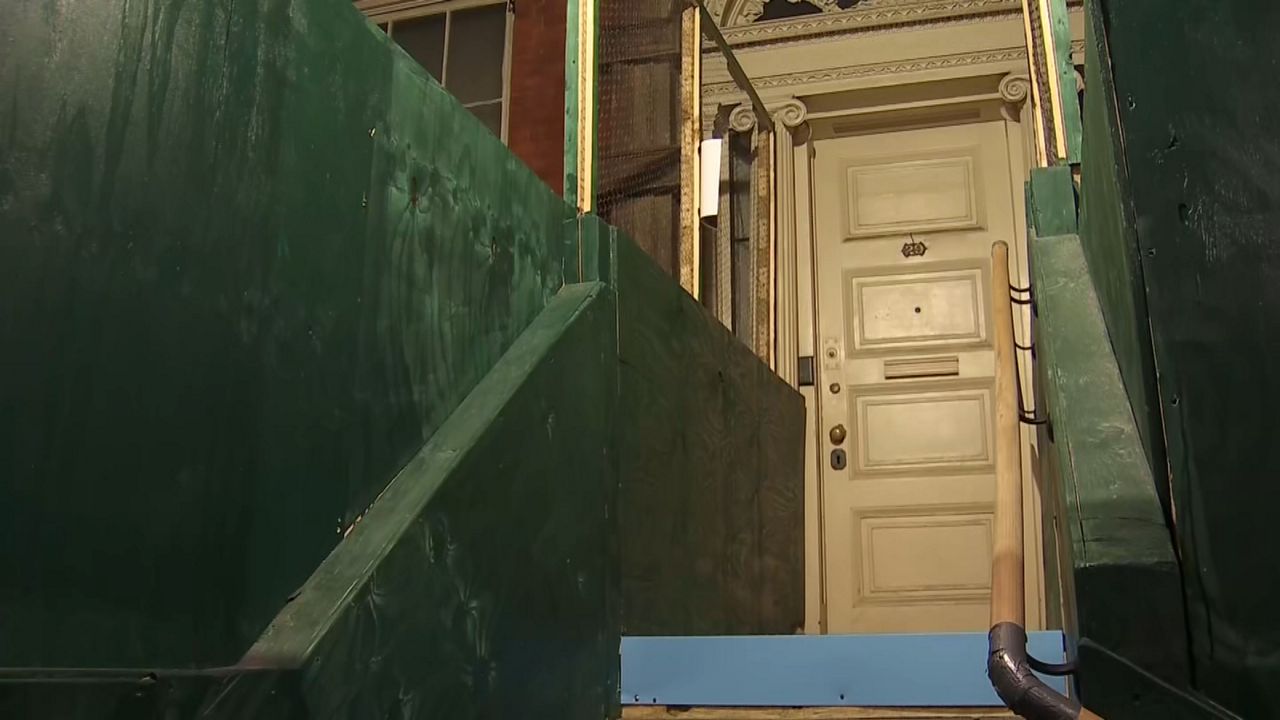
For nearly two centuries, a brick townhouse on East 4th Street in NoHo has stood quietly through defining chapters in America’s fight for freedom, from slavery to the Civil War to the generations of civil rights struggles that followed.
Now, the building that has witnessed centuries of history finds itself at the center of a modern battle over development.
What You Need To Know
Supporters gathered inside the Merchant’s House Museum Monday, urging the city’s Landmarks Preservation Commission to reject a proposal to demolish a neighboring garage and build a new commercial building
A schematic highlights what engineers call the “zone of influence,” the area most likely to be affected by excavation. Preservationists say what is believed to be a stop on the Underground Railroad falls within that zone
The Landmarks Preservation Commission is expected to discuss the project at its meeting on Tuesday, which will give the commissioner and the public an opportunity to ask questions of the developer
“For a developer to destroy history for profit is something that we should not tolerate or stand silent,” the Rev. Al Sharpton said.
Sharpton, along with other supporters, gathered inside the Merchant’s House Museum Monday, urging the city’s Landmarks Preservation Commission to reject a proposal to demolish a neighboring garage and build a new commercial building.
Their concerns intensified after a discovery hidden inside the house itself.
Behind a built-in chest of drawers, a narrow passageway, about two-feet wide, drops roughly 15 feet between floors. The find was exclusively shown to NY1’s Cheryl Wills, something preservationists believe is a stop along the Underground Railroad.
“The Underground Railroad site has accentuated the importance of this building because it’s the first Underground Railroad site to be discovered intact in Manhattan in over 160 years,” Michael Hiller, a preservationist attorney, said.
Renderings from the developer show the proposed building on the adjacent site towering beside the historic house.
Another schematic highlights what engineers call the “zone of influence,” the area most likely to be affected by excavation.
Preservationists say the newly discovered passageway falls within that zone.
“Two independent engineers have confirmed that this building would be a risk for structural compromise,” Hiller said.
According to historians, the land was once part of one of New York’s earliest free Black settlements, raising the possibility that artifacts or even burial sites remain underground.
Some advocates say the city should delay construction or purchase the adjacent lot to allow further archaeological study.
“As chair of the Landmarks subcommittee in the City Council, I urge LPC to do the right thing,” Councilmember Christopher Marte said.
Museum leaders say if construction moves forward, the building and its historic collection may have to close during the project.
“We are asking the Landmarks Preservation Committee to do the right thing and to ensure that this house and this really special discovery is protected and saved for future generations,” Emily Hill-Wright, director of operations, said.
For preservationists, the fight is about more than one building, but whether a place tied to the history of freedom in New York will remain standing for generations to come.
NY1 reached out to City Hall and the developer for comment regarding the claims and concerns, but had not heard back.
The Landmarks Preservation Commission is expected to discuss the project at its meeting Tuesday, which will give the commissioner and the public an opportunity to ask questions of the developer.