
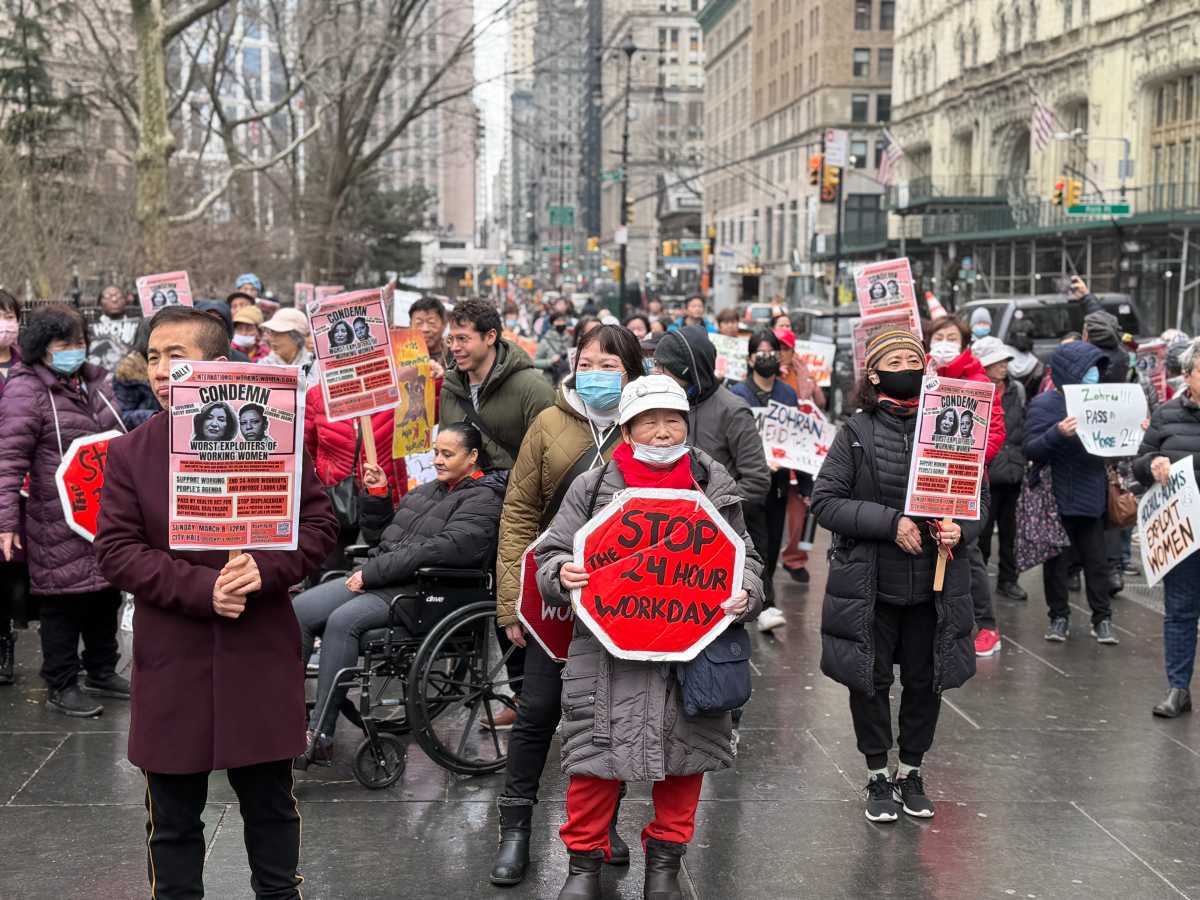
Protesters and labor unions from Queens and across New York City rallied near City Hall on March 8, International Women’s Day, demanding the City Council stop delaying the passage of the No More 24 Act, which would ban the 24-hour workday that disproportionately impacts women working in home health care.
If the bill is not passed by March 18 — two days from now — members of the Coalition to Fight for Our Health and Lives said they would organize daily sit-ins at City Hall until it is passed.
“Every day you delay is another day we women workers suffer,” one protester said. “We have permanently lost our health, and no amount of money can buy it back. Some of our sisters have already passed away. The 24-hour workday must stop immediately.”
The next City Council meeting will be held on March 26, making that the earliest possible date for the bill to be passed.
Under New York State law, it is legal for employers to only pay wages for 13 hours of a 24-hour shift, claiming the unpaid hours for sleep and meal breaks. However, home care workers at the protest said these breaks do not exist, and many are forced to endure sleepless nights to care for patients.
According to Legistar, the bill is currently laid over in the Committee on Civil Service and Labor, although Councilman Christopher Marte originally introduced versions of the bill in 2022 and 2024 that never made it to a vote.
As of press time, there’s no listed date as to when this version of the bill would be voted on because the bill’s final language is still being negotiated between the committee and a representative from Mayor Zohran Mamdani’s office.
Once the bill is aged — meaning the language is finalized — the bill will be placed on all councilmembers’ desks to be reviewed for at least one week before the City Council can vote on it and, subsequently, the mayor can sign it.
However, a spokesperson for Mamdani’s office said the mayor’s legal team is working to address legal concerns in the bill’s language that could leave workers vulnerable.
Nonetheless, Mamdani said he is committed to working alongside home care workers, the council and the state government to pass stronger protections that improve working conditions for caregivers.
 Protesters emphasized the deadly toll of 24-hour workdays on workers — especially women — who said they suffer from sleep deprivation and perform physically laborious tasks with no sufficient breaks for rest.Photo by Renee DeLorenzo
However, protesters said while workers keep waiting for its passage, the 24-hour work day continues to take a deadly toll on home care aides — especially women, who make up 89% of the NYC home care workforce.
They also accused Gov. Kathy Hochul and former Speaker Adrienne Adams — running mates in this year’s gubernatorial election — of abusing their power to line the pockets of health insurance companies at the expense of women’s health.
“It is the tradition of Sojourner Truth, who stood in front of a hostile crowd and asked a question that still echoes today — ‘Ain’t I a woman?’” said Renee Keitt, president of the NYCHA Elliot-Chelsea Houses tenants association. “She was asking the world to recognize the humanity and labor of women who were ignored, exploited and erased. We are the women who are often so invisible in the politics of this city, but whose labor makes this city possible.”
As of press time, the Office of the Governor did not respond to requests for comment from either Hochul or Adams.
Members of several labor unions attended the protest — including the Chinese Staff and Workers Association, Feminist Generation Flushing, Flushing Workers Center, Health Justice for NY, NY Progressive Action Network, Queens Anti-Casino, and Working People for Health.
What are the challenges faced by home care aides?
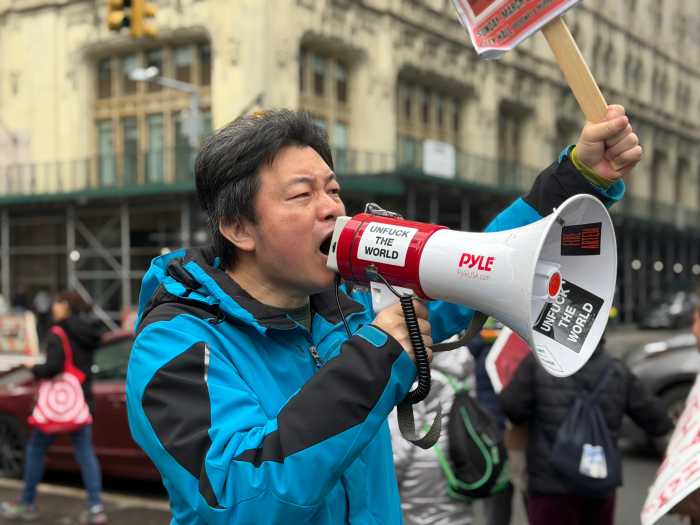 Protesters marched in support of home care workers, shouting chants demanding no more delays to the No More 24 Act.Photo by Renee DeLorenzo
According to a report by the City Council Labor Committee, not only are a majority of home care workers women, but 59% of them are people of color.
The starting salary for home care workers is just over $36,000, and the experienced salary is just under $43,000.
The report points out that the estimated true cost of living in New York City for a single adult is between $46,000 and $76,000, depending on the borough.
About 15% of home care workers live in poverty.
“Stop the displacement,” protesters chanted on March 8, pointing out that when wages don’t keep up with cost of living, many of these essential workers in the growing industry are priced out of the city.
According to state law, the 24-hour workday excludes 11 hours for sleep and meal breaks from compensable hours for home care employees assigned to 24-hour shifts, provided that the home care worker has uninterrupted 5 hours of sleep and 3 hours of mealtime. This is often referred to as the “13-hour rule.”
“The court reasoned that an employee who was on a meal or sleep break, even if they were present at the care recipient’s home, was considered ‘unavailable for work,’” the labor committee report explains. “Thereby, [it is] excluded from billing for such uninterrupted time.”
While the report states that the median age of home care aides is about 49 years old, a Journal of the American Medical Association Network study found that workers who were “providing care and experiencing caregiver strain” had mortality risks 63% higher than those of non-caregiving participants.
 A protester recounts her own experience as a home care worker, saying it led to chronic pain and medical conditions that stem from inhumane working conditions.Photo by Renee DeLorenzo
One healthcare worker at the protest said she endured eight years of 24-hour shifts, lifting a 160-pound senior onto the toilet and their wheelchair, turning their body every two hours in the night.
She said her work caused chronic insomnia, osteoporosis, joint damage, shoulder and nerve pain, declining eyesight, cramps and crooked fingers.
“The 24-hour workday is a chronic murder of hundreds of women,” a protester said, who called it a modern-day slavery system. “Everyone acknowledges that the 24-hour shift is wrong and inhumane. When workers are brutalized, our patients can’t get the good quality care they need.”
What is included in the No More 24 Act?
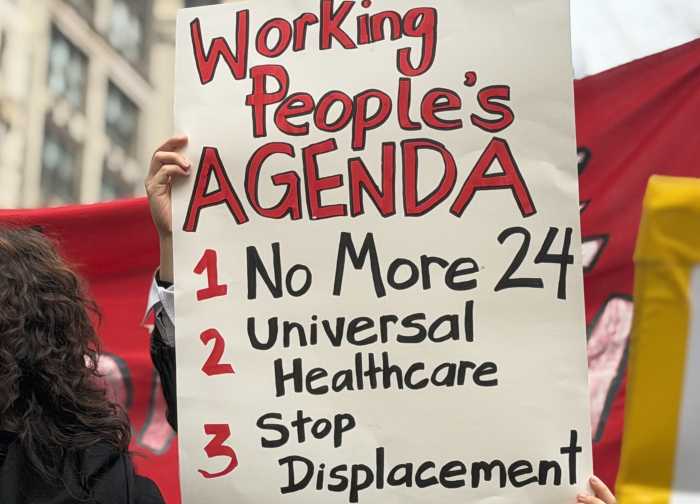 Protesters held signs that outlined their demands, including the passage of the No More 24 Act.Photo by Renee DeLorenzo
A summary of the No More 24 Act — which was reintroduced by Marte on Jan. 29 from previous versions in 2022 and 2024 — states that it would amend the administrative code of the city of New York in relation to maximum working hours for home care aides.
The bill states that assigned hours to home care workers would be limited to 12 hours for any shift, or within any 24-hour period.
While a home care aide could be assigned additional hours in an emergency, the bill would limit them to no more than 2 hours per day or 10 hours per week.
A home care aide could be assigned to work more than 56 hours in a week, but the bill would require the employer to provide 2 weeks’ advanced notice and obtain written consent from the home care aide in order to do that.
On Feb. 18, a public hearing was held in the labor committee during which community organizers, workers, council members and a member of the mayoral administration had the opportunity to testify.
 Councilman Christopher Marte — who introduced versions of the No More 24 Act in 2022, 2024 and January of this year — accused former Speaker Adams of blocking the bill’s passage.Photo by Renee DeLorenzo
At the March 8 protest, Marte claimed former Speaker Adams refused to push forward the No More 24 Act, and that Hochul, who has been in office for over five years, has still not worked to end the 24-hour work day across the state.
He said the protest was not just a celebration of women and workers — it was a call to action.
“We’re living in a society where we’re only asking for crumbs — we’re asking for the bare minimum,” Marte said. “We’re asking for dignity. We’re asking to make sure that New Yorkers can stay here.”
Why are protesters blaming Hochul and Adams?
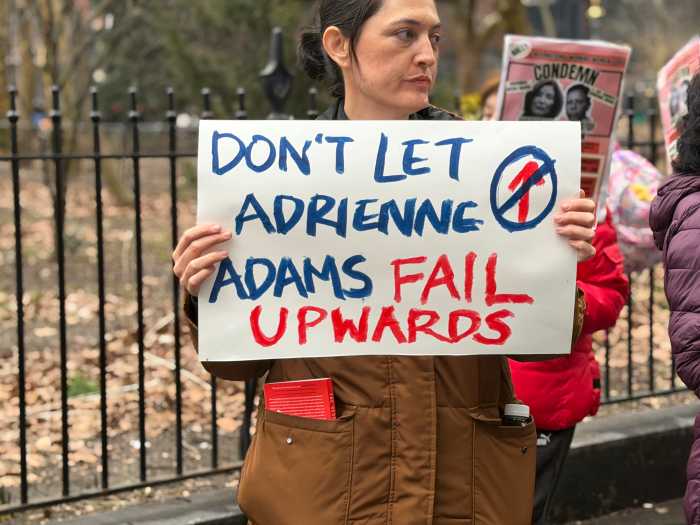 Protesters called on voters to reject Hochul and Adams in the governor’s race, claiming they do not protect women’s or worker’s rights.Photo by Renee DeLorenzo
Protesters accused Hochul and Adams of blocking the bill and failing to enforce labor law.
While the No More 24-Hour Workday Act is a city-wide proposal, protesters said Hochul has fueled the 24-hour workday across the state.
“These women sit on thrones cushioned by the insurance companies, sweatshops, and other politicians they collude with,” one protester said. “They ignore the blood, sweat, and tears of the working people they claim to serve time and time again. Progressive faces in high places sell our health and livelihood to the highest bidder.”
Their criticisms stem from a Nov. 14 case filed by Roberta Reardon, commissioner of the New York State Department of Labor, that appealed an Albany County Supreme Court decision reopening hundreds of wage theft cases that had been closed by the DOL.
According to documentation about the case, Reardon filed an appeal in the state’s appellate court to reverse the court decision made on Oct. 9, 2024, which annulled the DOL’s determination to “discontinue investigations of complaints for underpayment of wages submitted by home care aides whose unions had either obtained relief or were pursuing claims for relief on their behalf.”
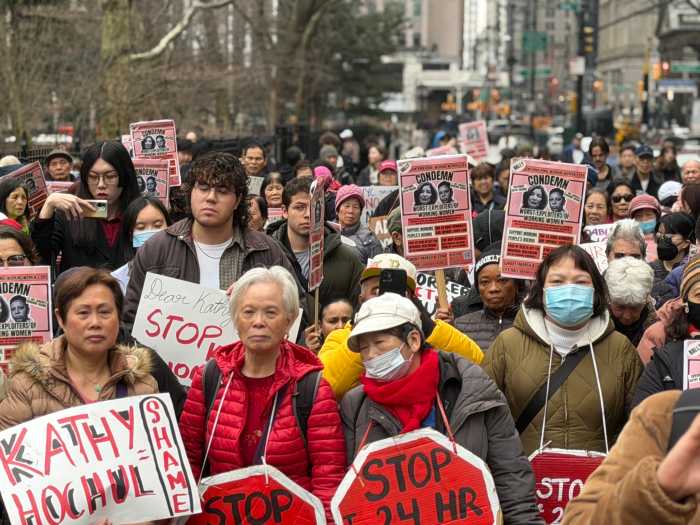 The crowd of protesters held signs claiming Hochul and Adams have perpetuated the 24-hour work day.Photo by Renee DeLorenzo
The original case — filed in 2019 by Gui Zhu Chen, Ya Yun Li, Maria Rodriguez, Gui Hua Song and Chun Feng Zhuang — specifically references the Chinese-American Planning Council (CPC) Home Aide Program and the First Chinese Presbyterian Home Health Agency, which workers claimed are violating the law and sued for stolen wages.
Hochul has regularly awarded funds to the CPC and called it “a social services organization that creates positive social change” in 2022, three years after the DOL became aware that 1199SEIU had filed grievances against the employer on behalf of home care aides.
Workers also protested against Hochul for partnering with the CPC for the New York’s Consumer Directed Personal Assistance Program in 2024.
“This must end now,” the protester continued. “We all deserve healthcare regardless of where and what hours we work. We call on all working people not only to condemn Kathy Hochul and Adrienne Adams, but to unite against the destruction of our health under these crushing policies.”
What do workers demand from Mayor Mamdani?
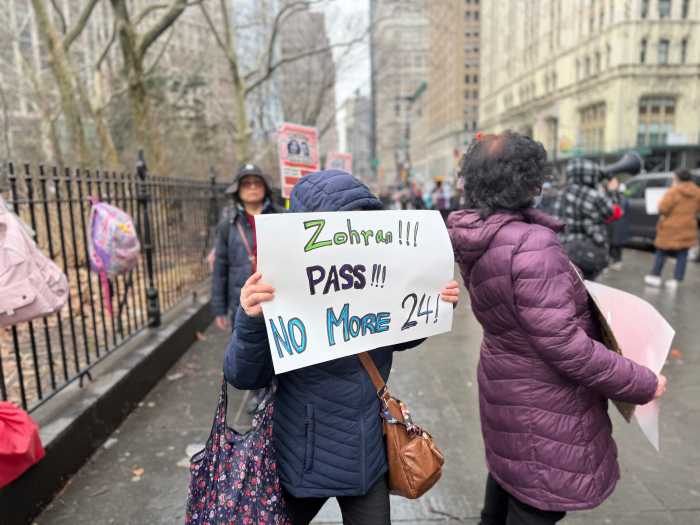 Protesters demanded Mamdani stop delaying the passage of the No More 24 Act and complete negotiations with the New York City Council to stop the suffering of home care workers.Photo by Renee DeLorenzo
While coalition members said they are aware of the process it would take to pass the law before it arrives on Mamdani’s desk to be signed, they called on the mayor to finish negotiations with the labor committee and urge finalization of the language so it can be voted on immediately.
Protesters said they are tired of the delays and demanded Mamdani — who said he has always stood with home care workers in their fight for dignity, fair wages, reliable hours and respect — to keep his campaign promise to home care workers.
“What [is Mamdani] still waiting for?” one protester asked. “Do you want to collude with Governor Hochul and keep tormenting us women?”
A spokesperson from Mamdani’s team wrote to QNS on March 11, emphasizing that the mayor cannot sign the bill until it makes it through the City Council.
However, he pointed out that Mamdani has long supported home care workers and even attended a December 2024 rally demanding the return of stolen wages to these workers.
“Home health aides show up for New Yorkers every single day, caring for our parents and loved ones,” the spokesperson wrote. “But the workforce that sustains our care system — predominantly women of color and immigrants — is too often asked to perform this vital labor without the fair pay and stable schedules they deserve.”
 Photo by Renee DeLorenzo
 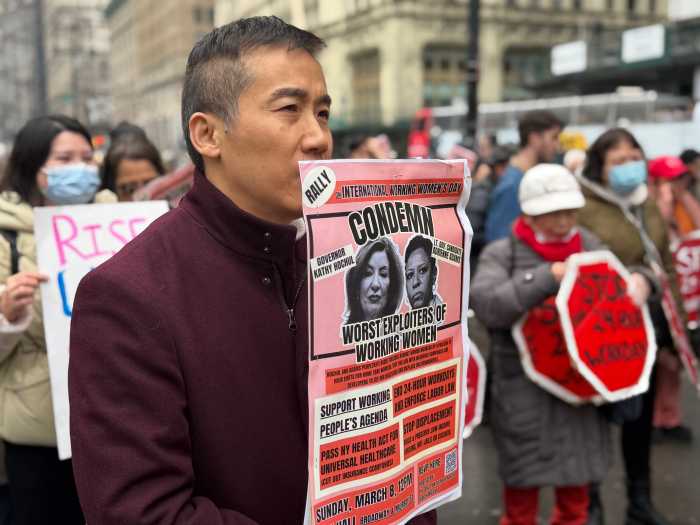 Photo by Renee DeLorenzo
 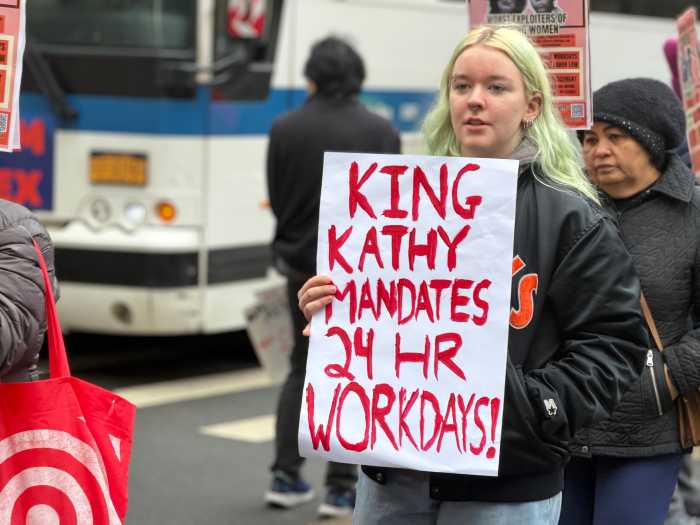 Photo by Renee DeLorenzo
 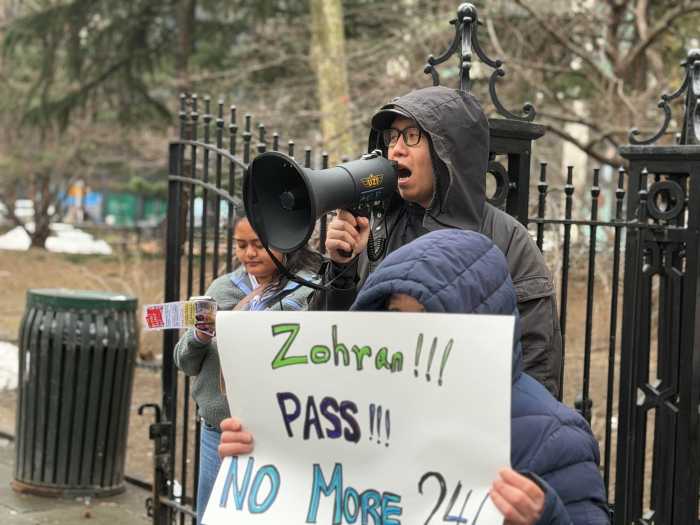 Photo by Renee DeLorenzo
  Photo by Renee DeLorenzo