
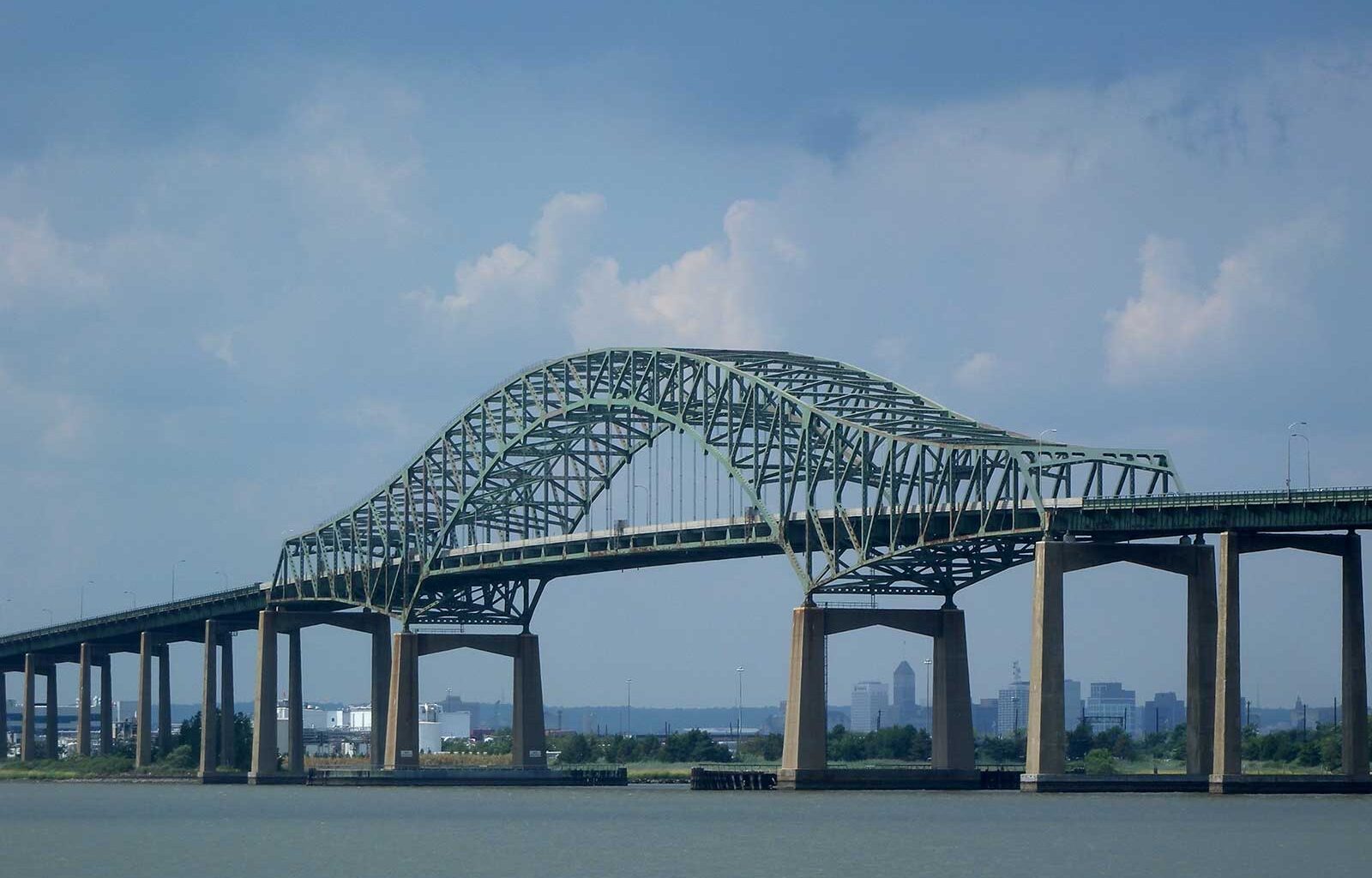
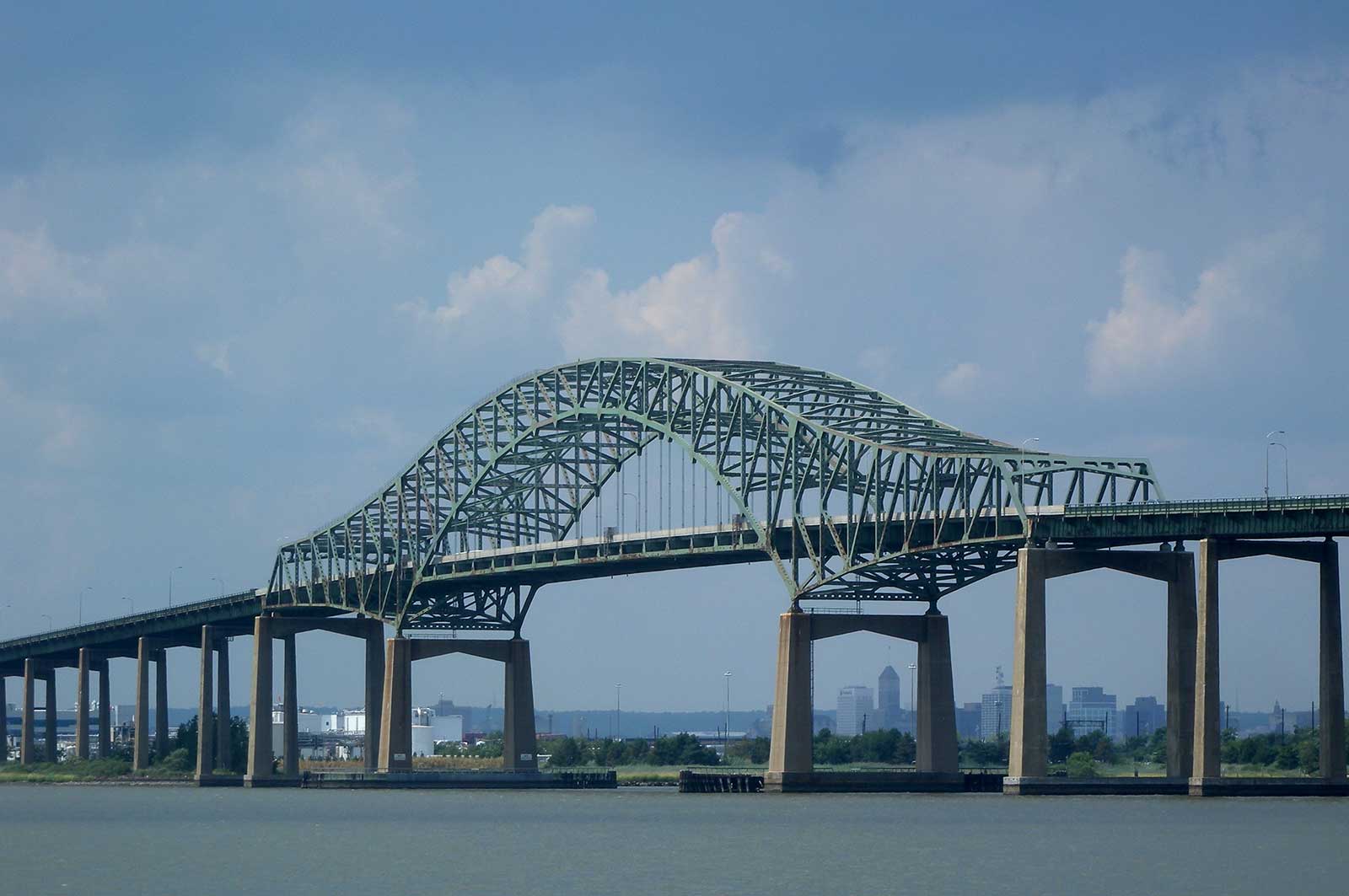
 The Newark Bay Bridge connects Newark to Bayonne and is one of the main routes in and out of lower Manhattan. Image via Wikipedia.
Governor Mikie Sherrill’s plan for the Newark Bay Bridge is being hailed as a victory for environmentalists who believe a previous plan unveiled during her predecessor’s administration to enlarge the bridge would have increased pollution without addressing congestion.
But transportation advocates believe this decision, along with a key staffing decision, could signal a broader shift in how the state government plans infrastructure in our largest cities.
The plan to replace the Newark Bay Bridge, which connects to the New Jersey Turnpike, was unveiled in 2020 when the Turnpike Authority unveiled its $24 billion capital plan. It was the largest capital plan in the agency’s history. But what was most notable to EmpowerNJ’s John Reichman was their plan to build a second bridge beside it to add additional lanes to the highway.
Reichman, who is credited with sounding the alarm about the bridge expansion at a time when many residents were distracted by the pandemic, launched an opposition campaign against it.
“We tried to elevate it and ultimately I think we were successful,” he said.
In New Jersey, transportation is the leading cause of pollution. More lanes mean more cars and trucks passing through places like Newark’s Ironbound neighborhood, which has some of the state’s highest asthma rates.
“It’s also the leading cause of greenhouse gases,” Reichman said. “It’s the same old story — the most disadvantaged communities would have seen the most significant damage from this expansion.”
It certainly helped that the state’s two largest cities, which are connected by the Newark Bay Bridge and its Turnpike connection, were against it. In 2022, the Jersey City Council passed a resolution against the expansion. Sitting on the City Council at the time was a once-and-future mayor, James Solomon.
“One of my earliest memories of Mayor Solomon was of him going out and getting people to sign petitions opposing the turnpike expansion,” Reichman said.
Soloman recently co-wrote a letter with Newark’s Mayor Ras Baraka in support of Sherrill’s announcement.
“Today’s decision acknowledges that the previous proposal would’ve opened the floodgates of heavy traffic through communities that already bear a high burden of traffic and air pollution,” the letter states. “For years, our communities fought against a seriously ill-conceived plan while proposing serious alternatives.”
There is a tenet in transportation circles called “induced demand,” meaning the more you build roads and highways, the more cars will come, meaning the expanded lanes never really meet the demand.
“If you look at the huge highways in Texas and Los Angeles, they keep building more lanes hoping to alleviate traffic, but within five years those lanes get full again,” said Talya Schwartz, president of Safe Streets and vice president of Hudson County Complete Streets. “We know traffic is a problem, but building more lanes isn’t going to solve it.”
Schwartz believes that Sherrill’s pushback on the Turnpike Authority’s original plan is significant, as the government agency has historically had little pushback in deciding the fate of our road network.
“From our perspective, the New Jersey Turnpike Authority hasn’t seen a lot of opposition to their work in the last 20 to 30 years,” Schwartz said.
Sherrill also made a major staffing decision by naming Kris Kolluri, chief executive officer of NJ TRANSIT, to become head of the New Jersey Turnpike Authority, a move that should bring the two agencies together.
“To us, it’s a signal that she is trying to bring the agencies closer together and to think more about how to move people more efficiently,” Schwartz said. “We took that as a hopeful sign that she’s looking at transportation differently.”
Sherrill’s predecessor, Governor Phil Murphy, leaves behind a complicated legacy in terms of transportation policy, as NorthJersey.com examined. His administration helped fund millions of dollars worth of train station upgrades while adding more buses, notable as we’ve seen the demise of commuter bus lines like Decamp.
However, before leaving office, Murphy signed a controversial law requiring e-bike users to obtain a license and registration and, in some cases, insurance. It comes at a time when Jersey City residents saw a 114 percent increase in bicycle use between 2016 and 2024, according to the American Community Survey.
Some believe this law will prevent road accidents, but others believe dedicated bike lanes could achieve the same without introducing so many new restrictions. In 2024, Murphy also approved a 15% NJ Transit fare hike.
New Jersey’s metropolitan areas seem to be opting for mass transportation. The American Community Survey estimates 44 percent of households in Jersey City are car-free in 2024, up from 37 percent in 2016. Jersey City has also seen a 33 percent increase in PATH use, 157 percent increase in light rail.
One idea that Schwartz’s organization, Hudson County Complete Streets, has proposed to address Turnpike congestion is to expand the light rail network in Newark, Jersey City, and Paterson. Her nonprofit recently launched a campaign called Better Light Rail. It comes at a promising time as Sherrill’s transition team published a report that dedicates an entire section to expanding light rail in New Jersey.
“When we were opposing the Turnpike, people were asking, what is our solution to traffic?” Schwartz said.