
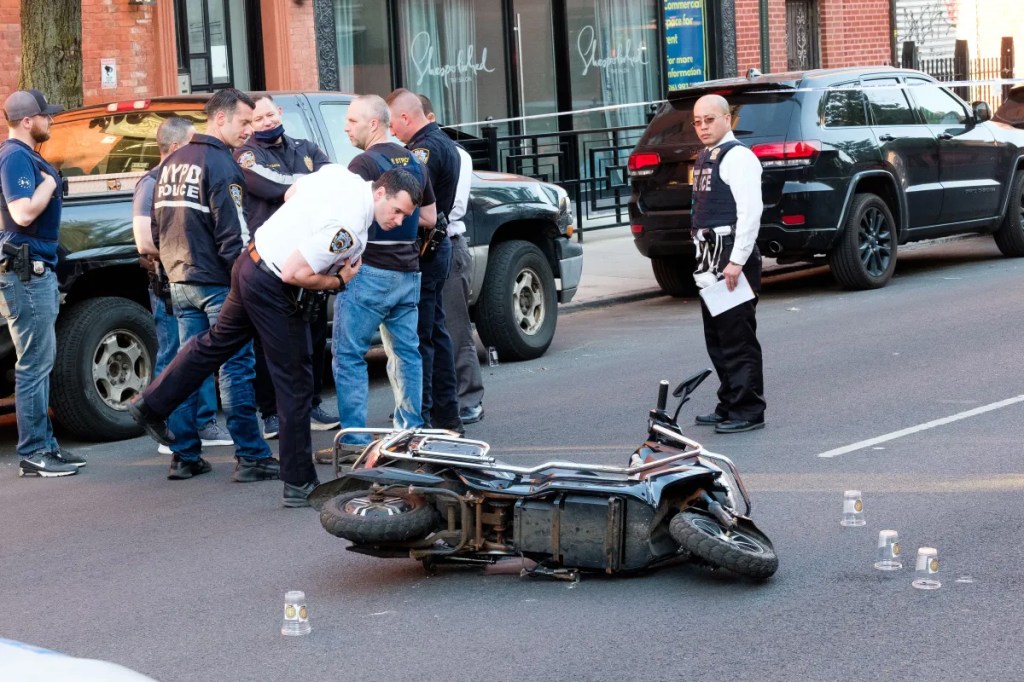
A Brooklyn drug dealer hired a third party to pressure a juror and get a mistrial in his murder trial, according to prosecutors — but round two didn’t go his way after a judge took the rare step of allowing a fully anonymous jury.
Saalik Jackson, 47, was sentenced to the maximum 25 years to life Tuesday, four months after being found guilty of second-degree murder and weapon possession in Brooklyn Supreme Court for the 2021 fatal shooting of Brandon Washington.
“As I presided over both trials in this matter, I did hear first-hand the details of the crime,” Judge E. Niki Larin said Tuesday. “The evidence showed a killing without any provocation, done in broad daylight, with many bystanders in close proximity. This was a brazen, targeted killing.”
Prosecutors called the shooting “utterly despicable and senseless,” laying out in a sentencing memo how Washington, 42, was riding on a moped, unarmed and heading to get a haircut for a memorial service in honor of his grandfather, when Jackson killed him on May 14, 2021.
“The day that we lost Brandon, we lost not just a son, but a devoted father, a brother, a grandson, an uncle and a great friend,” Washington’s family said in a statement read in court.
Jackson ambushed him in the middle of the street on Marcus Garvey Blvd. and Hancock St. and fired five times, hitting him in the torso, hip and buttocks.
Jackson, a long-time drug dealer in Bedford-Stuyvesant, had been feuding with Washington for decades. Washington shot one of Jackson’s childhood friends to death in 2001, prosecutors said in an October hearing.
“Brandon Washington was unarmed and simply going about his day when this defendant brazenly opened fire, killing him and endangering others nearby,” Brooklyn D.A. Eric Gonzalez said Tuesday.
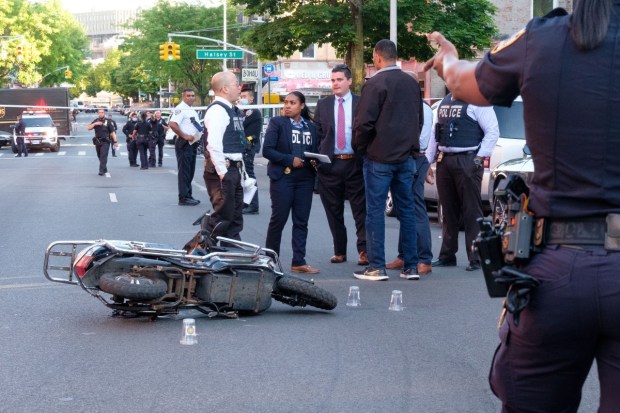 Brandon Washington was fatally shot in the head as he took a ride on his new motorized scooter on Marcus Garvey Blvd. and Halsey St. in Brooklyn on May 14, 2021. (Gardiner Anderson for New York Daily News)
The decision to shield the names and addresses of the jurors from Jackson, though not his attorneys, is so rare that the judge made a note of it in an October hearing, stating that her research showed the only comparable decision in state court cases came in the 2024 hush money trial of Donald Trump.
Trump, who was convicted of 34 felonies at trial, had a “extensive history of publicly and repeatedly attacking trial jurors and grand jurors,” Judge Juan Merchan said in a footnote in that case.
Anonymous juries in federal cases are less rare — the jurors in Trump’s civil rape and defamation trials in Manhattan were anonymous, as was the jury in the trial of Sean “Diddy” Combs earlier this year.
The first time Jackson went on trial, in April, 11 of the jurors were ready to convict immediately but a lone holdout refused to go along and wouldn’t entertain any discussions about the evidence against Jackson, according to prosecutors.
The jury knew they were at an impasse two hours into deliberations and told the judge as much but Warin had them continue, including through a week-long delay stemming from one juror’s medical procedure, before ultimately declaring a mistrial on April 28.
When the prosecution talked to the jury, the 11 jurors who wanted to convict mentioned the holdout appeared to be compromised, noting “she was not being reasonable during the deliberations no matter how or in what way the other jurors attempted to review and explain the evidence to her,” Assistant D.A. Sarah Jafari said in an October hearing requesting an anonymous jury for the retrial.
“She did not have an open mind and seemed to have made her decision long before deliberations had began and was unable to articulate her reasons and contradicted herself,” Jafari said.
The holdout also kept telling her fellow jurors about how she was familiar with the neighborhood, leading them to believe someone had gotten to her, Jafari said.
The D.A.’s office looked into it and found a flurry of recorded jail calls between Jackson and one of his girlfriends, identified in court proceedings as Kisha Johnson, before and during the trial.
They discussed getting “the information, the people’s names and everything” to another man, identified as Daniel Collado, and spoke about paying him $1,000, according to Jafari.
During the deliberations, Johnson gave a status report in another recorded call about Collado’s efforts, “He is like, ‘I know, that is what I am working on. I am going to put them against each other, those two people.’”
Jackson responds that he wants the trial over with and says, “I am trying to walk out of here now. That is what I am hoping for, but, I will take a hung jury over any day. I can restrategize anyway.”
In another call, Jackson reads off another juror’s name for his girlfriend, spelling her last name letter by letter, according to Jafari.
Months after the mistrial, Jackson and Johnson spoke again on a recorded jail call, talking about jury selection for the retrial. “It’s open court. You will see. That is cool too, because you will get to see a lot of people. You know what I am saying,” she said, according to Jafari.
Johnson and Collado both denied they tampered with the jury when confronted by investigators and the lone holdout also denied she’d been approached.
Attempts to reach Collado and Johnson for comment were unsuccessful.
Nevertheless, the judge found that prosecutors had presented “compelling facts that the defendant intentionally attempted to interfere with the jury in his first trial” and “there is a likelihood that the defendant would attempt to repeat these efforts at his retrial, especially as there was ongoing conduct with the same individual after the mistrial.”
When a second jury got the case in November, they needed just an hour and 34 minutes to convict Jackson of murder and firearm possession.
Jackson, who maintains his innocence, made no statement at his sentencing.
“It’s not an easy number for the family to hear but we’re certain we’re going to be victorious on appeal,” his lawyer, Hilary Chernin, said Tuesday.