
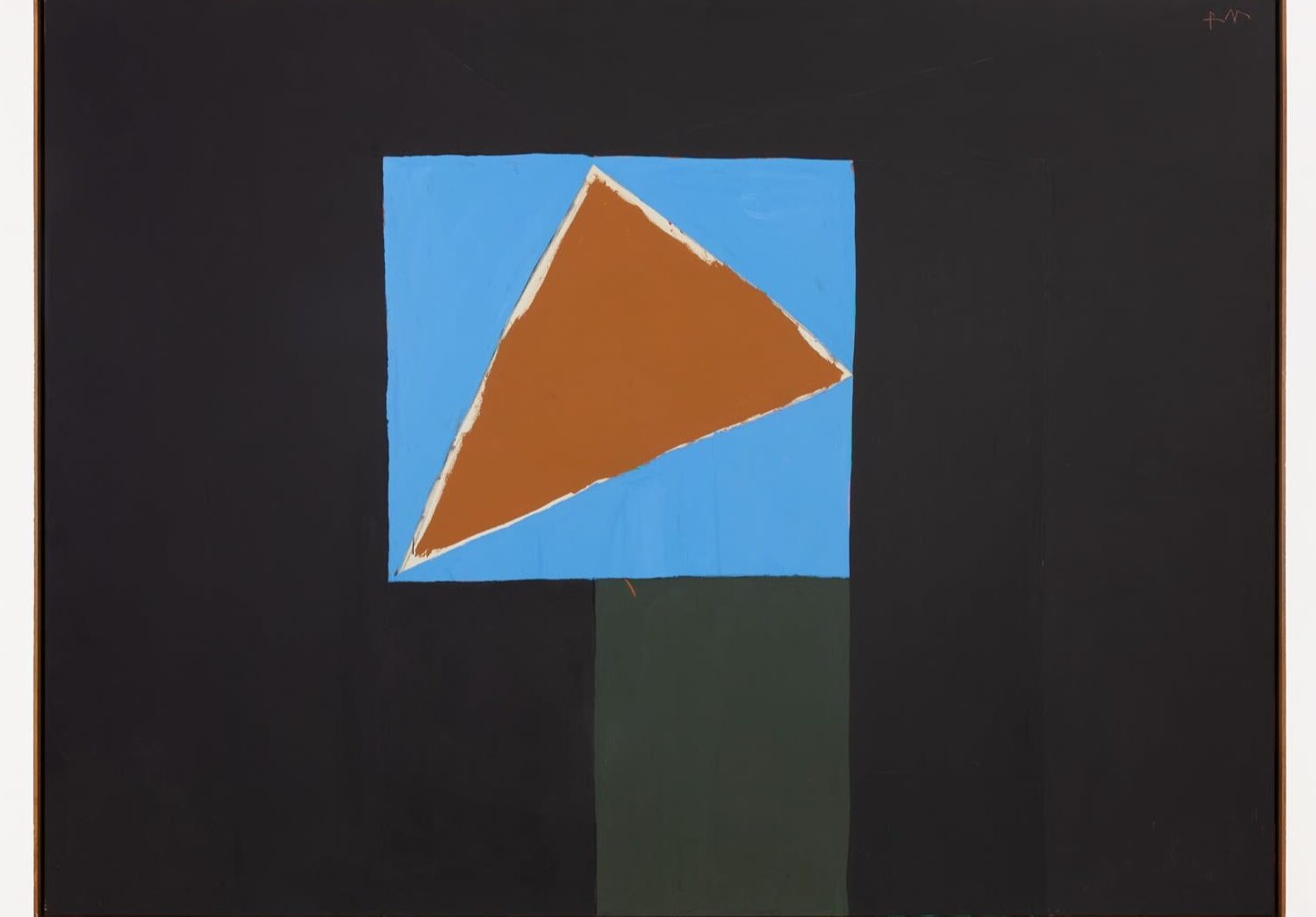
Surface/Subject
Olney Gleason
February 19–March 28, 2026
New York
“There are no second acts in American lives,” F. Scott Fitzgerald bitterly lamented; he was mistaken. An art market no longer obsessed with the new working in tandem with museums has stepped in to provide that second act to artists who might otherwise slip into oblivion. Recent exhibitions of Franz Kline, Cy Twombly, Louise Bourgeois, and Helen Frankenthaler confirm the point, as will the combined show of Lee Krasner and Jackson Pollock to open at the Metropolitan Museum of Art in October.
It is now Robert Motherwell’s turn for artistic resurrection. Olney Gleason has compressed twenty-five years, roughly 1950–75, of Motherwell’s career in a dense show of sixteen lithographs, drawings, and paintings, augmented by a vitrine filled with photographs and documents, including a draft of Motherwell’s 1963 lecture “A Process of Painting,” delivered at the Eighth Annual Conference of the American Academy of Psychotherapists. This wonderful show shares a common feature with those dedicated to the artists mentioned above: self-imposed limitations. These are not retrospectives but segments of careers long enough to fall into discrete phases. Careful selection enables us to grasp a significant phase in an oeuvre without that moment being engulfed in the work of a lifetime.
This matters a great deal in the case of Robert Motherwell (1915–91) because he had his first New York show in 1944 at the age of 29 and exhibited regularly until his death. So, in his 1963 talk, almost nel mezzo del cammin with regard to the years covered here, Motherwell can look back and explain how he came into himself: “I began 22 years ago with the Parisian surrealists . . . The surrealists had a theory of creativity called ‘psychic automatism’ and what psychoanalysts would call ‘free association,’ about what in its most common visual term in everyday-life would be called ‘doodling.’” Here is the means whereby the highly educated, self-aware Motherwell, the man Clement Greenberg famously urged to “stop thinking instead of painting himself through” could liberate himself from self-consciousness. It also enacts the idea Stéphane Mallarmé includes in his famous 1897 poem Un Coup de dés jamais n’abolira le hasard (A throw of the dice will never abolish chance)” the idea that the drop of ink, the blob of paint is a point of departure subject to infinite revision.