
All of You
Martos Gallery
February 19–March 28, 2026
New York
Iranian-American artist Andisheh Avini’s All of You consists of printed postcards, blown glass, steel sculptures, found objects, and sound as one immersive installation. To varying degrees, each of the works draws on Iranian/Persian leitmotifs as recollected by the artist. The structures are endowed with a mediated sense of cultural-historical remembrance as the assemblages, with their various connotations to Persian mythos, architecture, and decorative art history, are filtered through Avini’s episodic memory. Ultimately, it is less so Avini’s remembering that us viewers are able to participate in, foreclosed as we are to his phenomenology and biographical history; rather, the works’ strength is in their reconciling well-examined symbolic folk traditions.
There are several constituent series within the show, each of which requires cultural-anthropological explication to properly appreciate. That is, one should not be overly taken by the presence of twelve postcards, some of which depict Avini’s works and others which provide photographic glances of various Tehran semblances. For, while we are admittedly in the grips of Avini’s nostalgia here, there are also strictly sociological referents that have fixed reference. Without possessing a command of the latter, one is left spinning in the wheels of sheer aesthetics—delighting in the installed marquetry spines and glass organs by misinterpreting them as merely colorful delights. This is, however, to improperly retrofit formalism on Avini’s more layered art practice.
The exhibition begins with Avini’s untitled coal-black stainless steel pointed arch, its highest point matching his height. The work’s strength is in its historical relationship to the form of orgival Mihrab prayer niches. These architectural structures famously line Safavid-era mosques like the Sheikh Lotfollah Mosque in Isfahan. A similar relationist principle anchors Avini’s resplendent untitled 2024 marquetry bust. The bust might very well be Avini’s own visage but its true value is tethered to the broader subtending Persian decorative history from with it emerges: the ancient Persian Khatam Kari craft tradition of inlaying functional items like vases, mirror frames, windows, and Qur’an boxes with geometric patterns constructed from lustrous materials like ivory, pearl, and gold.
The next set of objects are Avini’s bulbous and circular striated blown glass spherules. Vertical lines gather along the cherry-red, mauve, and golden spheroid structures’ vertices; many of their twisted edges slightly unwrap like confectionery treats. They are paired with more amorphous forms, such as a teetering golden-orange wedge delicately balanced atop a pedestal. The press release tells us that “[a]t varying states of rupture and explosion,” these forms “evoke the plastic stripes of a popular childhood toy that has persisted across several generations of Iranian children, shaping core experiences and memories. Also called a Poppy or Pearl Ball, these toys were initially introduced in Iran during a period of economic change dominated by the petroleum industry.” One might also add that they resemble Safavid-era pulled candies and the Atlasi hard confectionaries sold in various Iranian markets and sweet shops.
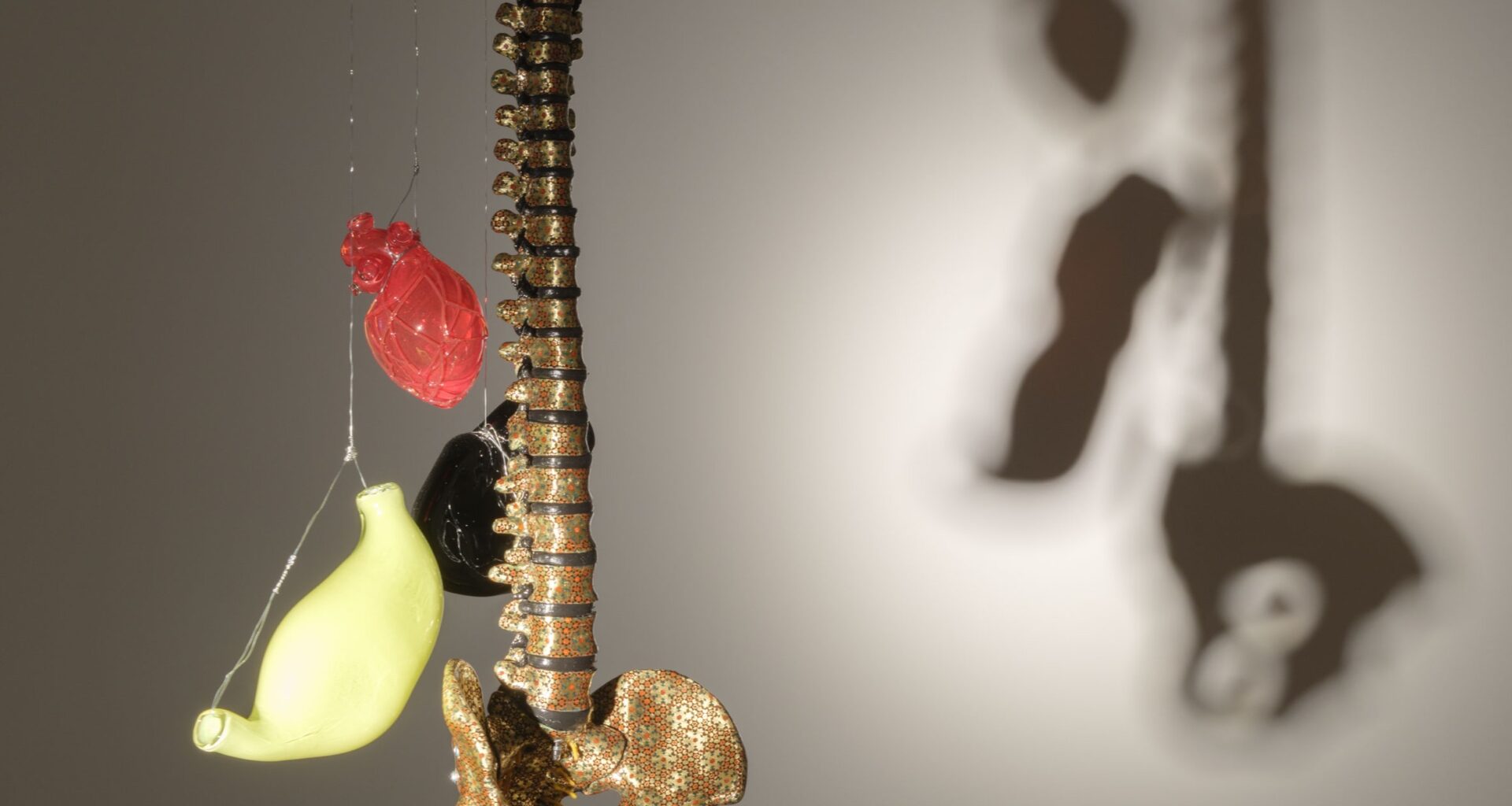
Five assemblages consisting of similarly candy-colored blown glass organs dot marquetry-adorned spinal cords. Some line the gallery walls, protruding like zoological studies. Others dangle from the roof, their upright form suggesting the decorated bones and body parts of a deceased human being. This is the strongest sub-series on display, dovetailing both the Khatam Kari pattern-making handicraft tradition and Persian literary metaphors. Each spine is flanked by a coterie of polysemous symbolic markers: “del” (heart), “jigar” (liver), and abdomen. In Persian, “del,” not only means “heart” in the anatomical sense but also “heart-stomach,” connoting courage, mindfulness, and patience (without being reducible to any of the aforementioned definitions). As Farzad Sharifian writes in his 2008 essay, Conceptualisations of del ‘heart-stomach’ in Persian, “[t]he word del can also be used in Persian to refer to the middle or inner part of something. The middle of the night, for example, might be referred to as the del-e shab (del-of night), a conceptualization that is parallel to the English the heart of the night.” In everyday Persian, “Jigar,” is expression of endearment that idiomatically picks out someone whom the speaker cares for dearly (e.g., “Jigar talâ,” translates to “gold liver,” or “Kheyli jigari!” which translates to “You are really a liver!” are all expressions of affection). Lastly, as Sharifian’s study clarifies, “abdomen” is continuous with “del,” as “[t]he word del is translated in the Aryanpur Persian-English Dictionary … as ‘heart, stomach, abdomen, belly, guts, mind, courage, patience, middle’” and “[w]hen used literally in contemporary Persain, it refers to the area of the body below the chest and above the pelvis, roughly similar to the area described in English by abdomen.”