
When traveling salesman Harry Shaw Newman stepped into the Old Print Shop at 150 Lexington Ave. for the first time, he couldn’t have known it was the beginning of a dynasty.
Over the next 101 years, other salesmen, collectors, historians, researchers, gift-seekers, tourists, U.S. presidents, bargain hunters and artists entered through its doorframe, near the corner of 30th Street.
That first year, 1921, founding owner Edward Gottchuck had moved up from a location near Union Square. Following his death a few years later, Gottchuck’s widow asked Newman if he’d take over the running of the 1898-founded business with an option to buy it later. He agreed to her plan.
Sign up to The Irish Echo Newsletter
His grandson, Robert K. Newman, oversaw a new move for the Old Print Shop a century on, in late 2022. “It was traumatic and a big deal,” he said of a process that took six months to organize and a month to move everything. The Old Print Shop reopened at its new home on the second floor at 49 West 24th Street, just a block down from the Flatiron Building.
“It has the feel of the old,” Newman said of the new store and gallery that occupies the same square footage of the two floors of the old place, “but brighter and cleaner.”
It was a new chapter in what is an amazing New York story, a reset for an institution whose favorite theme has been the city itself.
Artist Bill Murphy’s relationship with the Old Print Shop goes back when it put together a portfolio to celebrate the centenary of the Jan. 1, 1898, consolidation of the City of New York. “They got contemporary printmakers to participate in that,” said the Staten Islander, whose contribution to the project is in the collection of the British Museum.
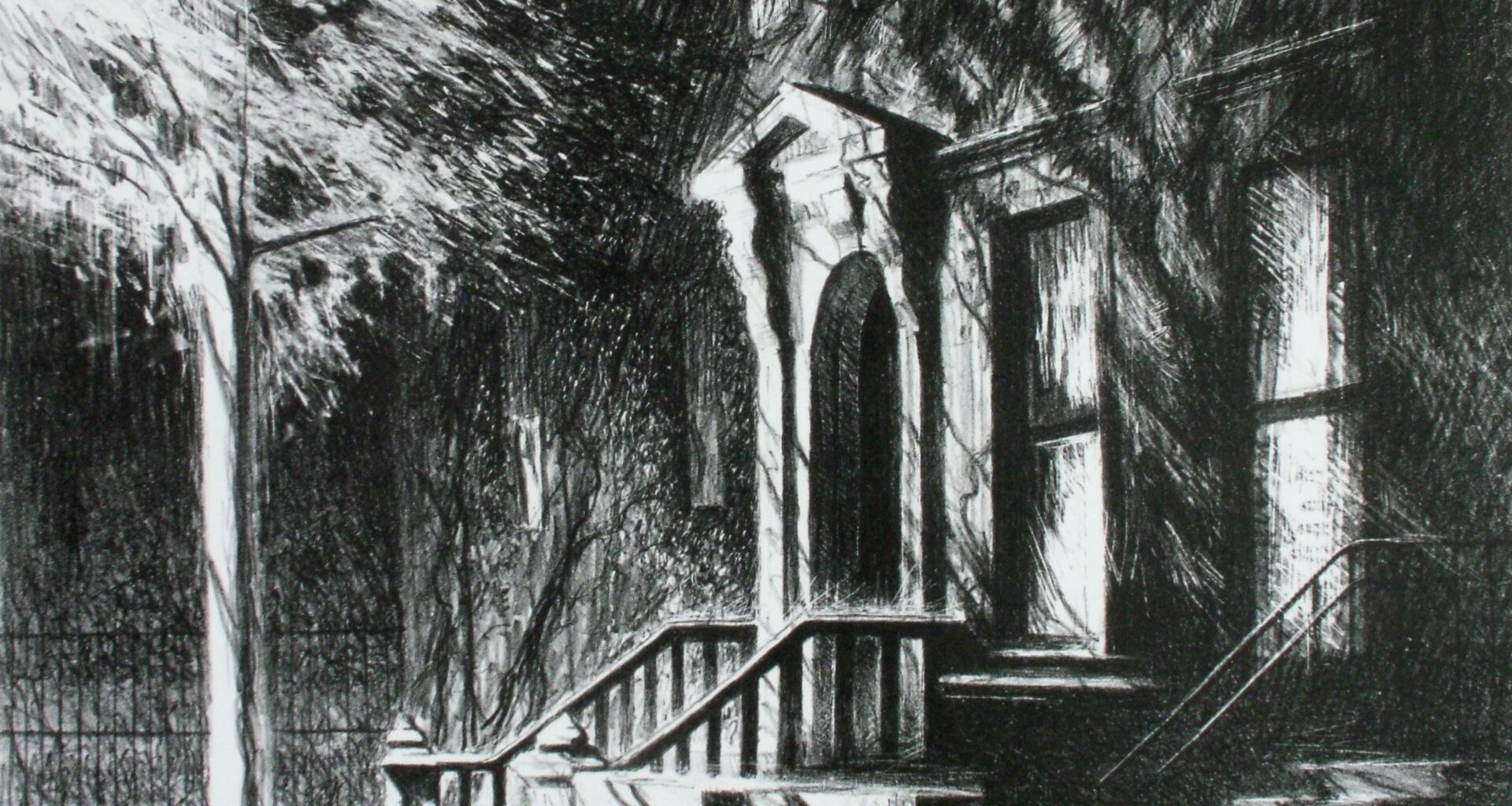
Murphy is known for landscapes and scenes of his home borough, but his Fall 2024 exhibition at the Old Print Shop gallery entitled “New Work” had a 2015 print featuring the Flatiron Building as if to mark the move to the district by the family-run business.
Newman’s earliest memory of that business is hiding under grandfather Harry’s desk at the back of the store at 150 Lex. He was 6, he believes, which would have made it 1963.
“As he sat down, I said ‘boo,’” recalled the current president of the Old Print Shop. “He yelled at me.”
He said of his grandfather, “He was probably thinking as an adult, not as a kid.”
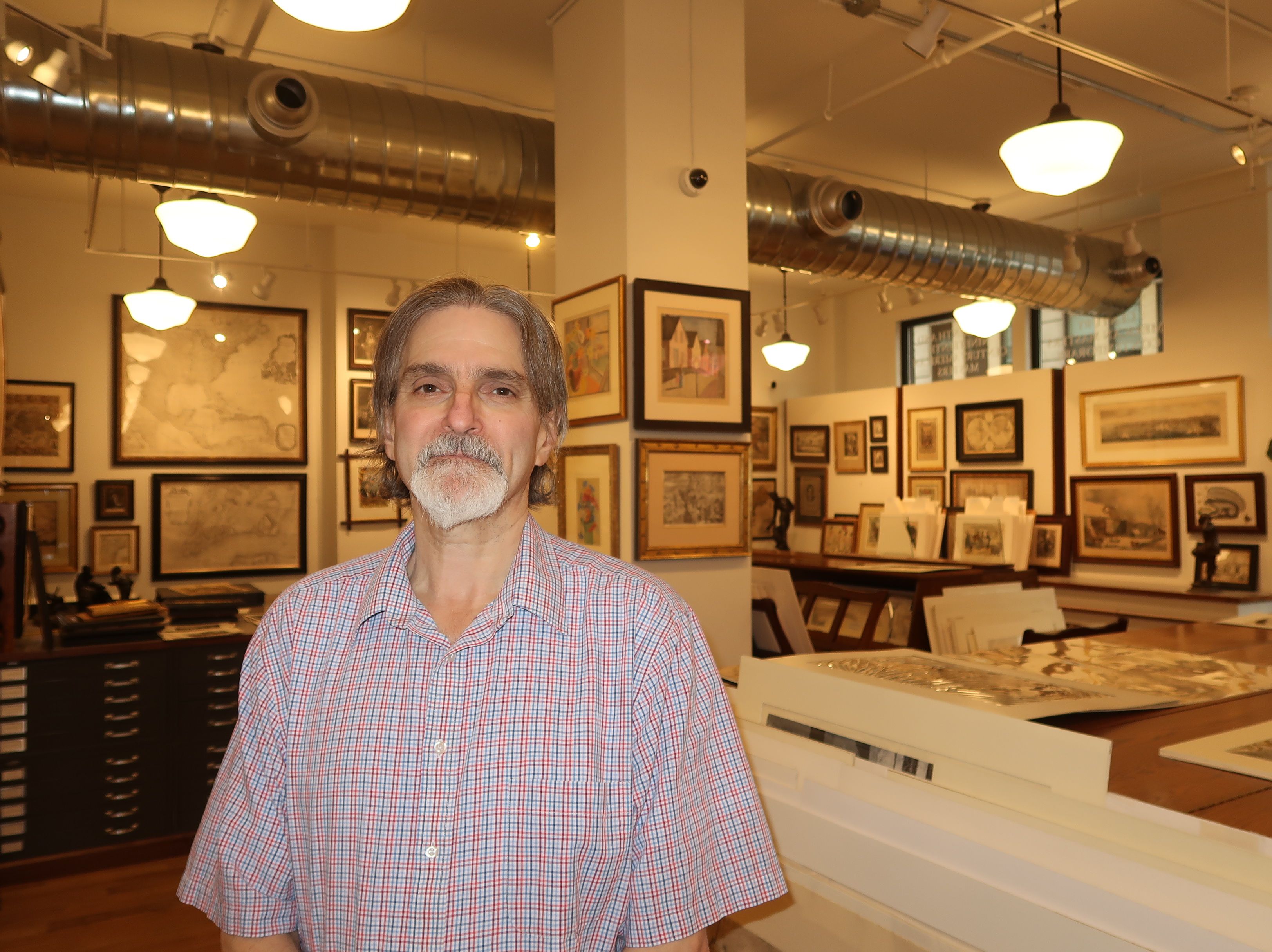
Robert K. Newman is president of the Old Print Shop, Inc. [Photo by Peter McDermott]
Harry Newman had a heart condition caused by childhood strep, and indeed had his first heart attack at age 16. In spite of that, he trained as an air corps aviator upon America’s entry into World War I. The 22-year-old’s war ended before it began. The family story has it that at the moment of the Armistice, 11 a.m., Nov. 11, 1918, his troop ship was still 100 miles away from the coast of France.
The store’s inventory includes plenty from that era. Edward Hopper’s etching “Evening Wind,” for instance, was made the year the business moved to Lexington Avenue. It depicts a naked young woman crouching on a bed before a window as a breeze catches the curtain. The Old Print Shop’s version of it has been acquired by an institution for $135,000, pending approval by the institution’s board.
Back from Europe, young Harry Newman was to make a living selling work that was somewhat more affordable, just as the business continues to today, with prints from living artists going from the low hundreds of dollars to the low thousands. At first, though, he sold basic dry goods door to door. These were the years of the Fuller Brush salesman and Harry was a natural.
The change of focus came when he’d been asked to investigate a water leak in the attic of his grandmother’s boarding house in Asbury Park, N.J.. There, he found a folio of work by the lithograph company Currier & Ives. His grandmother said he could have the prints. Harry easily found buyers for them and his days as a salesman of life’s mundane necessities were behind him.
With its roots in the 1840s, Currier & Ives published two or three lithographs each week over the last half of the 19th century that reflected life back on America, its passions, enthusiasms and bigotries – the artists’ subjects were wars, sports, elections and political commentary, sea disasters, theatrical events and world news. The company had specialists working in the area of American landscapes and it was famous in particular for its Christmas and winter scenes. [See the sidebar about Currier & Ives’ cultivation of the Irish-American market here.]
Eventually having a Currier & Ives on a wall of one’s home, including those depicting lots of snow, became a mark of middle-class respectability.
The company folded a dozen years before the serendipitous find in the Asbury Park attic, but it became one thread that unites the Newman generations. (See also the sidebar: “Currier & Ives cultivated Irish-American market”)
“Dad was all about Currier & Ives,” said the current president, “He loved them – and really expanded the market big time.”
He was referring to Kenneth Newman (1928-2018), a renowned expert in the field, who became the boss in 1966 upon his father Harry’s death. He served an aggregate 61 years with the company before his retirement in 2014 at age 86.
As Kenneth had learned from Harry, in their turn Robert and younger brother Harry Shaw Newman II, the vice president and a leading world authority on maps, learned from Kenneth.
“I was traveling with my father a lot when I was 9 and 10 years old,” Robert Newman recalled. “He would go up to Maine doing the antique runs.”
He remembered, too, being picked up during his first year of college in 1975 by dad Kenneth and they went “hunting for artwork, which we did a lot of and still do, looking for stock.”
Newman continued, “He bought 18 large folio Couriers to put in his car in Erie, Pennsylvania, then drove up to Buffalo, New York, to get another pile of stuff from an antique dealer up there and then we were on the road and he said he wanted to pick up something from a guy in Boston.
“I said, ‘What? Really? Boston?’”
Next stop, a flea market outside of Syracuse. It took 15 trips from the field to load the family’s oversized 1970s station wagon. The son thought it was full, but then “he filled my lap up.” He couldn’t even see his father in the driver’s seat on the journey home.
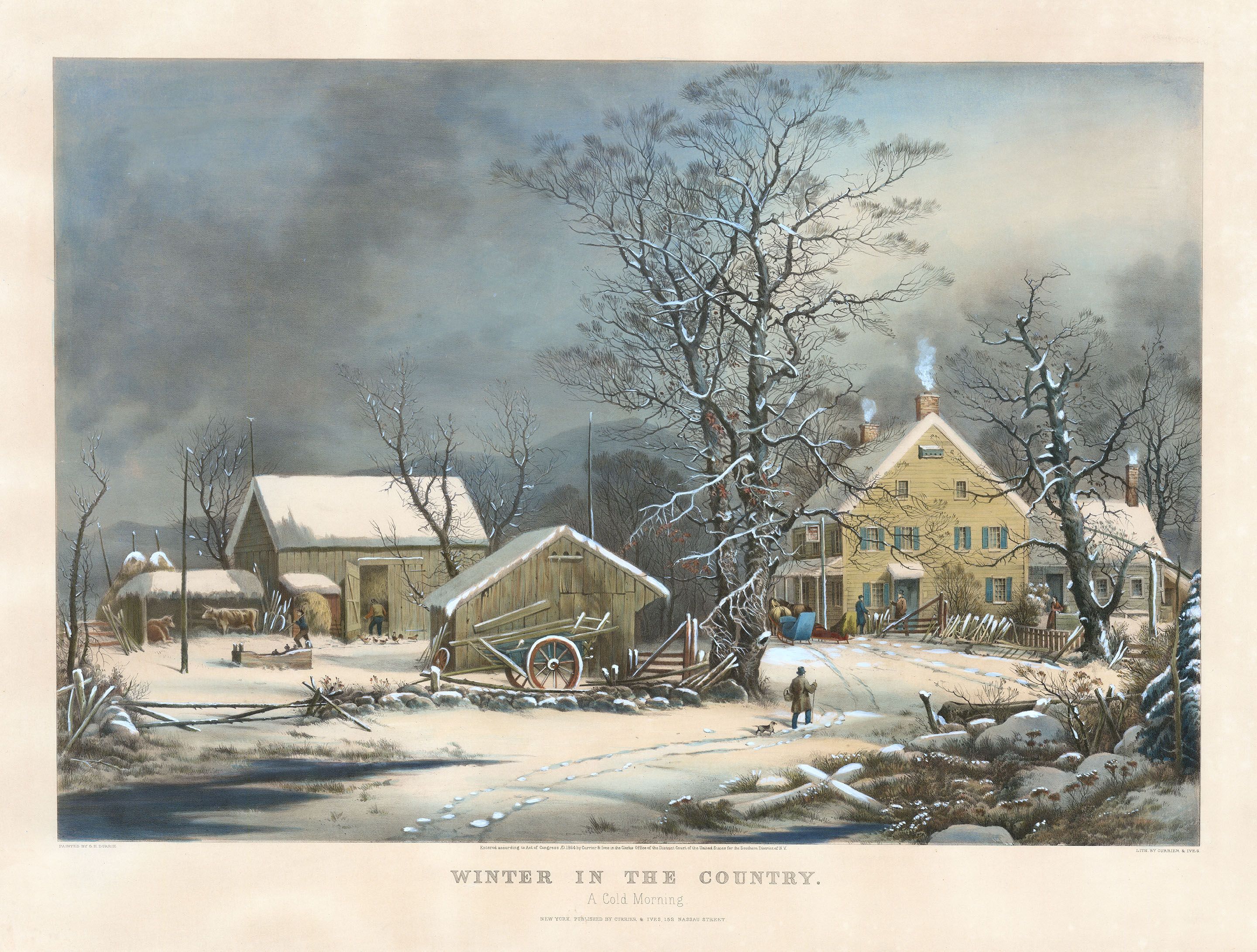
“Winter in the Country: A Cold Morning,” Courier & Ives. [The Old Print Shop]
Some of the practices are basically the same, but things have been greatly changed by the internet – “No more visiting every antique store all the way from Maine,” the current president said.
He joined the company full time upon graduation from college in 1979, while his brother signed on in 1982. Now there’s a fourth generation: Brian Newman, Robert’s son, and Scott Newman, Harry’s son, have become members of staff, continuing the New York story that started in their great-great-great-grandmother’s attic in New Jersey more than 100 years ago and includes customers Franklin Delano Roosevelt, who shopped there shortly after his election in 1932, and John Fitzgerald Kennedy, who bought a naval print in the late 1950s.
Newman’s presidential predecessors were a study in contrasts. Harry was “articulate,” chairman of the debate team at college and an imposing 6-foot-4 and 34o pounds. “He was big portly fellow,” his grandson said, adding though he had to slim down following a near-fatal heart attack in 1949.
“My father suffered from dyslexia,” he said. “He dropped out of high school to go into World War II, which upset my grandfather greatly.
“He was a good businessman,” his son said. “But he was much more of a laid-back personality than my grandfather.”
Robert Newman has a perspective that his grandfather and father didn’t have, for he trained in the mysteries and complexities of printmaking as part of his education.
He described it as an “ancient art form in Europe dating back to the 14th and 15th century.” There is, he was keen to stress, a big difference between reproduction and the process of print-making.
“I love MoMA’s definition: ‘artist’s intent,’ the intent involved in the creation of the 50 prints, or whatever the number is. Each is in a sense an original,” he said.
“Made by hand, one by one,” Murphy said, who also has works in the collections of the Brooklyn Museum, the 9/11 Memorial Museum, the New York Public Library, the National Baseball Hall of Fame at Cooperstown, the Library of Congress and elsewhere. “There’s a lot of confusion out there. It’s led to some hijinks.” He remembered that a supposed print by John A. Noble, for whom a museum and one Staten Island Ferry is named, was a matter of contention on “Judge Judy.”
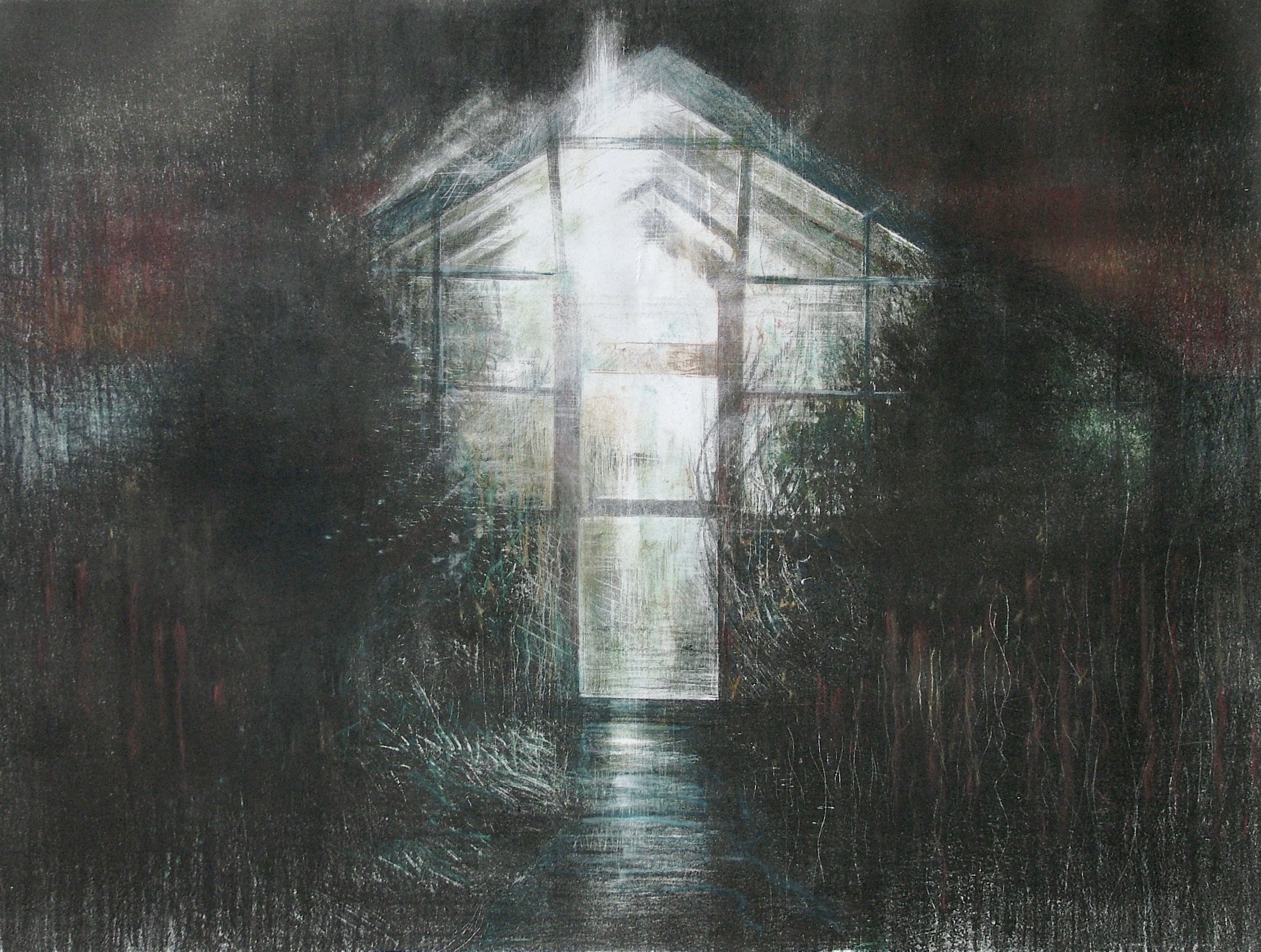
“Winter Solstice ( Greenhouse) with Hand Coloring,” Bill Murphy. See aburninglight.com for the artist’s work.
While his grandfather and father dealt only in painting and printmaking up through 1900, Robert Newman made the 20th century and its great printmakers an Old Print Shop specialty.
Martin Lewis is about the most prominent among those printmakers. Born in Australia in 1882, he was to spend his adult life mostly in the New York area, where he taught his friend Hopper everything that he knew.
If Kenneth Newman might have been more at home with art from the 19th century, Lewis’s work was ideal in one important respect. “Dad was a big proponent of American views, urban views,” Robert Newman said.
Linda Amato, who left England as a 19-year-old in 1962, the year Lewis died, became a printmaker in that Old Print Shop spirit.
“Her work is distinctive for its delicate synthesis of composition, subtle use of color, classical elegance, and her personal interpretation of the architecture of New York City,” according to an edition of the business’s magazine, Folio, devoted to her after her sudden death at age 79 in 2021.
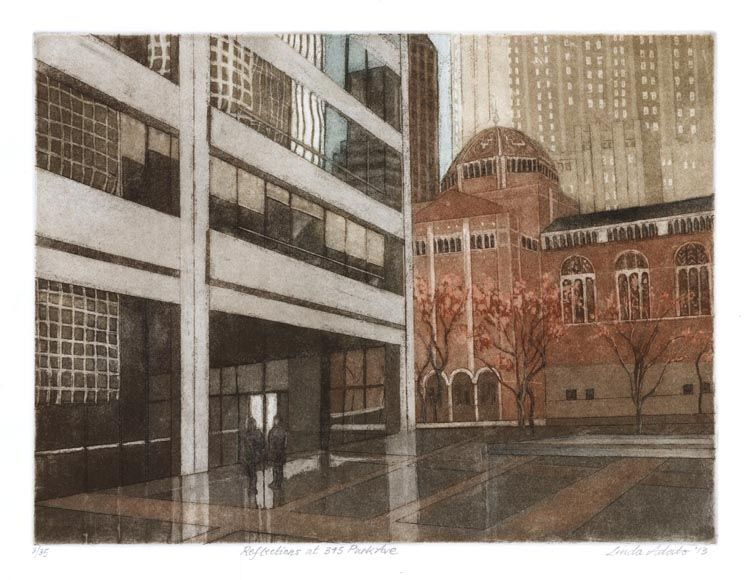
“Reflections at 345 Park Ave. [with St. Bartholomew’s Church.]” Linda Amato, 2013. [The Old Print Shop]
The Old Print Shop recently has been celebrating beloved former member of staff Michael Di Cerbo, who died in 2025. In 2018, he told the Irish Echo his mother was from County Monaghan and his father grew up one of seven sons in an Italian family in East Harlem. They met in Belfast during World War II before he was shipped out. Di Cerbo, who was born in Patterson, N.J. in 1947, moved from architecture to art in early adulthood. He was manager of the gallery on the second floor at 150 Lex before his retirement.
An edition of Folio was dedicated to Murphy, one of the 75 or so living artists represented by the Old Print Shop, to coincide with his exhibition in 2024.
He is grateful for one of the remaining outlets for printmakers and printmaking, which was once described as the “most aristocratic and most democratic” of mediums. The artist needs a “good amount of supplies, a press, technique,” he said, but the economics of it make the artwork accessible to the person in the street.
“The Old Print Shop has some really good prints for a couple of hundred dollars,” Murphy said.
The Old Print Shop is located at 49 West 24 St., 2nd Floor, New York, N.Y. 10010. Go to www.oldprintshop.com for details.