
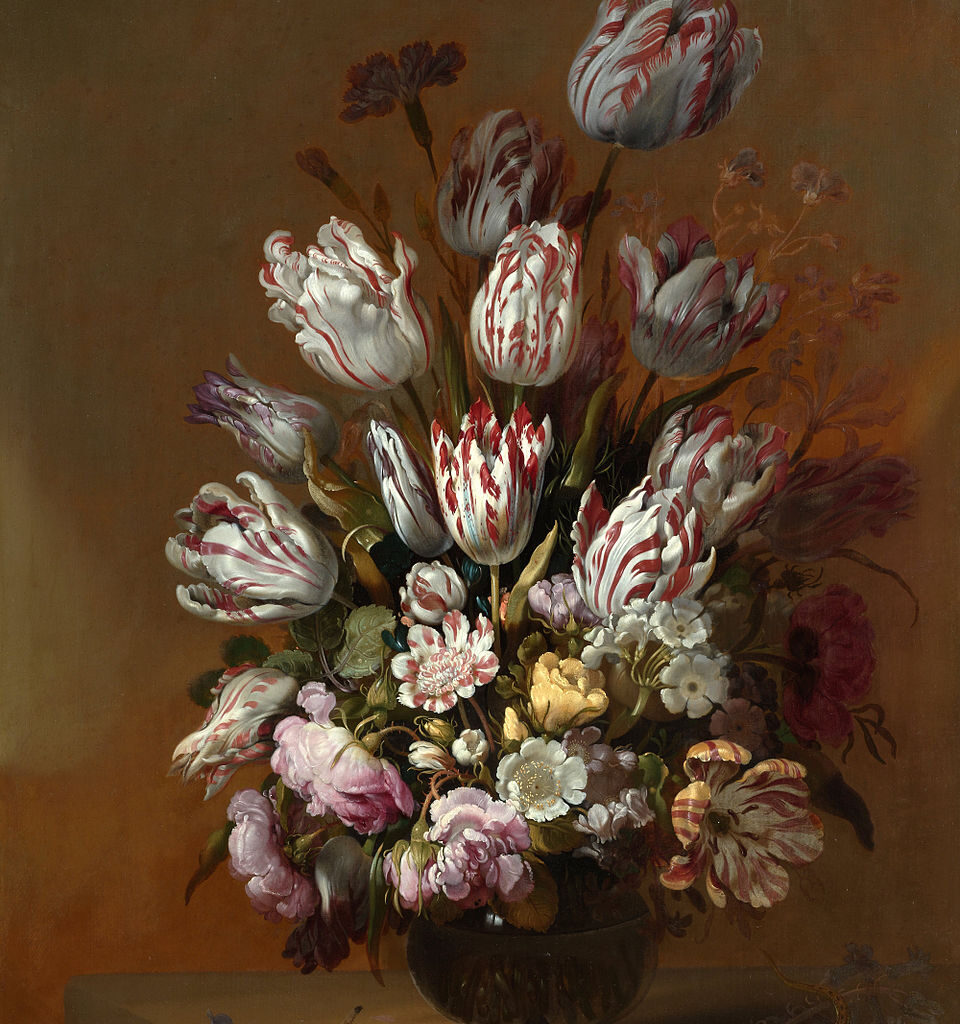
What follows is a triptych in prose: a painting, a film, and another painting. At center, a film of an architect building a pavilion in a garden; on the left, an image of an old tree trunk; on the right, a handsome floral still life. Although the works discussed herein are historically disparate, spanning multiple centuries, they are brought into dialogue through a shared engagement with nature and time, where the natural world surfaces through structures that eschew linear or calendrical logics. In John Constable’s Study of the Trunk of an Elm Tree (dated by some art historians to 1821, though this attribution remains contested), landscape is brought to fruition through sustained attention and repeated encounters; in Juan Benavides’s observational documentary film At the Garden’s Pace (2024), which follows the construction of a garden pavilion in the Netherlands, natural and built environments coalesce through the lengthy process of hand-making; and in Hans Bollongier’s Still Life with Flowers (1639), multiple botanical seasons are folded into a single pictorial field. This is a project in accumulated looking and contemplation.
Panel 1: John Constable, Study of the Trunk of an Elm Tree (ca. 1821)
The elm’s massive trunk dominates the composition. Its rugged bark, rendered with near-photorealistic precision (predictive of the uncanny sharpness of the imminent daguerreotype), forms a variegated surface dense with crevices and chiaroscuro. Light and shadow play across this skin, recapitulating the surrounding woodland, which likewise moves between illumination and obscurity—what Constable described as the “chiaroscuro of nature.” Finally, a breath at the top of the canvas, where the upper branches form a loose circle around an open patch of sky.
This exacting study of a single tree in situ, and Constable’s sustained attention to the specificity of bark, species, and site, distinguishes this work within the broader tradition. The elm cannot be apprehended in a single glance; rather, the composition implies a viewpoint assembled through multiple acts of looking, from base to crown, to surrounding woodland, and upwards to sky. This accumulated perspective emerges only through durational study and sustained observation, articulating an embodied, temporal mode of perception.
Panel 2: Juan Benavides, At the Garden’s Pace (2024)
Prolonged attention to the natural world structures Juan Benavides’s At the Garden’s Pace (2024), a 68-minute film which follows architect Enzo Valerio’s hand-built construction of a garden pavilion at the forested Pinetum Blijdenstein botanical garden in Hilversum, Netherlands. Together with a small team, Valerio undertakes the unusual task of building the pavilion by hand—a slow, labor-intensive process that Benavides documents through static tripod shots, long takes, and wide angles. The building process is not registered through dates or calendrical markers, but through the visible accretion of labor: materials layered, forms gradually emerging, and architectural skins accruing texture over time. The viewer is rarely oriented within a specific day; instead, duration is apprehended through the intricacies of construction.
Scenes of construction are interwoven with moments from daily garden life—neighbors pause to observe, the gardener describes playing classical music to his plants, meals and coffee are shared among the builders. Here, the passage of time is demarcated by a series of non-linear, lived moments, as suggested by the film’s title. Benavides’s camera attends most closely to the construction of the pavilion’s piers. Wood formwork leaves the concrete with a visible imprint of wood grain, layered with sand and stone. Once the concrete sets and the sand is cleared, warped fissures emerge on the form’s striated, shadowed surface. The architectural skin recalls, as Valerio remarks to a neighbor at one point, the bark of the surrounding trees. The remainder of the pavilion comes to fruition with a terrazzo-like floor embedded with stones from the garden, followed by the roof. The film concludes as winter arrives, dusting the pavilion with snow. The seasonal shift marks time’s passage more palpably than any clock.