
Beautiful music at Auschwitz concentration camp, the most infamous Nazi camp, is not something one would expect, but for some prisoners, it helped save their lives.
David Lennon, the son of Holocaust survivor Yvette Assael Lennon, said his mother was a member of the women’s orchestra at Auschwitz — a role he credits with keeping her alive.
What You Need To Know
A Holocaust survivor’s son says music in Auschwitz’s women’s orchestra helped save his mother and her siblings
Prisoners with musical skills were selected to perform, which often meant better conditions and survival
A new book and performances are revisiting the orchestra’s history and emotional legacy
Many survivors stopped playing music after the war, but one family continued for generations
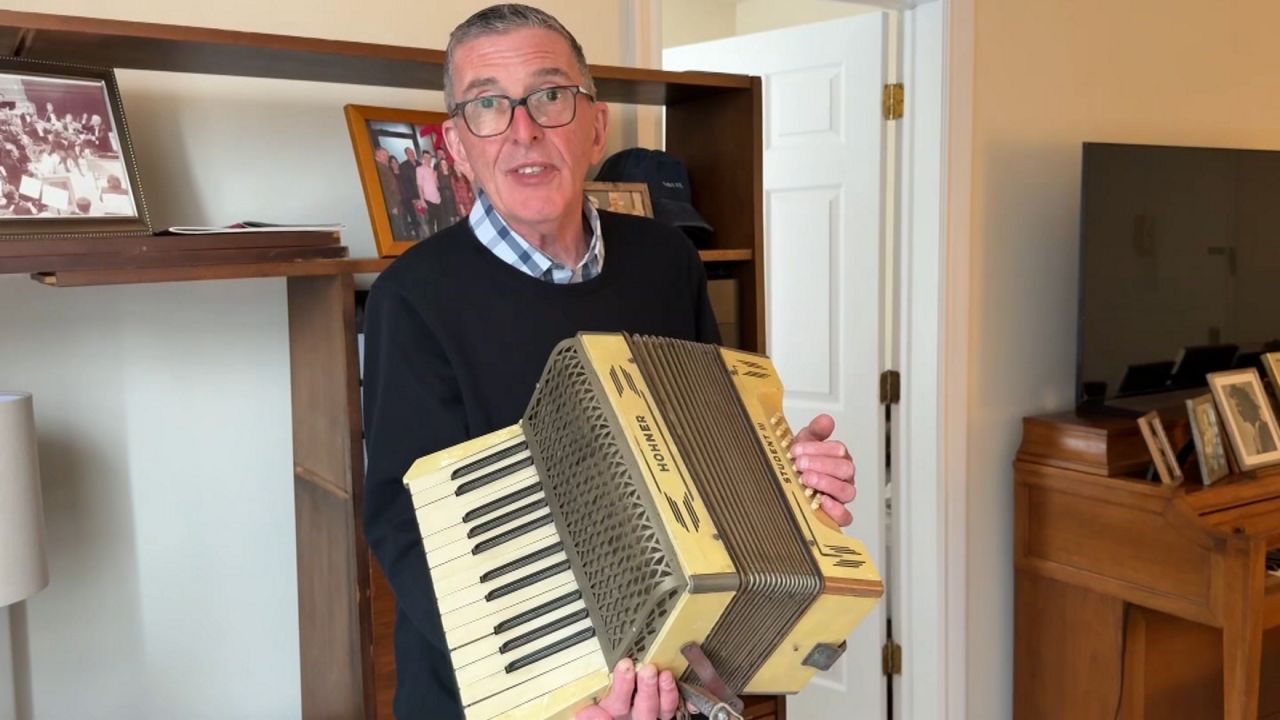
Yvette Assael Lennon, born in Silanica, Greece, and her siblings Michel and Lily all learned to play the accordion before World War II.
“Had they not learned how to play this [accordion], they wouldn’t have been musicians in the orchestra in Auschwitz,” Lennon said. He still keeps the accordion they learned on in his Upper West Side apartment.
Lennon said his mother, aunt and uncle survived because of the music they played. Their parents were sent to the gas chamber upon arrival.
Yvette’s mother insisted her children learn instruments, eventually steering her toward the double bass — the instrument that would later prove crucial.
“What was amazing was my mother did learn it and she studied a little bit with a teacher and that was the instrument they needed in the all-women’s orchestra in Auschwitz,” Lennon said.
When Yvette arrived at Auschwitz, she was stripped of her belongings, tattooed and had her head shaved. Then came an unexpected question.
“One of the guards came in and asked if anybody played musical instruments. And she thought she was hallucinating,” Lennon said. “The only instrument they needed, because they filled all the other spots, was a double base. She really only had rudimentary skills, but of course, what are you gonna do? You say, yes, I play that instrument, and she auditioned. Could you imagine auditioning for that?”
Yvette and her sister joined the women’s orchestra, while her brother played in the men’s orchestra.
“By virtue of her terrible, terrible circumstances, great misfortune, but also great fortune to be playing music saved your life. Without that, I wouldn’t be here,” Lennon said.
British author Anne Sebba documented these experiences in her book, “The Women’s Orchestra of Auschwitz: A Story of Survival,” published last year.
“The Nazis wanted to exterminate the Jews, to obliterate them. And these women said, actually, if we can, we’re going to live, we’re going to survive,” Sebba said.
At a recent New York City event hosted by Holocaust Music Lost and Found, musicians performed pieces once played by the orchestra.
“It’s beautiful music that we know, Schumann, Chopin, Mendelssohn, but the reality of what these women had to endure to perform this music, it takes a whole other emotional impact,” said Janie Press, the organization’s president and founder.
The performance stirred deep emotions for Lennon, nearly 18 years after his mother’s death.
“It was extremely emotional,” he said. “I couldn’t help think this is what my mother played, this is what she heard.”
At the event, Press also played a prewar recording of Alma Rosé, one of the orchestra’s conductors. Lennon said hearing her for the first time moved him, as he credits her with helping save his mother’s life.
Rosé, a Jewish Austrian violinist and niece of composer Gustav Mahler, led the orchestra with strict discipline. Some members had complicated feelings about her, but many understood her approach helped keep them alive. She died in April 1944; the cause remains unclear.
Members of the orchestra often struggled with guilt, as they were forced to play while other prisoners were sent to their deaths. The orchestra also played as trains arrived, part of Nazi deception efforts.
According to Sebba’s account, Yvette once began crying while playing during an arrival. Rosé ordered her to stop immediately, warning that the entire orchestra could be killed if she did not.
Despite the trauma, the Assael family continued with music after the war — an exception among survivors. Lennon earned two degrees from Juilliard School, performed professionally as a violist and now works at Carnegie Hall. A cousin performs as a Broadway cellist.
“It’s interesting that David and his family are musical and do play music because for most of the members of the orchestra, music was finished,” Sebba said. “They couldn’t play. They couldn’t even listen to music. They couldn’t go to a concert.”
Lennon said music in his family was essential.
“We were brought up to understand the music, in some way, is lifesaving. So to me, it was like learning how to breathe and how to eat, literally,” he said.
Anita Lasker-Wallfisch, believed to be the last surviving member of the orchestra, lives in London. She is 100 years old.