
Michael Meredith and Hilary Sample
Public Spaces, NY
Park Books, 2025
MOS Architects opens Public Spaces, NY with a straightforward conceptual assertion: “Public spaces are legal constructions as much as they are spatial.” This claim dislodges public space from any assumption of neutrality or inevitability. Rather than treating parks, plazas, sidewalks, or civic interiors as self-evident or assumed urban facts, MOS insists that publicness is negotiated politically—through law, policy, ownership structures, and governance—as much as it is produced through form or accessibility.
The book also foregrounds the fact that public space is encountered unevenly in embodied experiences that are shaped by subjectivities of bodily politics and social vulnerability. Publicness is not merely a matter of openness; it is structured by who is permitted to appear, linger, assemble, or remain visible.
This position is historicized with force. Public Spaces situates contemporary urban conditions within the long history of the United States as a nation founded on contested lands. The book traces how the emergence of the US is inseparable from disputes over lands seemingly designated as “public” through legislature beginning with the abstraction and dispossession of Indigenous homelands and continued through accelerated settler colonization westward after 1781. Public space, in MOS’s account, is never simply civic or democratic; it is bound to colonial measurement, territorial management, and the conversion of land into administrable and extractable units. The legal frameworks governing contemporary public spaces are not anomalies but inheritances. While MOS maps public space through formal architectural typologies, it also expands the definition of public space as a temporal condition that becomes publicly designated through acts of use, such as protest. This flexibility reinforces MOS’s argument that spaces which appear formally public are often shaped by overlapping legal, private, and governmental claims to land and urban territory that ultimately is an affect of colonial histories and presence.
The book begins at a continental scale, tracing the earliest colonial attempts at quantifying and parcelling lands with the ambitious project of mapping Indigenous territories. Then, it moves through national civic, transportation, and landscape infrastructures and ultimately narrows its focus to New York City. This calibration of scale reveals how techniques of measurement, abstraction, and governance persist even as their spatial focus contracts. Manhattan emerges not as a unique case but as a clarification and microcosm of broader North American spatial control.
As a successor to MOS’s publication Vacant Spaces, NY (2021), Public Spaces marks both a continuation and an intensification of the studio’s inquiry. Where Vacant Spaces foregrounded bureaucratic absence—sites awaiting development, spaces suspended between use and speculation—Public Spaces turns its attention to presence, access, and use. This political turn from vacancy to publicness amplifies, rather than resolves, the tensions of urban space. Vacancies are not neutral voids, and public spaces are not inherently democratic. Both are produced through legal, economic, and representational systems.
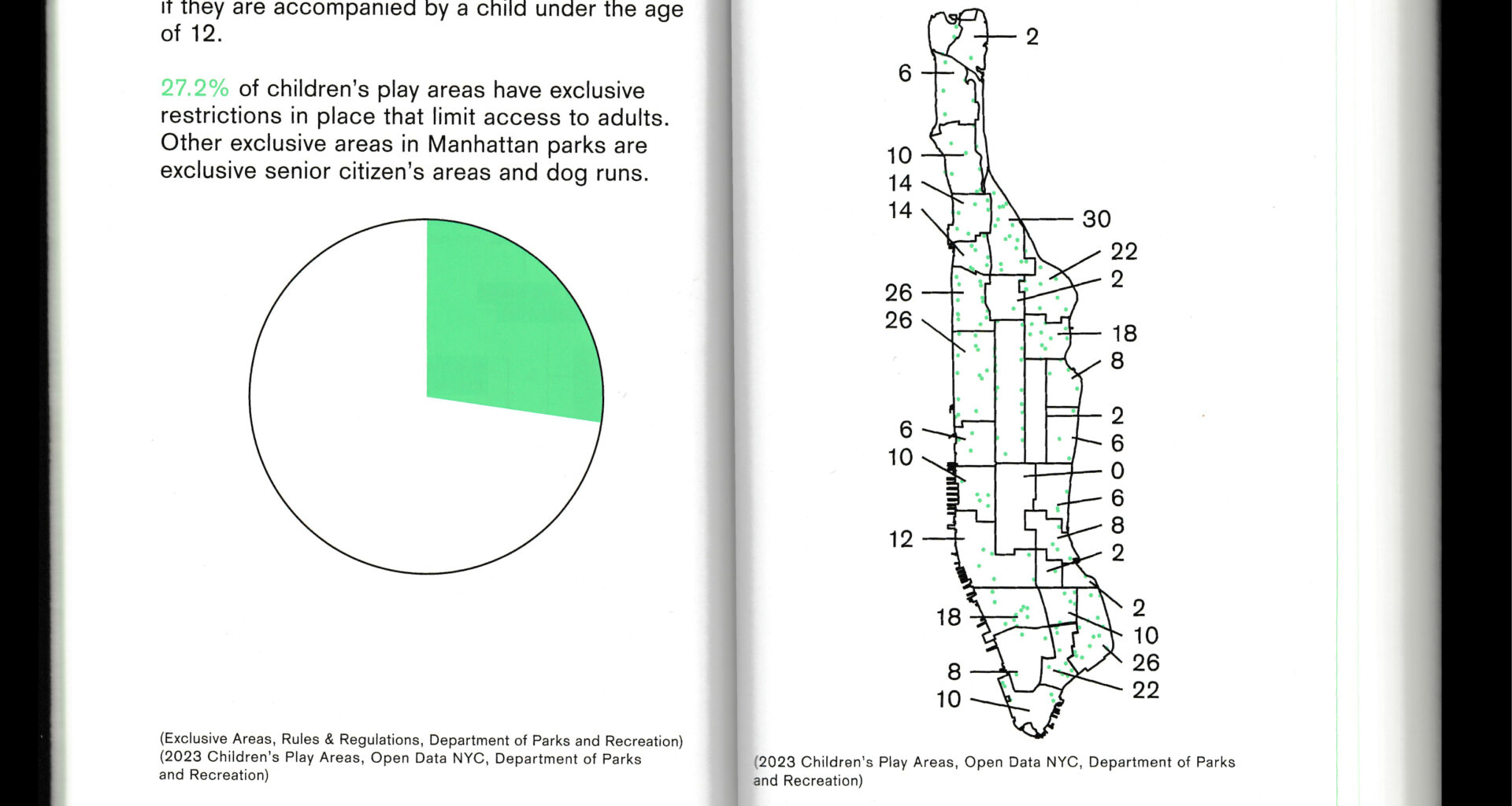
Publicness is a data project, and so, graphic representations emerge as central to the book’s project. The diagrams, drawings, and cartographic systems function as primary instruments of analysis. They allow the book Public Spaces to operate simultaneously as a time-sensitive, archival document anchored to statistics, zoning regimes, and access rules, and also—as that will inevitably change—as a durable and rigorous theoretical framework. Maps are reduced to bold outlines, repetitive silhouettes, and minimal symbology. Yet this austerity is consistently paired with moments of extreme specificity: annotations identifying the five largest landowners of the twentieth century in the United States, precise access schedules, or regulatory thresholds. The drawings train the reader to move fluently between abstraction and detail, overview and exception. Manhattan is reinscribed again and again, each time subjected to a different metric of measure: square footage, hours of access, ownership regimes, degrees of enclosure, or infrastructural adjacency. The book does not attempt to deny the expiration of its data, it embraces it. Legislative obsolescence is part of the argument, mirroring the contingent and negotiated nature of public space itself.