
Arctic Voices
Elbphilharmonie
February 26–March 1, 2026
Hamburg, Germany
Greenland has pulled the global searchlight toward the Arctic regions, so the time now seems fitting for a season of connected-though-diverse purveyors of vocal traditions from the indigenous inhabitants of the northernmost lands. Not always traditional, of course, although all drawing heavily from the tonsil-quivering history of these icy vastnesses. Vocalists are united by throat singing, a cord-approach that resonates similarly around the circle of Japanese, Mongolian, Canadian, and Scandinavian sources, whether joik or khöömei, Ainu canon fodder or avant-Inuit wildness.
The gloriously quirked Elbphilharmonie in Hamburg has an ongoing taste for themed sequences of concerts, and Arctic Voices offered performances of the type that most listeners will have had few opportunities to experience, all lined up during a four-day celebration of these multiple aspects. Visually and aurally, this towering cake-wedge of a building, with its Gaudí-esque curved lines of acoustic shaping (for both practical ear and peeper bedazzlement purposes), made for a most suitable setting, as capacity audiences inched up its gradual gradient escalators, fresh from their strolls around the waterway latticework of this Hamburg port zone. The venue’s stewards wear striped sailor shirts, ready to spout sea shanties to their customers.
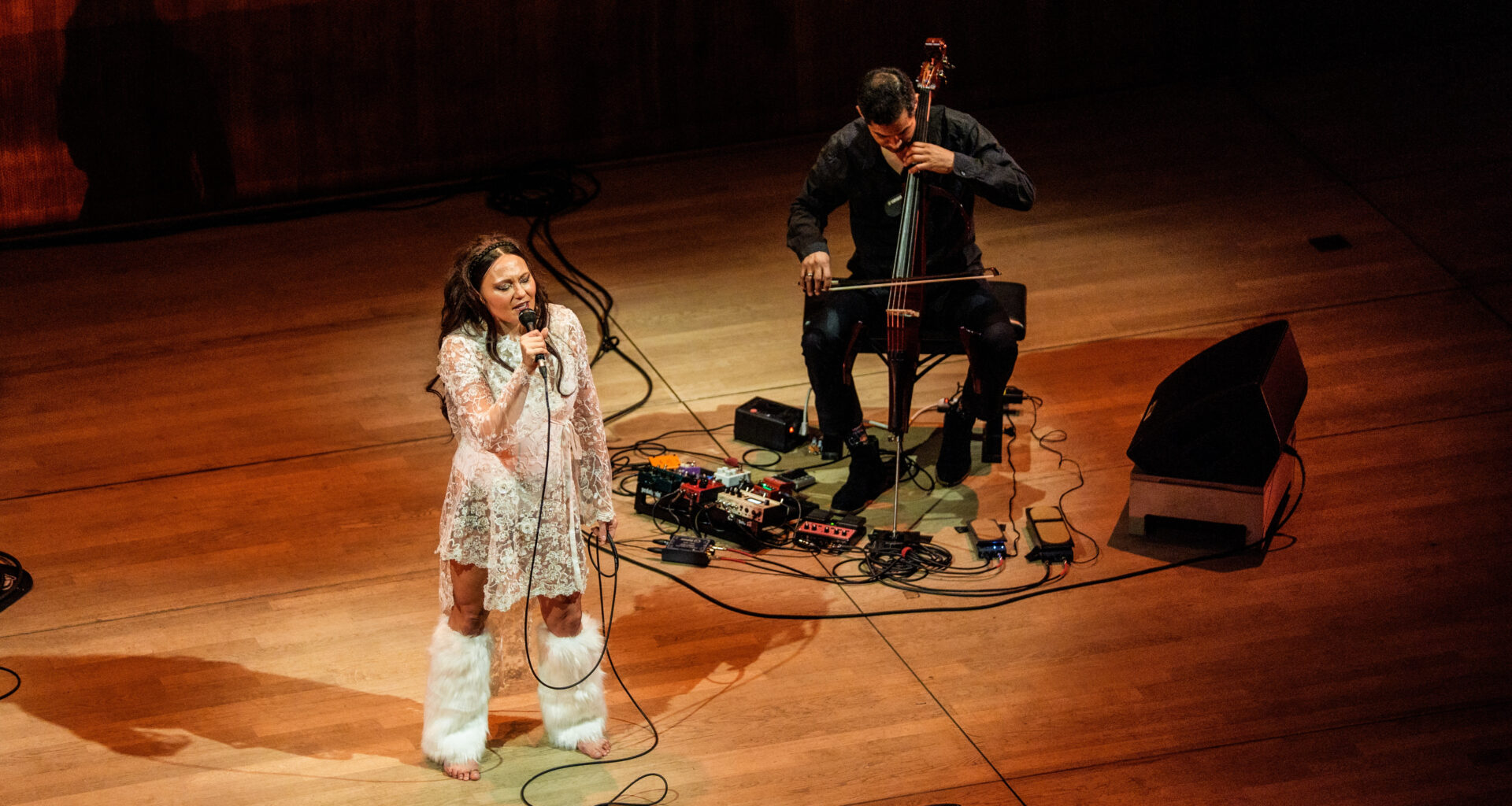
Tanya Tagaq is one of the most familiar artists present, right on the eve of her new LP release, Saputjiji (Six Shooter Records), which is bursting with her most extreme songs so far. She’s an Inuk from the far Canadian north, with an enthusiasm for industrial scale electronic disruption. Tagaq’s organic throat vocalizing forms an unholy partnership in noise evisceration, twinned prongs of distressed attack. Before her performance begins, Tagaq points out the exits, cautionary advice as we take this sonic flight, but in reality almost all of the crowd remains seated until the (literally) blooded end. They surely know what sort of songs to expect.
Tagaq and her father recently dusted off some old footage from the 1970s, which was used as a huge stage backdrop, slushing up tranquil snowscapes with bloodletting “brutality” (the Inuit lifestyle involves hands-on, community knife-action, as a culinary prelude). By chance or design, these images clicked well in Tagaq’s improvisatory set with her colleagues Jeffrey Zeigler (cello/electronics) and Jean Martin (drums/electronics). Tagaq, while not openly needing to use effects, has such natural modulation facilities down deep in her vocal cords, and her resonating mouth chamber, that her naked voice perverted sufficiently in its natural state. This is not much like Mongolian throat singing, but within similar tectonic bass regions, growling multiphonics and pinched nasal slicing in the Inuit katajjaq style.
A meditative opening builds very gradually, as we knew it would, to a more roused and agitated state, wrestling with her inner beast, emitting heightened breath-sounds, cello sending out a mournful groan. Considering the eventual violence of these songs, Tagaq is an easygoing hostess when explaining their content and background, calmly soothing the audience in between numbers. Despite improvising, recognizable compositions do rear up in the flow, such as “Exit Wound” and “Fuck War” from the new album. Tagaq also speaks in tongues, aiming for ritual climax, repeating what sounds like “marrow,” biting a bone fragment in her jaw, either as symbol or actual musical instrument, as Zeigler emulates a riding circus organ, while polar bears rummage through garbage piles in the background. Tagaq sports chunky white fur boots. She brings out a pair of semicircular knives, sharpening them against each other as a rabbit gushes blood on film.