
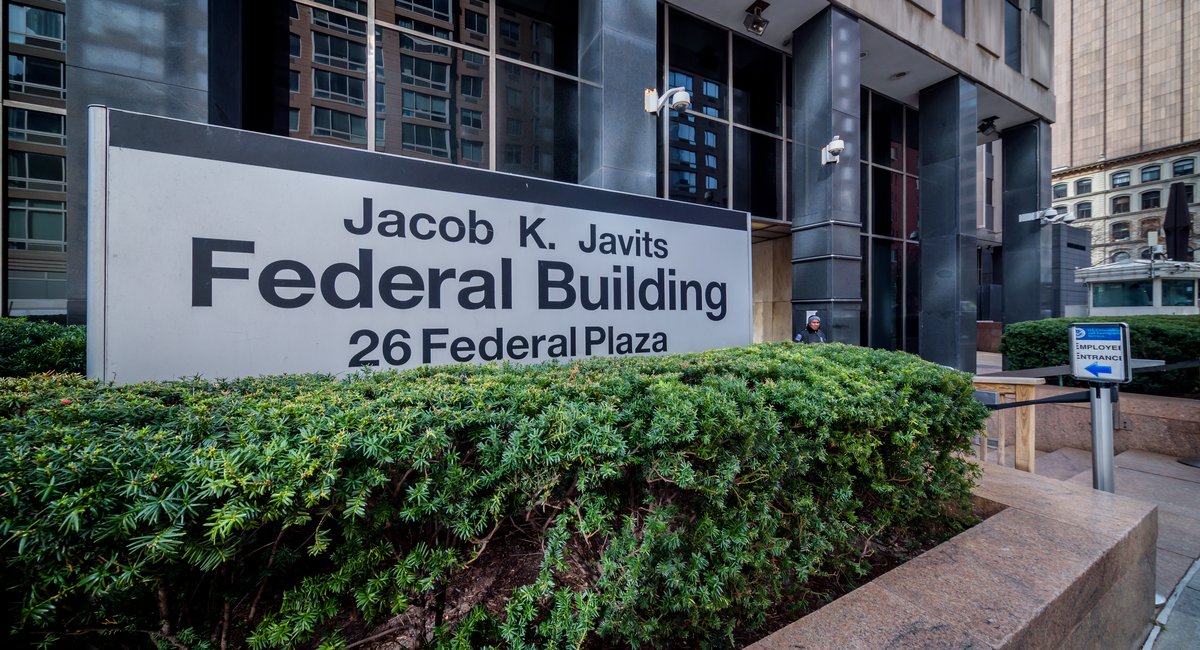
Members of the public have been systematically barred from observing federal immigration court proceedings in New York City for the past year, to the detriment of those ordered to appear, and in violation of federal regulations and constitutional protections, according to a new lawsuit.
Federal agents and courthouse employees have imposed a series of unwritten, and at times arbitrary, rules to “discourage, restrict or entirely block public attendance” to immigration courts, according to the complaint, brought by five plaintiffs, who include clergy, legal observers and social services providers.
“Long-time practitioners in this court system have informed [one of the plaintiffs] that the presence of even a single observer influences courtroom conduct, raising concerns about proceedings conducted without public oversight,” according to the filing. It asks a federal judge to declare the restrictions unconstitutional and order the immigration courts to remain open.
Spokespeople for the U.S. Department of Homeland Security and Department of Justice, among the named defendants, did not immediately respond to requests for comment. A spokesperson for the Executive Office of Immigration Review, which oversees the nation’s immigration courts, declined to comment.
The lawsuit, filed in the U.S. District Court in Manhattan, comes amid President Donald Trump’s crackdown on immigration, which has flooded the federal courts with hundreds of thousands of cases, with immigrants of all ages thrust into complicated, potentially life-altering proceedings, and very often without the assistance of counsel.
The legal action also brings into view the work of community volunteers and advocates who accompany immigrants to the courthouse, provide non-legal assistance, emotional support and sometimes watch from galleries. The latter, according to the filing, “is particularly important as respondents frequently retain little of what occurs during their hearings.”
Attorney Stephen Kelly, one of the plaintiffs, said it’s important that the public and legal observers be able to access immigration courtrooms. He cited the threat of due process violations and limitations on other avenues to follow immigration court proceedings.
Unlike many other criminal and civil courts, immigration courts do not make records of their proceedings readily available to the general public.
“They’re shut out from the public,” Kelly said. “There’s no accountability whatsoever.”
He added, ” It’s in an administrative process. It’s sealed from public view that doesn’t keep any meaningful records and has these horrific penalties imposed.”
The complaint states, “Government opposition to protected activities has permeated all aspects of the daily operations of the immigration courts, starting before a visitor even enters the building.”
Under rules for the Executive Office of Immigration Review, which oversees the country’s immigration courts, immigration court hearings are generally open to the public, except in limited circumstances, such as when there’s a concern about protecting witnesses or parties in a case.
The five plaintiffs — Pastor Fabián Arias, attorney Kelly, journalist Debora Nathan, psychologist Zoey Phillips and artist Laura McCallum — represent the range of people who frequent local immigration courts: clergy, legal observers, social services providers, community volunteers, and members of the press.
After federal immigration agents began arresting immigrants at immigration courthouses in increasing numbers last spring, in New York City and across the country, volunteers, journalists and other onlookers stationed themselves at the sites in an effort to observe and document the arrests and happenings in court.
Faith leaders and volunteers also regularly accompany immigrants to their hearings to comfort and aid those facing potential arrest.
Many of the plaintiffs in the case describe instances of being excluded from courtrooms.
One day in November, when journalist Nathan went to enter a courtroom with extra empty seating, a court employee told her she couldn’t enter because “it’s too small” and “the judge never allows the public in the courtroom,” according to the filing.
Since June 2025, Kelly has been denied access to immigration courtrooms about 20 times, according to the lawsuit.
Arias has been accompanying congregants to immigration court hearings for two decades. On multiple occasions in the past year, federal agents ordered Arias not to speak with his congregants, even when they requested his presence and were standing in public hallways and waiting areas, according to the complaint.
And on numerous occasions, Arias has been ordered to leave courtrooms, hallways, or the building without explanation, the lawsuit claims.
The lawsuit asks the court to block federal agents and court employees from restricting public access to immigration court proceedings “except as permitted by law.” It also asks the government to pay the plaintiffs’ attorney fees.