
Editor’s note: This is the third in a four-part, season-long series looking back at the New York Rangers’ four Stanley Cup wins as the team celebrates its centennial season. Read Part 1 about the 1928 championship here and Part 2 about the 1933 title here.
By the time the New York Rangers won their third Stanley Cup in 1940, none of the five original Blueshirts who were part of the team’s first two titles in 1928 and 1933 remained on the roster.
Bun Cook was the first to go in a 1936 trade to the Boston Bruins, but the others would soon follow. The 1936-37 season marked the last in New York for Bun’s brother, Bill, along with Murray Murdoch and Ching Johnson. The aging Rangers were the final team to qualify for the playoffs that year, mustering a last-gasp run to the Cup Final. They built a surprising 2-1 series lead over the Detroit Red Wings before losing the final two games of the best-of-five, signaling the end of the most successful era in franchise history.
The fifth and final original Ranger, Frank Boucher, barely outlasted the rest, retiring 18 games into the 1937-38 season after he was invited to coach the Rangers’ minor-league affiliate, the New York Rovers. But while Boucher’s playing days were through, he still played a pivotal role in that 1939-40 championship season.
The Rangers came close to winning their third title the year prior, pushing the mighty Bruins — who went 36-10-2 that season — to seven games in the 1939 semifinal. That summer, New York’s longtime GM and coach Lester Patrick summoned Boucher on what the latter described as “one steaming July afternoon” in his 1973 book, “When The Rangers Were Young.”
Patrick requested that Boucher meet him at the Chateau Laurier Hotel in downtown Ottawa at 2 p.m. Little did Boucher know, Patrick had scheduled a press conference for 2:30.
After reporters arrived, Patrick announced, “Gentlemen, I have an unusual announcement that will come as a surprise, I’m sure, even to our mutual friend Mr. Boucher.” He proceeded to name Boucher the new coach of the Rangers, as well as assistant GM. Patrick would stay on as GM and shift to an assistant coaching position.
Later, back in Patrick’s suite, Boucher signed a contract for $4,500.
“I laugh about it now,” Boucher wrote, “until I remember that in Ottawa that summer eggs were five cents a dozen, butter five cents a pound, and income taxes negligible.”
The Rangers entered the 1939-40 season with a team that the second head coach in franchise history believed was ready to win. That proved true, largely because of the innovative farm system Patrick implemented in the mid-1930s.
Between the Rovers and the Philadelphia Ramblers, New York created a developmental pipeline to feed the NHL club. It produced Mac Colville, Bryan Hextall, Babe Pratt, Alex Shibicky, Phil Watson and Patrick’s two sons, Lynn and Murray (known as “Muzz”), among others, laying the foundation for what Boucher called “the best hockey team I ever saw.” (“An admittedly subjective opinion,” the coach confessed.)
But Lester Patrick was always looking for outside help and augmented the Rangers with a couple of key additions: goalie Davey Kerr and defenseman Art Coulter. Both arrived in New York via trade — Kerr from the Montreal Maroons in 1934 and Coulter from the Chicago Blackhawks in 1936 — and became franchise pillars.
There was some initial friction between Coulter and Patrick, who battled over contract negotiations, but Boucher viewed the strapping defenseman as “a superb ice general” and suggested naming him captain. Patrick agreed, with Coulter “responding beautifully to his new responsibilities,” as Boucher wrote. He formed a stingy pair with Muzz Patrick, who “wasn’t a natural skater nor was he quick … (but) was one tough cookie.” (Muzz doubled as a Canadian amateur heavyweight champion boxer.)
Kerr, meanwhile, was the Rangers’ backbone. He posted a 1.54 goals-against average in 1939-40 and won the Vezina Trophy as the NHL’s best goalie. The year prior, he became the first hockey player to ever appear on the cover of Time Magazine.
New York also featured “beautifully balanced” forward lines, Boucher wrote, adding, “It didn’t matter which of the three I sent out; there was always the threat of a goal.”
The stats reflect that. Nine forwards scored between 21 and 40 points in that Cup-winning season, with five landing between 31 and 40. Hextall led the team in both goals (24) and points (40), with Boucher describing the lefty-shooting right winger as “a hard rock of large bone structure and taciturn nature who could score off his forehand or backhand equally well.” He skated on a line with Watson and Lynn Patrick, but the Rangers were equally reliant on another trio with top-line pedigree featuring Shibicky and the Colville brothers, Neil and Mac.
Neil Colville finished second behind Hextall in scoring with 19 goals and 37 points. Boucher described him as “a fine puck-carrier and playmaker,” but his recollection of Shibicky was most memorable. The Winnipeg native was known for a strong right-handed shot, but had a tendency to hold the puck too long and let scoring opportunities pass him by. Boucher recalled the Rangers bench frequently shouting, “Shoot, Shibicky! … Shoot, Shibicky! … Ah, s—, Shibicky!”
Having one of the deeper lineups in the seven-team league allowed Boucher to get creative. At the suggestion of Neil Colville, the 1939-40 Rangers introduced an aggressive penalty kill that went against common wisdom at the time. Rather than sitting back to defend, Boucher put four skaters in a box formation that was designed to restrict shots to the outside and create counter opportunities. The attacking philosophy led New York to outscore opponents by a margin of nearly 2-1 in shorthanded situations, changing the way teams ran their PKs for decades to come.
The Rangers set an NHL record that season by going 19 straight games without a loss, but they couldn’t pull away from a Bruins team that Boucher labeled “the second-best team I ever saw.” Boston finished 31-12-5 to edge New York (27-11-10) for first place.
The rivals met in the semifinals, where the Bruins took a 2-1 series lead before the Rangers rallied to win the next three. Kerr posted shutouts in Games 4 and 5, which were both won 1-0 on third-period goals from defensemen — first Muzz Patrick, then Babe Pratt — before New York closed it out with a 4-1 victory in Game 6.
Next up were the Toronto Maple Leafs in a rematch of the 1933 Cup Final. Lester Patrick predicted the Rangers would win in six games, which turned out to be prophetic.
The Rangers won the first two games in New York, but the rest of the series was played in Toronto due to the circus being scheduled at Madison Square Garden. The Leafs were known as a better team on home ice and won the next two games to even the series at 2-2. Shibicky missed Game 4 with an ankle injury, but returned for Game 5 after receiving what the New York Times described as “baking treatments.”
It was part of a dramatic finish, with Games 5 and 6 both requiring overtime. Muzz Patrick ended Game 5 by scoring the winner 11:43 into the second overtime, while multiple players produced clutch moments in Game 6.
The Rangers trailed 2-0 entering the third period, but Neil Colville and Alf Pike scored less than two minutes apart to even the score. Hextall played the role of OT hero.
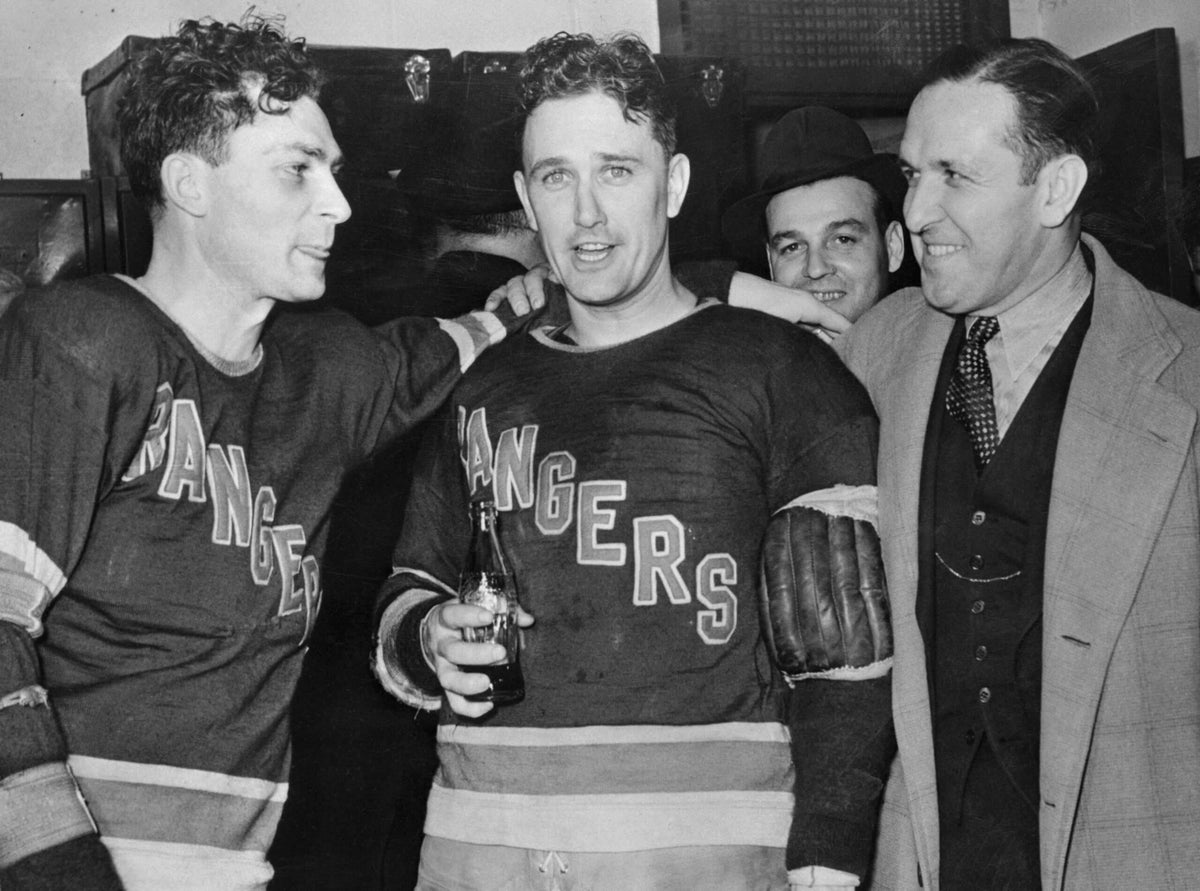
New York’s leading scorer was held without a goal in the semis, but notched a hat trick in Game 2 of the final and ended the series 2:07 into the first overtime period of Game 6. The play resulted from a collision between Toronto players Gordie Drillon and Jack Church, which cleared space for Watson to send a pass ahead to a wide-open Hextall.
Here’s how The Times described the scene: “Hextall, a dead shot from that position, fired seemingly without aiming, but the drive was true, the red light flashed, and the rival skaters immediately forgot their professional differences and pounded their erstwhile opponents on the back in the time-honored gesture of friendliness that marks the end of every hockey play-off series.”
The conquering Rangers appeared poised for sustained success, but that’s not how it turned out. They were eliminated by the Red Wings in the quarterfinals the following season and failed to capitalize on a first-place finish in 1941-42. New York finished 29-17-2 while producing the NHL leaders in points (Hextall with 56), goals (Lynn Patrick with 32) and assists (Watson with 37), but lost to the eventual champion Leafs 4-2 in the semis.
It all fell apart from there. With World War II raging, the Rangers lost key players to military service. Lester Patrick was convinced the 1942-43 season would be canceled, with Boucher recruiting players who’d yet to enlist for a Canadian Army team based in Ottawa.
Much to their surprise, the NHL did not cancel, leaving New York, as Boucher put it, “in woeful condition.” The Rangers sank to last place that season (11-31-8) and were even worse the following year (6-39-5). They wouldn’t produce a winning season again until 1955-56 and would go 54 total years between their third championship in 1940 and their fourth in 1994.