
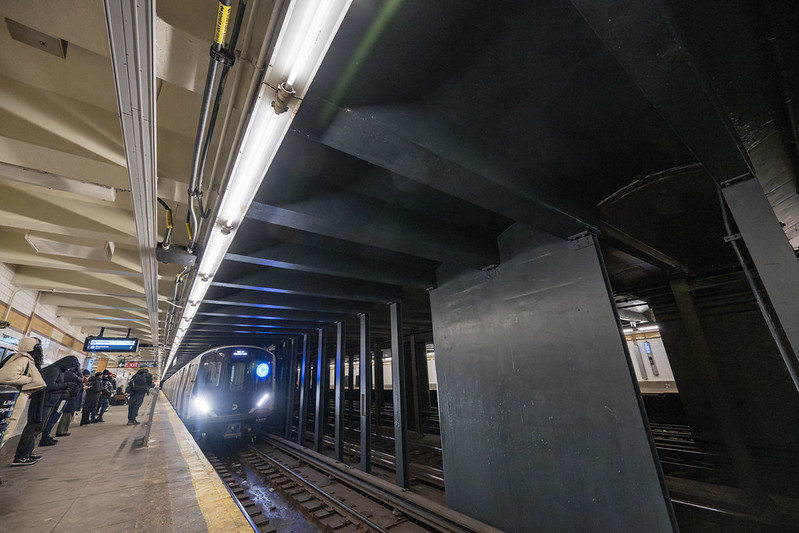
A C train pulls into a Brooklyn subway station.
Photo: MTA / Trent Reeves
The first year of congestion pricing in New York saw straphangers take more than 90 million additional subway rides than in the previous year, a new report from the Permanent Citizens Advisory Committee to the MTA (PCAC) found.
According to the rider advocacy group’s analysis, which it released on Tuesday, ridership on the city’s rails grew from 1.21 billion to 1.3 billion between 2024 and 2025. The bump marked a 7.7% rise — double the increase in ridership between 2023 and 2024.
Brian Fritsch, PCAC’s associate director, said that while there are many factors affecting changes in ridership from year to year, the introduction of congestion pricing was the most consequential.
Activated last January, congestion pricing is a state-run program that charges drivers a $9 base-toll to enter Manhattan below 60th Street — a portion of the borough referred to as the Central Business District (CBD) or Congestion Relief Zone (CRZ).
“While it’s not possible to ascribe all the ridership increases last year to the start of the program, clear trends have emerged that show the program’s influence on ridership increases, which we detail,” he said in a statement.
Frisch said the ridership bump driven by congestion pricing is evidenced by sizable increases following the COVID-19 pandemic, which mostly leveled off by 2024, leaving few other major factors to boost ridership last year. Ridership shot up by 33% between 2021 and 2022, according to PCAC, and about half that amount between 2022 and 2023, but rose just 3.7% in 2024.
Proponents of congestion pricing — including Gov. Kathy Hochul, the MTA, and transit advocates — have been singing the program’s praises over the past 14 months. They have touted data showing that, in addition to boosting transit ridership, it has reduced congestion, cut pollution, and put a dent in noise complaints within the CBD.
“We hope our report illuminates yet another aspect of the congestion pricing program that has positive implications for the MTA and New York City, and hope the agency will continue to support the ever-increasing number of frequent riders through enhanced fare incentives and programs that continue to make transit the most affordable way to get around our city and region,” Frisch said. “Above all: Congestion Pricing is working!”
The MTA did not immediately respond to the report.
Congestion pricing hasn’t slowed commuting
PCAC argues its findings rebuff congestion pricing’s critics’ central claim that the program would lead people to stop commuting into Manhattan south of 60th Street. To that point, the report shows a 7.1% rise in total rides into the CBD since congestion pricing took effect — an increase of 20 million trips.
In its analysis, PCAC also identified several notable data points on ridership growth over the past year.
The report found that weekend ridership gains outpaced those of the overall citywide average, with an increase of 9.4%, or 21.88 million riders, between 2024 and 2025.
Thirty-nine of the subway’s 472 stations saw full-year ridership grow by more than 20%. At the same time, just 38 stations experienced a decrease in ridership in 2025, 12 of which were significantly impacted by the reconstruction of the bridge that carries the A train across Jamaica Bay.
The Times Square-42nd Street station, a major hub that serves nine train lines, had the greatest overall increase in new rides between the two years, with 2.5 million new rides.
Meanwhile, the Rockaway Pkwy L train station in Canarsie, Brooklyn, saw the greatest percentage increase of 300%, or 1.7 million new riders.
However, Frisch said that the major jump was a statistical outlier because it was driven by the stop being at the end of the L line and riders who transfer from buses having to tap into the system when they previously did not.
The report also has a series of commendations, which include running more weekend subway service, keeping up with future scheduled congestion pricing toll increases, and implementing more fare discounts and transfers throughout the system.