

Dozens of home care workers settled in Wednesday for a sit-in outside City Hall, calling on Mayor Zohran Mamdani and the City Council to support legislation that would ban 24-hour shifts they say has ravaged their physical and emotional well-being.
The sit-in of indeterminate length is the latest escalation by New York’s home care workers, who for more than a decade have sought to end state rules that allow 24-hour home care workers to be paid for only 13 hours a day. The shifts are permitted as long as workers are allotted three hours for meal breaks and at least five hours of sleep without interruption.
Workers claim they routinely work up to 96 straight hours without rest — while getting paid for only a fraction of that time.
The organizers and workers — many of them elderly immigrant women from Asia and Latin America — gathered on Broadway near Murray street, braving unseasonably cold temperatures and vowing to stay until the Mayor and the Council approve a bill that would cap shifts at 12 hours a day. The shift would effectively replace 24-hour shifts with a pair of 12-hour shifts. Some worker allies, including the city’s worker protection agency, say the effort must be supported with additional state funding.
Mireya Silva said she was forced into early retirement due to the physical strain of her work. The 73-year-old said she’s had multiple surgeries to address chronic pain and injuries she’s sustained on the job, including spinal issues from standing for hours at a time and turning over patients in their beds, along with stress fractures on her hands from wrangling patients and carting their wheelchairs.
“Of course, I could have worked longer,” Silva, who retired in 2016, said in Spanish. “But the work was killing me.”
“The 24-hour shift is abuse, plain and simple,” she added.
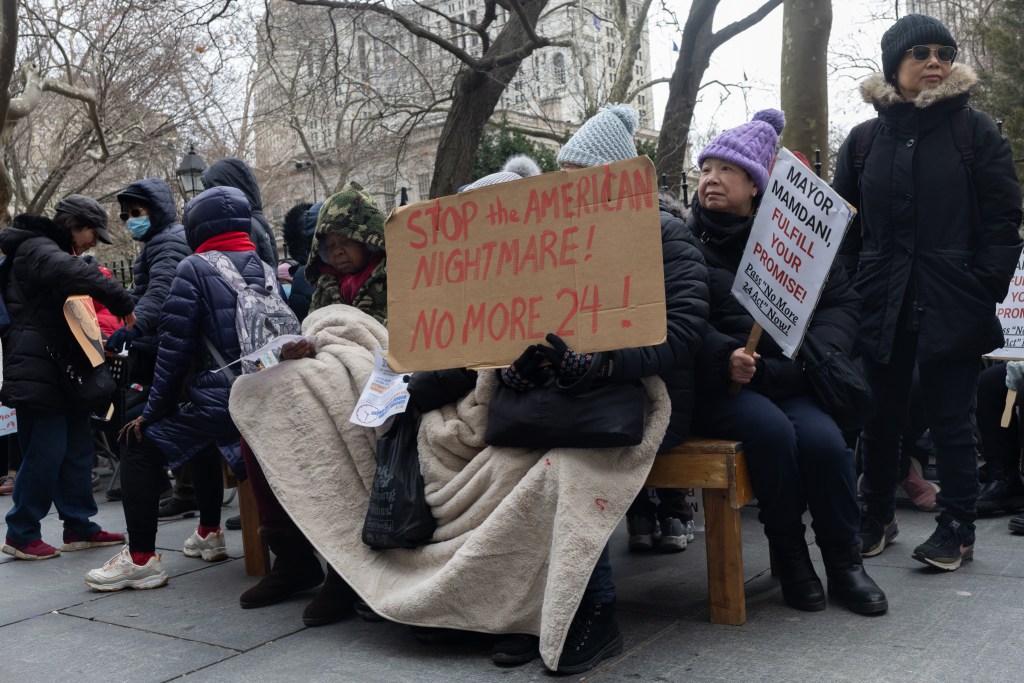 Home health aides began a sit-in outside City Hall, March 18, 2026. Credit: Ben Fractenberg/THE CITY
The pending proposal, which was re-introduced by Councilmember Christopher Marte in January, has 17 sponsors but has not yet been put to a vote by the labor committee.
Late on Wednesday, news broke that the Speaker’s office had not included the bill on the agenda for the March 26 stated meeting, when members of the Council vote on pending legislation, delaying the bill’s passage until next month at the earliest, according to a source close to the matter.
Mayoral spokesperson Dora Pekec said Mamdani is “committed to working alongside home care workers, the Council, and state government to pass stronger protections that improve working conditions for caregivers and ensure they can provide the high-quality care their patients deserve.”
“Mayor Mamdani has always stood with home care workers in the fight for dignity on the job: fair wages, reliable hours, and respect owed to those who make it possible for so many New Yorkers to live safely at home,” Pekec added.
In December 2024, as an assemblymember and Democratic mayoral hopeful, Mamdani rallied with home care workers outside of the state Labor Department’s Brooklyn headquarters, declaring, “We need to end the 24-hour work day.”
Home care programs are administered by organizations that receive state funding through Medicaid, over which the City Council has no control. State lawmakers have long opposed similar statewide proposals to split up 24-hour shifts over concerns that, without additional funding, expanded worker protections could cause nonprofit agencies to risk insolvency, cost workers their jobs and leave vulnerable patients without needed care.
At a Feb. 18 hearing, a representative from the city’s Department of Consumer and Worker Protection said the agency supported the intent of Marte’s bill, while expressing concerns that “prohibiting 24-hour shifts without additional Medicaid funding to home care providers could have unintended consequences for patients and workers.”
Replacing 24-hour shifts with two 12-hour shifts could cost an additional $645 million per year in New York City, the New York Times reported, citing an analysis by 1199SEIU, the union which represents many home care workers across the city and state.
In an interview, Marte dismissed concerns about costs as “fear-mongering,” noting that some home care agencies have already voluntarily moved away from the 24-hour shift model.
“We’re talking about a fraction of the home care industry,” Marte said, citing data from DCWP that only about 8-10% of home care workers in New York City work 24-hour shifts.
Earlier this year, a state judge sided with home care workers who were seeking to force the state Labor Department to reopen hundreds of wage-theft cases after investigators dropped them in 2023. In court papers, one worker who sued the state over her dropped wage-theft case claims she is owed as much as $171,000 in back pay.
But workers who spoke with THE CITY have said that no amount of money is enough to make up for the cascading health issues they accumulated over many years on the job.
Belkis Cid de Bruno said her body has “completely deteriorated” as a result of more than 10 years spent working the 24-hour shift, pointing to chronic pain in her knees, heart issues and insomnia. The 78-year-old called on Mamdani and other elected officials to “end the abuse, and do the right thing for home care workers.”
“When the patient sleeps, I can’t sleep, and when I want to sleep, the patient is awake,” she said in Spanish. “It’s a never-ending cycle.”
Related