
Real journalists wrote and edited this (not AI)—independent, community-driven journalism survives because you back it. Donate to sustain Prism’s mission and the humans behind it.
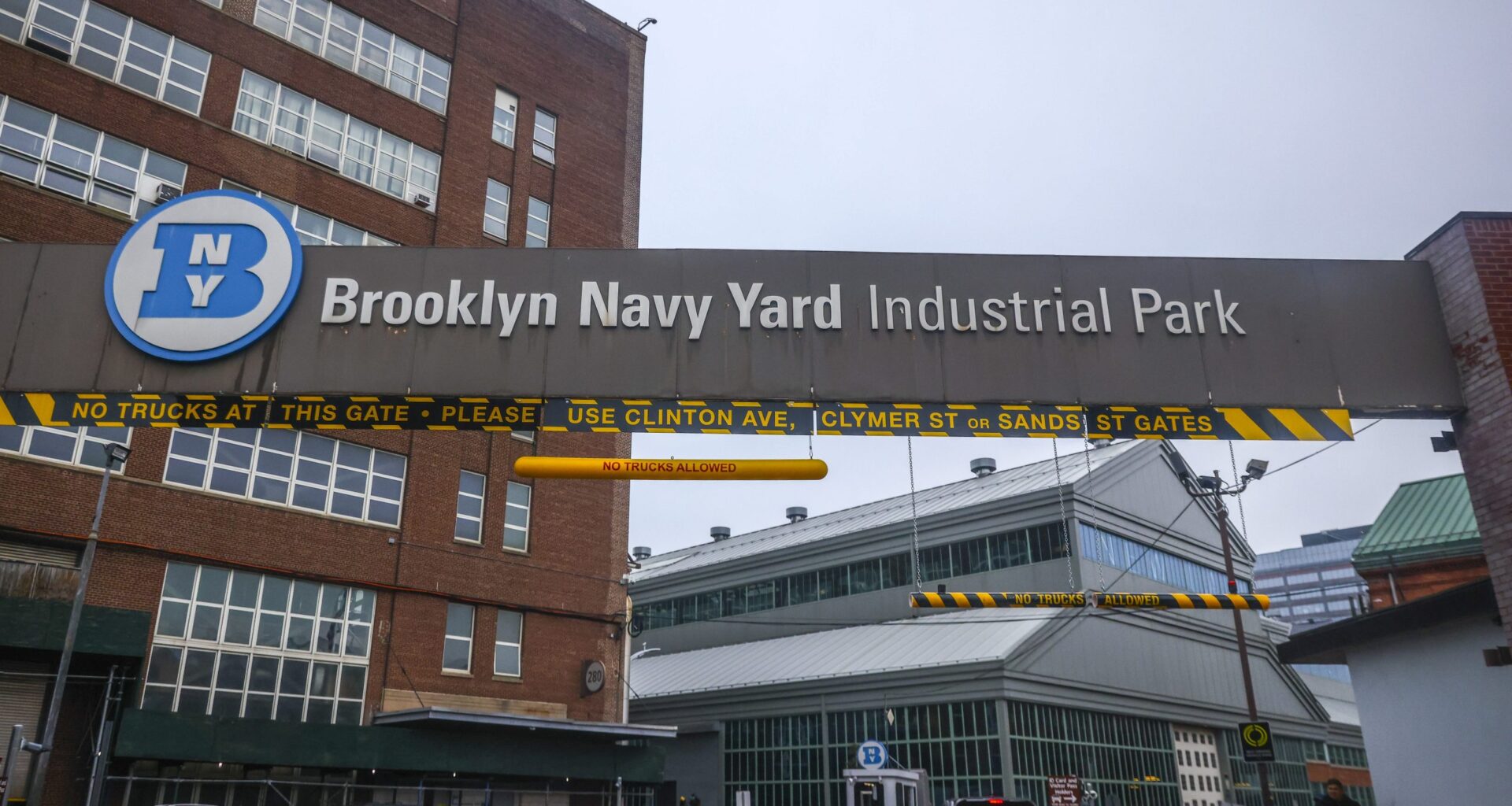
Israeli drone manufacturer Easy Aerial’s lease at the Brooklyn Navy Yard will not be renewed after more than a year of protests. Now activists are demanding that another military gear manufacturer follow it out the door.
The Brooklyn Navy Yard, a New York City-owned industrial campus, confirmed in February that it would not renew Easy Aerial’s lease after Demilitarize Brooklyn Navy Yard (DBNY), a coalition of tenants and organizers, organized weekly protests inside and outside the Navy Yard for more than a year. Amid Easy Aerial’s impending departure, organizers are now focusing their attention on the other target of their protests: tactical apparel and body armor company Crye Precision, which recently won a contract with Immigration and Customs Enforcement (ICE).
In an email response to Prism, spokesperson Claire Holmes said the Brooklyn Navy Yard Development Corporation voted in December not to renew Easy Aerial’s lease over “repeated compliance issues dating back to 2023,” including unauthorized drone flights and improper utility use. “There were no other factors in our decision,” Holmes added.
City Council Member Lincoln Restler, who represents the district, praised the move, posted on social media that Easy Aerial was set to leave the Yard
“This public asset should not be leasing space to companies producing drones that are being transformed into weapons of war,” wrote Restler, who did not respond to Prism’s request for comment.
“From the streets of Brooklyn to the border in Texas, gear made right here in Brooklyn is being used to harass, detain and endanger migrants and communities of color,” DBNY said in a statement. “Meanwhile, this same gear is shipped to the Israeli military. We are drawing a direct line from the occupation of Palestine to the violence at our own border, and it runs straight through the Brooklyn Navy Yard.”
DBNY organizers saw the nonrenewal of Easy Aerial’s lease as proof that sustained organizing can move decisions at a public campus, and they are now pushing for Crye Precision’s eviction.
“We demand a termination of all of Crye Precision’s leases and to vacate the Brooklyn Navy Yard immediately,” an organizer with DBNY, who requested anonymity due to fear of retaliation, told Prism in an email.
“Crye Precision has supplied ICE and Border Patrol with over $1,000,000 in plate carriers, helmets, and uniforms since 2014,” the DBNY organizer added. They said DBNY’s campaign focuses on specialized units, alleging that Crye supplies ICE’s Special Response Team (SRT), which they characterized as deployed for “high risk operations,” including protests and incidents in detention facilities.
Public documents confirm that Crye was contracted to provide gear for ICE, the Department of Homeland Security (DHS), and SRT. Prism was unable to independently verify the total dollar total, but confirmed several of the contracts that organizers cited.
BNYDC leadership and Crye Precision did not respond to Prism’s request for comment.
From New York to Maine
DBNY’s calls for city officials to terminate the leases of Crye Precision, housed at the Yard since 2002, drew renewed attention after Crye won a federal purchase in January to supply gear for the U.S. Customs and Border Protection (CBP) in Maine.
On Jan. 19, CBP’s Houlton Sector in northern Maine issued a sole-source purchase order to Crye Precision for cold-weather jackets and pants. The award totaled $39,681.32, and the supporting notice said that Crye could rapidly provide the gear “critically needed” for operations.
Days later, ICE carried out what officials described as an “enhanced” operation that led to hundreds of arrests in Maine over just a few days.
DHS media spokesperson Robert Kay did not respond to Prism’s request for comment.
Crye’s footprint on Brooklyn’s waterfront
The Navy Yard on Brooklyn’s waterfront is a former military shipyard now promoted as a major industrial campus with around 500 tenants.
The Yard is run by a nonprofit that operates as the landlord and developer on city-owned land. In its audited financial statements, BNYDC is described as “a component unit of The City of New York” and the Yard’s “real estate developer and property manager … on behalf of the City,” responsible for leasing, management, and development across industrial and commercial space.
BNYDC’s arrangement with the city is also unusually long term. The audit states that BNYDC operates under a city lease that, after renewals, runs until 2111. And it doesn’t just rent space; it also runs day-to-day campus operations, including upkeep of buildings, roads and utilities, sanitation, snow removal, and “street security.”
Because the Yard is city-owned, tenants are positioned to benefit from a package of incentives that can lower operating costs. The Yard advertises Qualified Opportunity Zone benefits and exemption from real estate taxes, and it promotes other programs that tenants may qualify for. City money also supports the campus itself. BNYDC’s audit shows the city fronted more than $8.3 million in 2025 for capital improvements under management.
Maisha Morales, a local community board member and resident who joined the DBNY campaign eight months after its launch, said she initially supported the Yard’s push to provide subsidized manufacturing space for small businesses, especially for minority- and women-owned companies.
“Commercial rents are astronomically high,” Morales told Prism, adding that “there is almost no manufacturing space in this city.” She said learning that companies tied to immigration enforcement and military supply chains were operating on the subsidized, city-owned space, changed how she viewed Yard’s public benefit mission.
DBNY has argued that it’s targeting the Yard because city-owned public land is being leased to harmful companies.
BNYDC does not routinely publish lease terms for individual tenants. But lease documents obtained through a public record request by Drop Site News show that Crye Precision received significant rent concessions at the Yard. According to a 2012 lease, Crye’s first year of rent was waived, saving the company at least $340,000, and the remaining rent was discounted by more than $1 million, while also offering up to $1 million in construction work directed by the tenant. A 2019 lease waived the first quarter of rent, valued at at least $159,444.
The DBNY organizer said Crye holds three leases for spaces in the Navy Yard: the longest lease term is 20 years, plus two additional leases of 10 years and five years.
DBNY also provided statements from a tenant at the Yard, a woodworker who has worked there for three years and was not named by the organizers. The tenant said that many people on campus did not initially know what the contested tenants made or who they sold to. “Many have joined or are supportive” of protests, the tenant said. The tenant said leasing can include concessions that help businesses survive buildouts in older industrial space.
“We received a number of months’ free rent to pay for the extensive remediation and buildout to our space, which was in poor condition,” the tenant said.
They said it would take “continued pressure” to remove a tenant like Crye from the Navy Yard.
Morales said she raised the issue to her community board and later attended meetings with Navy Yard leadership as a Brooklyn resident. She said after she attended the meeting, she left feeling the board was looking for the easiest legal path out. “They kind of mentioned and alluded to … ‘We can’t break the lease,’” she said. In her view, Easy Aerial was simpler to remove than Crye Precision.
“Easy Aerial’s lease was up to renewal … whereas with Crye precision’s position, I don’t think that is the case, which is why we need to continue to do the work,” Morales said.
She also claimed that the Yard leadership agreed to meet with a small group of residents.
“The meeting was done outside in the Yard with security surrounding us,” she said.
Morales also said she raised the campaign directly with Zohran Mamdani when he was a mayoral candidate. “I gave him the rundown: ‘You should meet with the campaign, so you can be better informed, so that if and when you become mayor, you know what you have to do from day one,’” Morales said, adding that Mamdani made a commitment, but there were no followups.
The mayor’s office did not respond to Prism’s request for comment.
For Crye Precision, Morales wants City Hall and the mayor’s office to step in.
“They need to look at their bylaws. They need to look at their mission statement,” Morales said. And if the companies don’t align, she argued, “that is a way to terminate their lease. …Where there is a will, there is a way.”
Morales also criticized the recent approval of another tenant at the Yard, Radical AI, which is a material science company. Gov. Kathy Hochul announced on Jan. 27 that the company would build an AI robotics-driven facility at the Brooklyn Navy Yard.
Crye’s ties to DHS and Israel
Crye Precision built its reputation designing the “MultiCam” camouflage now widely used by U.S. and allied militaries. A company profile from the Cooper Union describes Crye’s rise through its camouflage innovations, including the development of MultiCam, and states that the company moved operations to the Navy Yard in 2002 before planning in 2014 to consolidate its headquarters into a single 85,000‑square‑foot space in the renovated Yard.
The company employs over 250 people at Yard headquarters. It also has an office in New Jersey, according to federal spending records.
Federal procurement records show Crye products appearing in purchases connected to DHS components, including immigration enforcement. A 2019 notice explicitly referenced Homeland Security Investigations’ SRT and a planned purchase of Crye tactical jackets.
DBNY organizers also argue that Crye’s supply chains extend overseas. Crye’s ties to Israel are mostly through MultiCam. The MultiCam website lists Agilite, an Israeli tactical gear company, among brands licensed to sell products made with “genuine MultiCam printed materials.” Agilite’s website states that some of its camouflage gear is used by Israeli forces.
In 2024, Drop Site reported that Crye-made gear supplied to Agilite was being used by the Israeli military in Gaza.
Crye disputed that this amounts to supplying to the Israeli military. In a statement to Hyperallergic last year, a company spokesperson said Crye has “no contracts with the IDF or any Israeli manufacturers.”
Crye’s filings show 238 U.S. government contracts since 2008, including with Defense and Homeland Security agencies.
A September solicitation from DHS also requested 200 Crye AVS and JPC plate carriers coded as personal armor for Border Patrol’s SRT, and DBNY highlighted additional plate carrier orders routed through distributors such as Goldbelt Security.
The sanctuary city
DBNY’s campaign comes as immigration enforcement has accelerated statewide. In New York, according to the Deportation Data Project, ICE made thousands of arrests statewide in 2025, with a large share of arrests involving people without criminal convictions and heavy enforcement concentrated around the New York City area.
City officials say they have tightened limits on when city agencies and city property can be used for immigration enforcement, including a Feb. 6 executive order from Mamdani aimed at reinforcing sanctuary protections.
The fight over Crye’s presence also exposes a longer history of oversight questions at the Yard. A 2006 audit by the New York City Comptroller found serious weaknesses in BNYDC’s leasing records and internal controls, including missing or expired leases in a sample reviewed and a lack of written leasing policies. The city comptroller’s office did not respond to Prism’s requests for comment.
BNYDC’s current real estate policy, according to the oversight memo, evaluates new tenants based on job creation, financial viability, and fit with the Yard’s industrial mission, as well as Minority and Women-owned Business Enterprise participation—not on who a tenant sells to or how its products are used.
Morales said the city needs to pause and thoroughly research who it’s bringing into the Yard to see if it aligns with the mission statement.
“And if it does not, they need to put a stop to it,” Morales said.
Editorial Team:
Sahar Fatima, Lead Editor
Lara Witt, Top Editor
Rashmee Kumar, Copy Editor
Related