
Sign up for Chalkbeat New York’s free daily newsletter to get essential news about NYC’s public schools delivered to your inbox.
In recent years, New York City’s public school system has made improving elementary school literacy rates the top priority.
That focus, experts have warned, doesn’t address an equally pressing challenge: Many middle and high school students are far below grade level, and their schools are not always equipped to help them catch up.
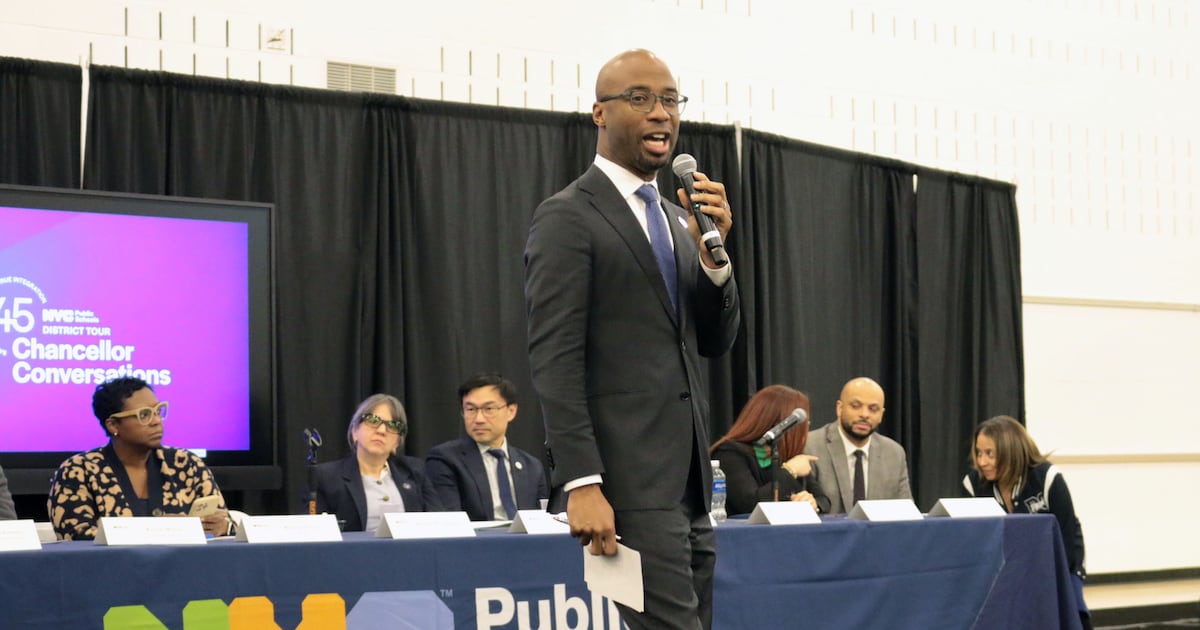
Now, Chancellor Kamar Samuels is vowing to shift the Education Department’s agenda. Addressing that gap will be the “next stage” of NYC Reads, the city’s plan to improve reading instruction, Samuels said at a recent literacy conference convened by Columbia University’s Center for Public Research and Leadership.
Middle and high school teachers “love books, they are wonderful at comparing themes, they’re wonderful at getting most of our kids … excited about reading,” Samuels said. “But what they’re not necessarily good at is teaching our kids to read.”
He added: “We have to ensure that when our kids are off track at sixth grade, that there are research-based interventions that can help to get them on track.”
Mayor Zohran Mamdani and Samuels have vowed to continue the previous administration’s focus on literacy, including a requirement that elementary schools remove discredited curriculums from their classrooms and adopt city-approved programs. Samuels has indicated that one of his top priorities will be getting older students who did not receive adequate reading instruction back on track.
The stakes of that effort are high. More than 40% of New York City middle school students were not considered proficient readers on last year’s state tests, and just under half of high school freshmen arrived on campus reading below grade level.
Officials have previously acknowledged the city’s approach to catching up students has been scattershot. For the first time this school year, all campuses — including middle and high schools — are required to use city-approved intervention programs for struggling readers. Officials are also requiring all middle schools transition to city-approved reading and math curriculums by fall 2027. Both of those efforts launched under Mayor Eric Adams.
Literacy experts welcomed Samuels’ focus on older students.
“I appreciate his acknowledgement that middle and high school students and teachers haven’t been a priority in this conversation around the shift to evidence-based instruction,” said Katie Pace Miles, a Brooklyn College professor and literacy expert.
The city should roll out training for middle and high school teachers on the latest evidence about how students learn to read, she said, and consider intensive tutoring programs for students who are behind.
The Education Department plans to share more detailed plans in the coming months, said agency spokesperson Onika Richards. She emphasized that schools are focused on using assessment data to identify students who need more help and ensuring dedicated time in the school day to provide extra help. (Officials did not say whether high schools will be required to use city-approved reading curriculums, as middle and elementary schools have.)
We’re on a need-to-know basis.
Every weekday morning, Chalkbeat New York is bringing thousands of subscribers the news on public schools and education policy that they need to start their day. Sign up for our free newsletter to join them.
When it comes to supporting older students, making the interventions schools deploy more coherent would be a welcome change, some observers said. Teachers have sometimes relied on elementary school reading materials for those who are behind, which can be embarrassing for middle or high school students, said Evan Stone, the CEO of Educators for Excellence, a teacher advocacy group.
A challenge will be finding time during the school day to offer interventions without pulling students out of their regular English language arts classes.
“You don’t want them to miss the ELA block to get their support because then they never catch up,” Stone said. The materials teachers use for students who are behind should be aligned with their school’s regular reading curriculum, he added.
Stephanie Vazquez, a literacy coach at M.S. 101 in the Bronx, said teacher training will be a crucial element of any effort to improve reading outcomes. Her students arrive with a wide range of reading abilities; some are capable of high school level work while others are far behind.
“As a teacher, you’re trying to figure out, ‘How do I help my student gain access and fully comprehend this text without completely modifying the text?’” Vazquez said, noting the city could create more opportunities for teachers from different schools to share best practices.
Vazquez said teachers in upper grades could also use more exposure to a longstanding body of research on how children learn to read, known as the science of reading.
“Oftentimes, when you’re a teacher in middle and high school, your certification program may not have taught you about the science of reading,” she said. “We don’t always feel well-equipped because we don’t walk in with that foundation.”
Alex Zimmerman is a reporter for Chalkbeat New York, covering NYC public schools. Contact Alex at azimmerman@chalkbeat.org.