
They’re off the charts!
Charter schools make up more than half of the top 100 performing public schools in New York City based on results of state math and English exams, a new analysis found.
Their domination on the top schools lists, compiled by the Washington Free Beacon, was noteworthy given that the 285 charter schools in the Big Apple make up just 15% of the nearly 1,900 publicly-funded schools under the city Department of Education.
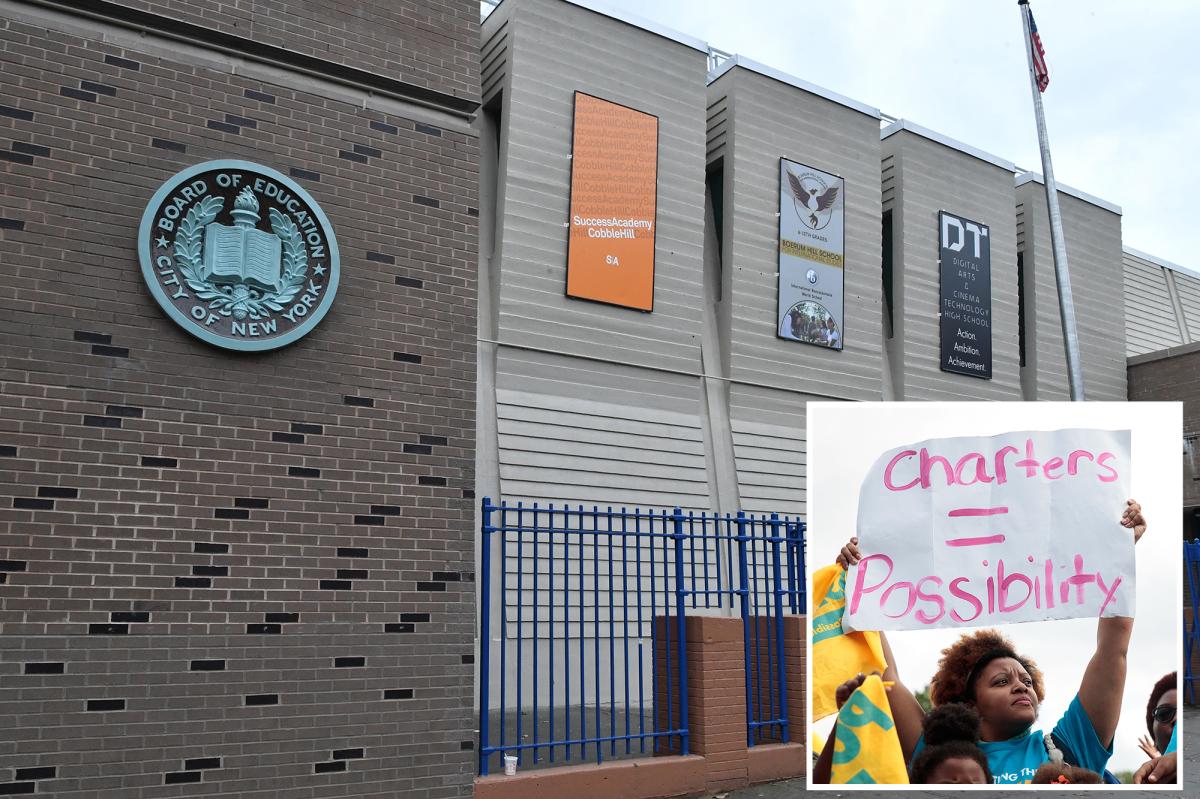
A new analysis finds that more than half of the top 100 performing public schools in New York City based on the results of the state’s grade 3-to-8 math and English exams are charter schools. Paul Martinka
Supporters seized on the fresh evidence of success, arguing it should persuade the state Legislature to lift the cap and allow more of the popular alternative schools to open in the five boroughs.
“These results prove what we have always known: all children are capable of excellence when given access to a high-quality education,” said Success Academy founder and CEO Eva Moskowitz.
“It is time to stop making excuses for the status quo and start expanding the school models that are actually delivering for our kids.”
According to the Free Beacon’s analysis of the 2025 results of the state’s grade 3-to-8 exams, charters comprised 59 of the 100 top math schools and 53 of the 100 top English Language Arts schools in New York City.
The 150,500 students enrolled in charters represent about 15% of the city’s approximately 1 million public school students.
Many of these charter schools educate economically disadvantaged students in mostly lower-income, minority neighborhoods, including the south Bronx.
Success Academy-run charter schools accounted for nine of the top 12 schools where 100% of the students scored proficient on the math exam and for six of the top 12 schools with student pass rates between 99% and 100% on the English test.
Charter schools represent only 15% of the entire school system across the Big Apple. Getty Images
Overall, about 69% of charter school students scored proficient on the state’s math exams, compared with 57% of traditional district public school students run by the city Department of Education.
Similarly, 67% of charter school students scored proficient on the English Language Arts exam compared with 56% of students in traditional public schools.
Black and Hispanic students in charter schools have pass rates on the state tests that are more than 20 percentage points higher than counterparts in traditional public schools.
“There is a reason almost one out of every three Black public-school students and one out of every four kids in the Bronx attend a charter school — even with an artificial cap in place that locks kids out,” said James Merriman, CEO of the New York Charter School Center.
“This is a true New York City success story that we should all be celebrating.”
The Free Bacon reports that charter schools had 59 of the 100 top math schools and 53 of the 100 top English Language Arts schools in New York City for the grades 3-8 state exams. Paul Martinka for New York Post
Despite the stellar results, the state imposes a limit on how many charter schools are allowed in the city — a cap that has been reached.
“The state should lift the cap on charter schools. The cap is an artificial restraint on providing options to parents,” said Joseph Belluck, chairman of the SUNY Charter Schools Committee that reviews and approves charter school applications.
“Many charter schools are doing excellent work and providing transformative education to kids. There’s a disconnect between state legislators and their constituents on this issue,” added Belluck.
Mayor Zohran Mamdani, a former state assemblyman, opposes charter school expansion. His office had no immediate comment on the findings.
His fellow critics, including the teachers’ union, argue that charter schools divert resources from traditional public schools and don’t serve as many students in need.
The majority of the charter schools representing the advanced schools are geographically located in mostly lower-income, minority neighborhoods. Paul Martinka for New York Post
“Too many charters push out the most vulnerable students. Before anyone talks about further expansion, charters need to accept and serve all children- something they have consistently refused to do,” said United Federation of Teachers spokesperson Alison Gendar.
But the Charter School Center has long disputed the union’s contention, with its own data showing that 83% of charter students are considered economically disadvantaged, 19% receive special education services and 11% live in temporary housing or shelter.
Charter schools are publicly-funded but privately managed and typically have a longer school day and year than traditional public schools. Most of the educators who work in charters are not represented by a union, while traditional public schools are unionized.
State Republican Party chairman Ed Cox said the results speak for themselves, and slammed Mamdani and Gov. Kathy Hochul for resisting charters “at the behest of the teachers union.”
“Once again, the facts are in, and they completely shatter the left’s narrative,” said Cox, who helped launch the SUNY Charter School Institute in 1999.
Former Gov. George Pataki approved the law in 1998 allowing charter schools to open in New York.
“Charters are proving every day that zip code does not have to determine destiny. They are closing achievement gaps, raising standards and giving parents real choices,” Cox said.
State Sen. John Liu (D-Queens), who oversees the committee on New York City schools and opposes charter school expansion, had no immediate comment.