
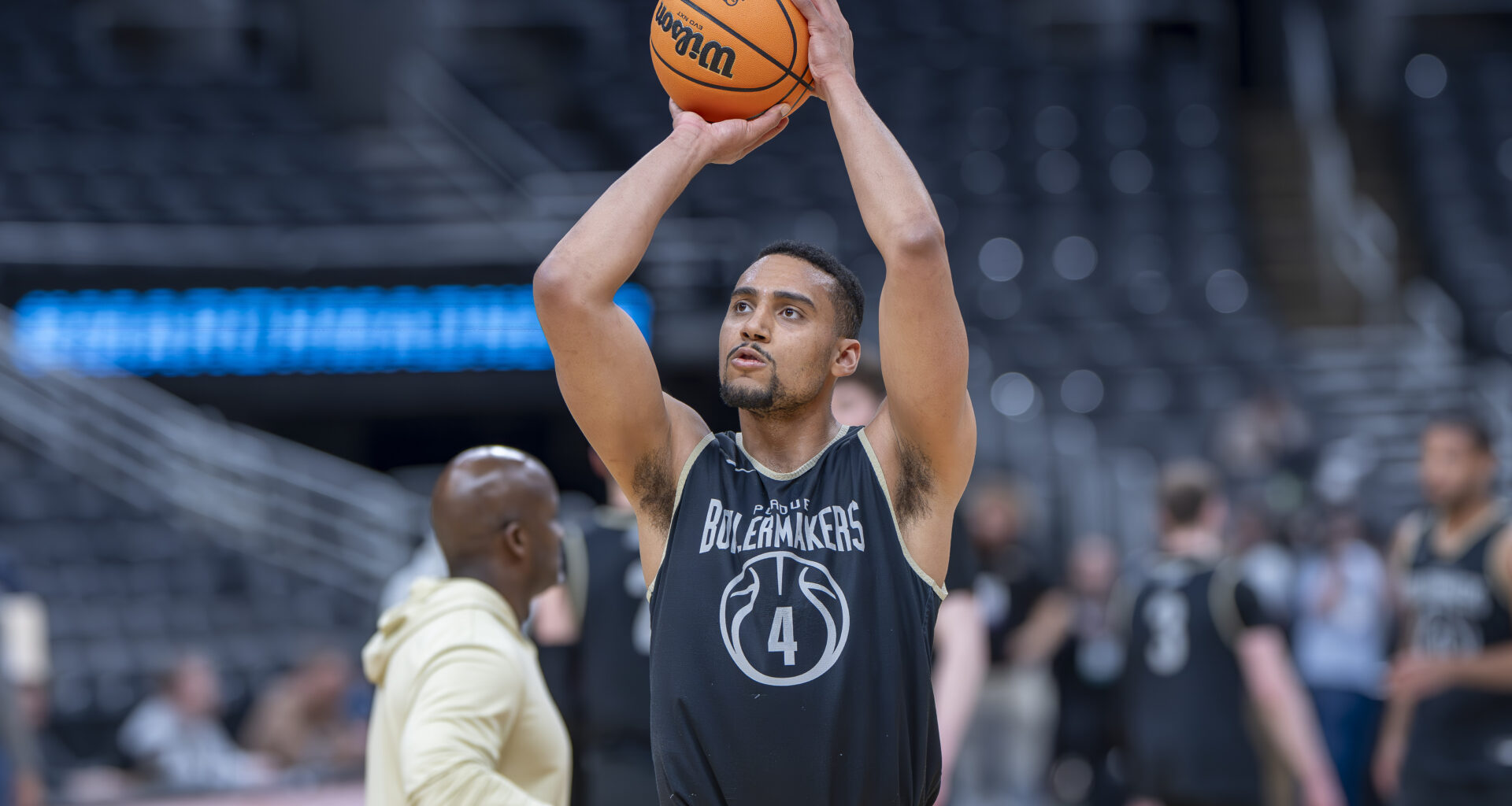
ST. LOUIS — It’s a given at this point that Braden Smith will claim the NCAA’s all-time career assists record, needing just two more.
But as Purdue prepares to meet Queens University Friday at the Midwest Regional, it was worth pondering how the record might fall.
It would be fitting if it was Fletcher Loyer, who’s started every game of his Purdue career alongside Smith. It’s not exaggeration to suggest that a backcourt starting together every game over a four-year career may never happen again in college basketball, at least not at a high level.
“It’d be pretty cool to be the guy to do it, just for a bit,” Loyer said of his classmate’s inevitable making of history. “But after that, it’ll just be behind us.”
Trey Kaufman-Renn would be the odds-on favorite to be the record-breaker. He’s finished off more of Smith’s assists than anyone and is clicking with his point guard better than ever this season.
In Purdue’s four wins at the Big Ten Tournament, Kaufman averaged 15.3 points, up two from his season total, and shot 69 percent, accounting for a slew of Smith’s 46 assists at the United Center, the push that cinched the record.
In Chicago, Smith’s and Kaufman’s connection in pick-and-roll was sharp as ever, toward the end of a season in which it came and went as Kaufman-Renn played a different position and opponents switched more, especially without a center involved.
Offense has never been Purdue’s problem this season, but in Chicago, it peaked, with Smith and Kaufman-Renn’s long-time connection looming especially large.
If there were odds on who gets the record-breaker, the smart money would be on Kaufman-Renn.
“I might finish the play, but he creates it,” Kaufman-Renn said. “Over our careers, we’ve done a great job complementing each other.
As for that assist, the record will have been the product of winning. Those four games in Chicago made this a formality.
“I’d love for him to get it early so it’s off his mind and he can just play freely,” assistant coach P.J. Thompson said. “No matter how mature you are, something like that is going to be on your mind — and it should be.”
PlayerAssists FinishedPointsTrey Kaufman-Renn224469Fletcher Loyer205554Zach Edey156322CJ Cox59155Mason Gillis56160Lance Jones55149Oscar Cluff51103
BACK TO 3
After wearing one of the three “blood” jerseys Purdue travels with for the majority of the Michigan game in Chicago after tearing his No. 3 jersey in frustration, Smith says he’ll be back in his normal number for the Queens game. No more 41, even though “41” was making shots.
PURDUE’S TURNAROUND
When Purdue struggled this season in ways that belied its ability and experience, no one seemed able — or willing — to articulate why. Now that the the Boilermakers seem to have actualized into their Preseason No. 1 billing, there again seems to be no explaining the sudden turn.
“We played a little better,” Loyer said. “We know we have the talent in the room and the staff behind us to back us up. Just going out doing our job and executing.”
“For us, how we played last week is something because we didn’t finish the season strong,” Coach Matt Painter said. “Offensively we have put up really good numbers this year. We have been very efficient on the offensive end. We’ve got a great assist-to-turnover ratio, a lot of different weapons. We didn’t put ourselves even in a position to win the Big Ten during the year. From a defensive standpoint we had to be better.
“With that being said, the talent in our league was probably the best it has been in a long, long time. We have really good teams in our league. It was good for our guys to build some confidence by being able to knock off some of those teams in the Big Ten Tournament.”
It was defense, though.
Attention to detail defensively. We still made mistakes, but we were more locked in and gave more resistance. We just played better defense.
“We struggled defensively at times during the season, and in conference play, teams are too good to be one-sided. When we’re better defensively, we’re naturally better offensively,” Thompson said. “That stretch in Chicago was also our best four-game stretch offensively in terms of efficiency.
“It’s not a coincidence. When we defend, we’re not forced to execute in the half court every possession. We can do that at a high level, but doing it constantly makes things tougher for any offense.”
Purdue’s energy and effort defensively in Chicago was different.
Paul Lusk, Purdue’s defensive coordinator, said the coaching staff “turned up the heat some” as it had done before, but credited players for the response.
“It’s our guys,” Lusk said. “The message hasn’t changed. I’ve said it before; we’re not going to be the best defensive team in the country, but we have to be the best version of Purdue we can be. That starts with effort and taking pride on that end. I think it came down to experienced players deciding what we were doing wasn’t acceptable. Our concentration was better, our effort was better — it was really about pride, both individually and collectively.”