
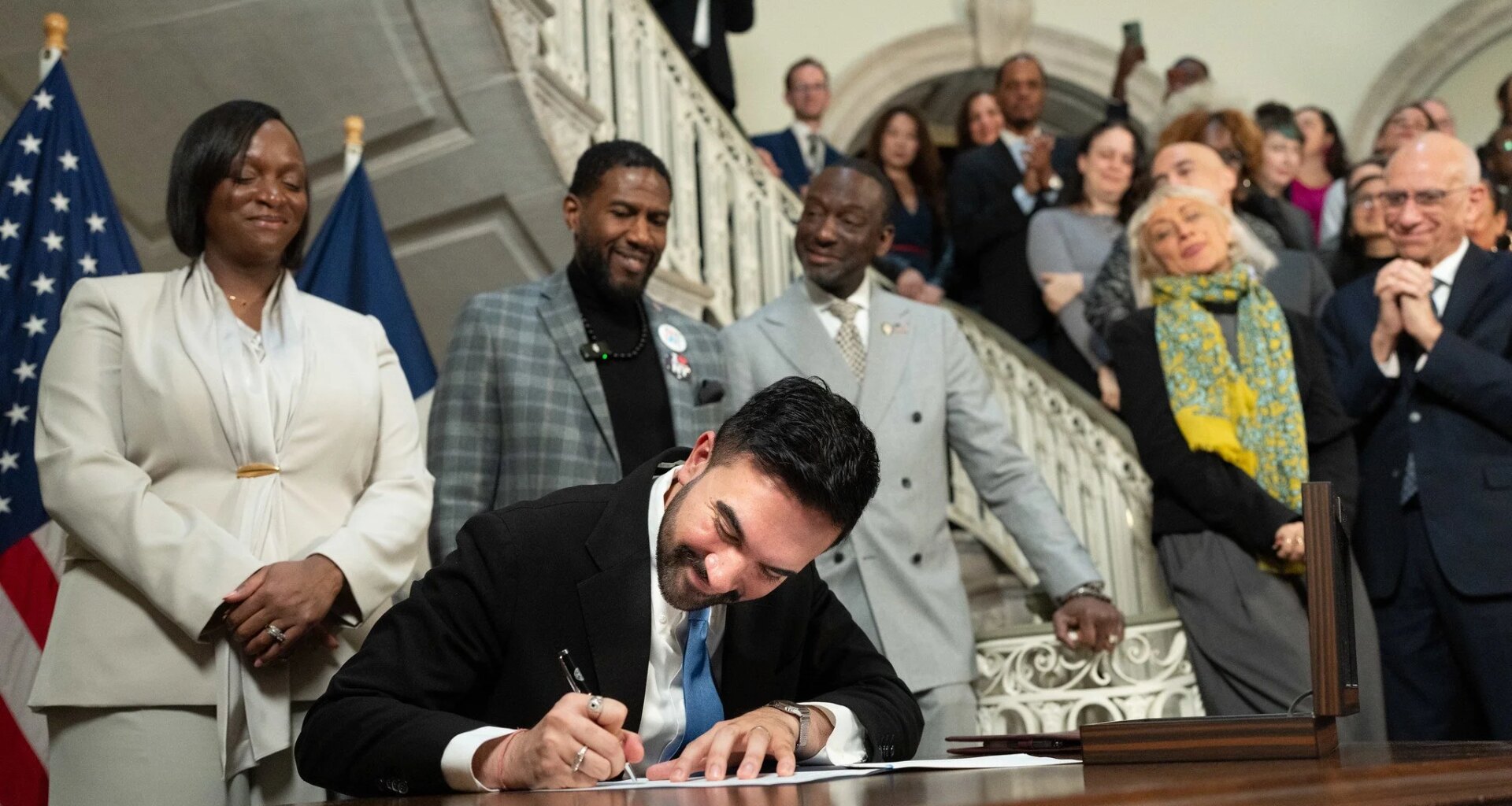
“At the core of both the campaign commitment and today’s announcement is a north star on delivering safety to each and every New Yorker, and on, finally, treating the mental health crisis with the seriousness and the specialization that it deserves,” Mamdani said.
Mamdani added that the new office would help bolster some of the city’s existing programs, like B-HEARD, which the mayor said had “long been kneecapped,” “underfunded,” and “under-supported.”
The office will be run by Francois, who previously served as executive director of the Mayor’s Action Plan for Neighborhood Safety within the Office of Criminal Justice under former Mayor Bill de Blasio.
“We will invest in the resources to ensure well-coordinated responses rooted in dignity and care, centered in community and informed by the experiences of those closest to the solutions,” Francois said on Thursday.
The office will be split into three divisions; the Division of Neighborhood Safety, which will focus on violence prevention and victim support; the Division of Community Mental Health, which will focus on crisis response; and the Division of Strategic Initiatives, which Mamdani described as a “place for innovation, where we pilot new public health-based approaches to violence prevention.”
Mamdani’s pitch to change the way the city addresses public safety and responds to mental health crises is not a new idea, but one that came to the forefront of his progressive campaign for mayor last year.
Public Advocate Jumaane Williams, who has pushed for community safety and policing reforms dating back to his time representing Brooklyn in the City Council, applauded Mamdani’s announcement as a key first step, but acknowledged that the bigger steps are the ones to come.
“There are a lot of questions to be answered, but you can’t do a thing unless you start,” he said. “It is really important that we begin so that we can get to a place where all of those questions will be answered.”
“We cannot overhaul public safety overnight, because we didn’t get here overnight, and to try to do that would threaten both success and safety,” he added. “Nor can we continue to do what has already been done and failed by our communities for decades.”
Mamdani’s announcement and executive order came before a raucous crowd of advocates and supporters, who also celebrated the plan.
“Today’s announcement is a vital step towards making New York City safer by investing in caring, empirically driven solutions that support strong neighborhoods rather than the failed practice of relying on police to respond to every societal ill,” said Queens Councilmember Tiffany Cabán. “Our communities have long known the true sources of safety — addressing poverty, mental health, substance use, and getting to the root causes of conflict and violence before they escalate.”
Organizations like the Legal Aid Society and the New York City Civil Liberties Union said they are eager to work with the new office.
In a statement, NYCLU Executive Director Donna Lieberman cited Chakraborty and Win Rozario, who, unlike Chakraborty, was fatally shot by police during a mental health crisis, as prime reasons for why a change in the city’s response to mental illness is necessary.
“We have seen the dangers of police responses to mental health crises too many times, most recently in the cases of Win Rozario and Jabez Chakraborty,” she said. “The success of any new approach will require being clear-eyed about the failures of existing responses, as well as deep engagement with communities and experts to develop its replacement.”
But not all were behind the new plan, including the former leader of the City Council’s Republican party.
“This is really not the right time for the administration to be creating a new office, and especially not one with a budget of over a quarter billion dollars, regardless of whether it is ‘new money’ or money being diverted from elsewhere” said Queens Republican Councilmember Joann Ariola. “Not just that, but the mayor is looking to take an end around to get this passed without having to go through the Council by making this an office instead of a department, and that does not sit well with me at all.”